Our website uses cookies to understand content and feature usage to drive site improvements over time. To learn more, review our Terms of Use and Privacy Policy.
The Green Revolution increased food production by spreading new seeds, fertilizers, pesticides, irrigation systems, and machinery worldwide.
Population growth and limited farmland drove fears of famine, prompting scientists and farmers to intensify agricultural production.
Synthetic nitrogen fertilizer and the Haber-Bosch process became central technologies supporting industrial agriculture and global food supplies.
The Green Revolution harmed ecosystems, reduced biodiversity, and increased dependence of poor farmers on richer countries and corporations.
Recent sustainable farming efforts use organic methods, local food movements, and crop science to address environmental challenges.
The Green Revolution helped feed a fast growing world with new seeds, synthetic fertilizer, pesticides, irrigation, and machines. It raised crop yields and eased fears of famine as population grew from 1.6 billion in 1900 to nearly 2.5 billion by 1950. But these gains came with real costs. Runoff, greenhouse gases, dams, and low crop variety harmed ecosystems. Poor farmers also became more dependent on rich countries and corporations. New organic methods, local food movements, and crop science aim to build more sustainable food systems.
The Green Revolution’s new agricultural technology transfers aimed to reduce world hunger, but also politicized food and aid in ways that were sometimes controversial.
Think about the following questions as you watch the video
Why did the US State Department official William Gaud coin the term “Green Revolution” in 1968, and what was he contrasting it to?
Eman M. Elshaikh refers to a common saying in the US State Department in the Cold War: “Where hunger goes, communism follows.” What does this mean, and how did this concern help launch the Green Revolution
How did the Green Revolution differ in different regions in its adaptation and its results?
What were some of the methods and results of the Green Revolution?
What are some of the critiques of the Green Revolution?
: (music playing)
: The need to eat is shared across humanity.
: But the resources needed to produce food
: are not always shared so evenly.
: It may seem simple, innocent, and universal,
: but food has a very interesting political history.
: So how can food be political?
: In the post–World War II period,
: as birth rates started to skyrocket
: in many parts of the world,
: countries struggled with how to feed
: their exploding populations.
: Starting in the 1940s--
: and partly funded by the Rockefeller Foundation--
: scientists tried a new way to produce more food.
: In Mexico, they used specially engineered seeds
: to maximize the yield of corn plants.
: These seeds responded well
: to artificial fertilizers and pesticides.
: With the help of irrigation,
: farmers were able to produce much more food than ever before.
: These techniques were later put to use on a massive scale.
: In the 1960s and '70s,
: this experiment was extended to Asia,
: with new wheat and rice varieties.
: The result was what is known as the Green Revolution.
: Now, a revolution definitely sounds political,
: but it's not political in the way you may be thinking.
: In fact, the guy who coined the term,
: a U.S. Department of State official,
: made a point to distinguish it from other revolutions.
: In a 1968 speech, he said,
: "These and other developments in the field of agriculture
: "contain the makings of a new revolution.
: "It is not a violent Red Revolution
: "like that of the Soviets,
: "nor is it a White Revolution like that of the Shah of Iran.
: I call it the Green Revolution."
: So, as he said,
: the Green Revolution was not a military coup or an uprising,
: or even a set of reforms.
: It was a transfer of technologies
: that resulted in increased crop yields,
: and it revolutionized the production, distribution,
: kinds, and availability of food
: all over the world.
: In fact, the foods we eat today
: are directly the result of Green Revolution technologies.
: What are other impacts,
: and what was the reasoning behind it?
: The Green Revolution had numerous impacts,
: which we'll look at in a bit.
: But first, where did it come from?
: Was it political?
: It sure was.
: And as we saw, the Green Revolution
: was part of a U.S. State Department program,
: and it was funded in part
: by the Rockefeller and Ford foundations.
: In fact, some historians argue that the Green Revolution
: was engineered as a way to fight communism during the Cold War.
: And you might be wondering:
: what does food have to do with communism?
: Well, apparently, a common saying
: among U.S. government officials at the time
: was, "Where hunger goes, communism follows."
: And at a time when the American public
: was against U.S. aggression in Vietnam,
: the Green Revolution was imagined
: as a peaceful, scientific solution
: to red revolutions abroad.
: If people weren't hungry, they reasoned,
: they wouldn't find communism appealing.
: So even though it was a development and aid program,
: it was also deeply political, as all such programs are.
: So how did it happen?
: It started with this new technology
: moving across networks of scientists and farmers.
: But it's important to see
: that such transfers are not always organic movements.
: In other words, it often takes political work
: to make them happen.
: You could say political work is the "fertilizer."
: In this case, scientists and farmers from countries
: like Mexico, India, the Philippines, and Indonesia
: were trained to use these methods
: and sold the equipment needed
: to implement these new techniques.
: But they then adapted them to their own local circumstances.
: And even though the technologies
: were first developed in the United States,
: how they worked was very local.
: It took a great deal of local infrastructure,
: like dams and other irrigation techniques,
: to generate the massive amount of water needed
: to supersize the amount of food being grown.
: Scientists and farmers had to experiment
: with their local soil conditions, climates,
: and food needs to get it to work.
: And it worked in some places more than others.
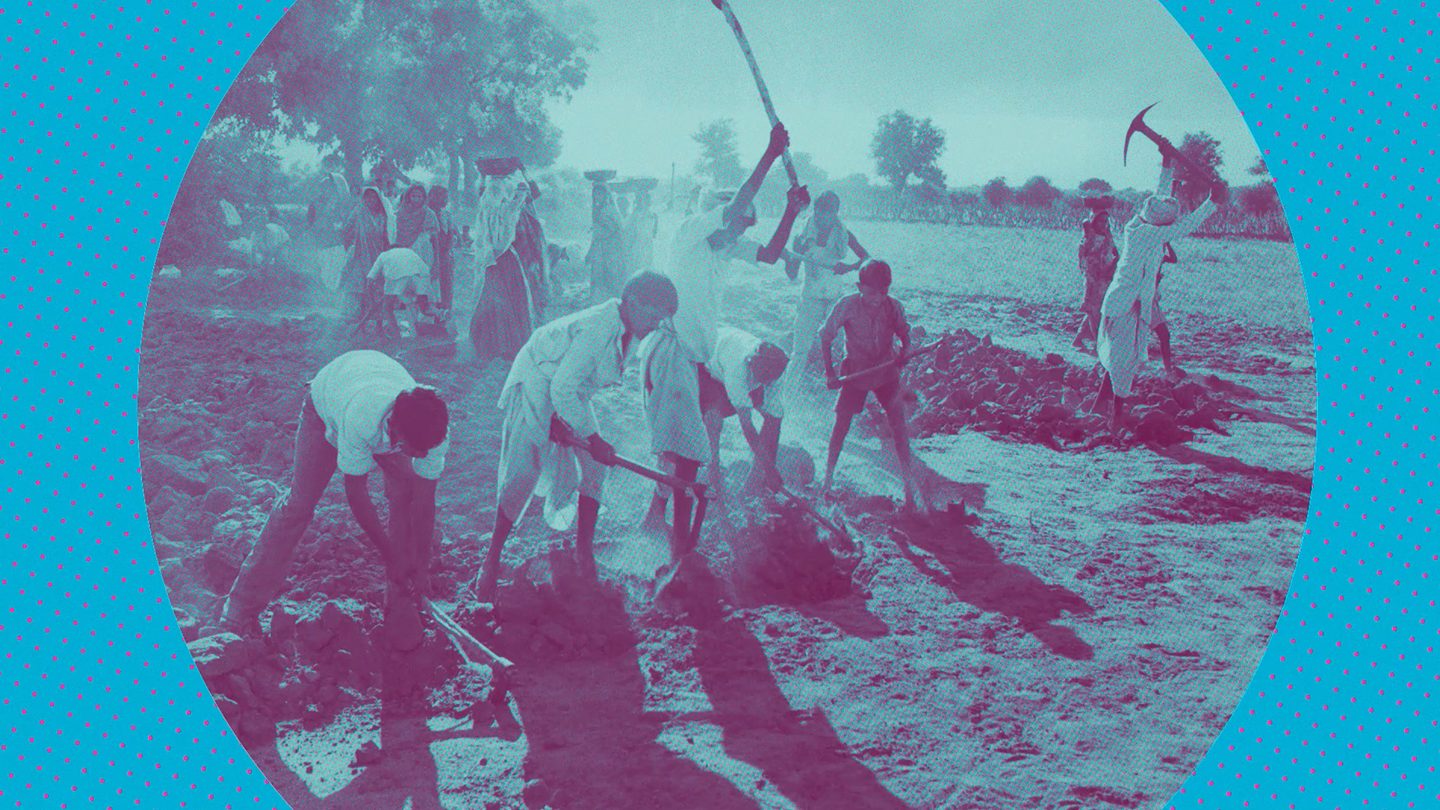
: India was one place
: where the Green Revolution really took off.
: In the 1960s, better living conditions and high birth rates
: helped the Indian population grow rapidly.
: Indian scientists adapted new varieties of rice and wheat
: to help feed this population.
: When grown with fertilizers and plenty of water,
: they grew many more grains per plant.
: The result?
: India is now one of the world's biggest producers of rice.
: But at the same time, far fewer Indians now work in agriculture,
: and the population is quickly catching up
: to the supply of rice.
: And while we're focusing
: on an anti-communist Green Revolution
: for the most part,
: it's also important to note
: that China had its own successful Green Revolution,
: but with a communist character.
: In the 1970s, under the leadership of Mao Zedong,
: the Chinese used similar technologies
: to increase farming output on communes.
: But labor was organized very differently.
: The government decided how and when people would work,
: and organized multiple households
: into teams of farmers.
: Military brigades enforced this organization.
: So the Green Revolution
: certainly had a local character in each location.
: But we really can't overstate
: the broader effects of these green revolutions.
: In Asia, between 1960 and 1990,
: rice production more than doubled
: and wheat production more than quadrupled.
: On a global scale,
: the Green Revolution dramatically changed
: the way food was produced, consumed, and distributed.
: Countries that had once been importers became exporters.
: Large industrial farms replaced small organic farms.
: And the owners of big farms
: could afford new equipment and costly seeds.
: Seeds usually needed to be purchased every season,
: because these specially engineered seeds
: had unpredictable results in the second generation.
: But regardless of these results,
: farmers often had legal agreements
: to rebuy seeds every season
: from the corporations that engineer them,
: as the seeds were considered their intellectual property.
: And there were other important global effects.
: For one, people started
: to think about hunger and poverty differently.
: Instead of seeing them as unavoidable realities,
: people started to think of them as solvable problems,
: and they enlisted scientific tools,
: believing that science could provide the ultimate solutions.
: And if the goal was to feed more people,
: science worked.
: Millions if not billions of people avoided starvation.
: And populations soared as a result.
: But did it actually make things better?
: This is a very big debate.
: There are many criticisms of the Green Revolution,
: but we're going to cover just a few.
: One big criticism is that it is simply not sustainable.
: Though it fed millions,
: the population is now even bigger,
: while the resources needed to feed that population
: are dwindling.
: Growing a ton of food requires a ton of water,
: which is a scarce resource in many places.
: And soil quality has suffered, too.
: Which leads us to another criticism:
: environmental degradation.
: Pesticides and artificial fertilizers are often blamed
: for destroying local plant and animal habitats,
: and they're also toxic to humans if not used correctly.
: And ironically, even with things like pesticides,
: these new plants are more susceptible
: to pests and disease.
: That's because the Green Revolution
: encouraged monoculture.
: Monoculture is growing only one species in a large area.
: As a result, there's less diversity,
: which means that one pest or disease
: can wipe out an entire crop.
: In India, for example,
: there used to be over 30,000 kinds of rice grown.
: Now there are fewer than a dozen.
: And the new crops have wiped out local plants,
: which were often more nutritious.
: And that brings us to the last criticism we'll talk about:
: Was the Green Revolution a trade-off
: between quality and quantity?
: It certainly made it possible to grow more food.
: But did it result in better health and nutrition?
: Food security is a major global problem,
: but does more food mean
: lower rates of poverty, malnutrition, and starvation?
: It's unclear.
: Food is still distributed in uneven ways,
: and there are many people still at risk
: of starvation and malnutrition,
: even where the Green Revolution succeeded.
: So, was the Green Revolution political?
: Definitely!
: It was supported for political reasons,
: whether in America or China,
: with private or public funds.
: And did the Green Revolution make things better?
: The jury is out on that.
: Decades later, people are still thinking about the same issues.
: Some scientists and policy-makers
: have been talking about a new Green Revolution,
: which now extends out of Asia and into Africa.
: But Africa has its own challenges,
: as its environmental conditions make it difficult
: to sustain the kind of growth India experienced.
: And the challenge is also global.
: Scientists predict that the global population
: will reach nine billion by 2050.
: With the temperature rising,
: the challenge is even greater than before,
: especially in countries
: where climates and soil quality are not ideal.
: Can our current technological and scientific tools
: help provide healthy food for all?
: Will new innovations help us?
: And will existing political arrangements
: make it possible to address these problems on a large scale?
: Only time will tell.