Our website uses cookies to understand content and feature usage to drive site improvements over time. To learn more, review our Terms of Use and Privacy Policy.
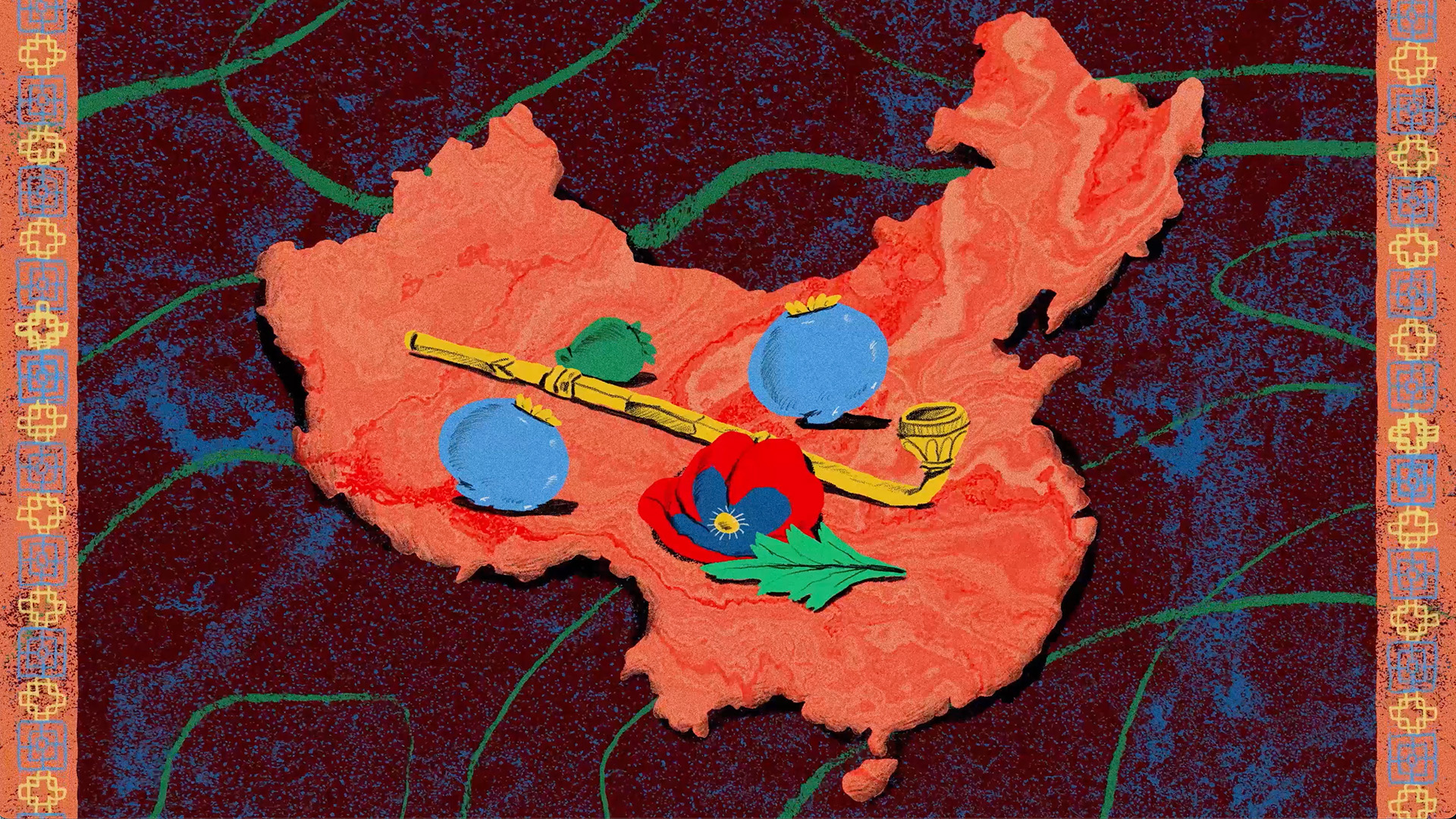
You might think of drug smuggling as a problem that nations only deal with today, but the drug trade stretches much further back. Learn how Britain became a drug-smuggling nation in China and how this trade changed the world.
Think about the following questions as you watch the video
Why did Lin Zexu ask the spirit of the southern sea for forgiveness for 23 days?
What were the two big problems that the East India Company (EIC) faced in its trade with China?
How did the Chinese emperor respond to the opium trade?
How did members of the British government respond to the threat of war with China over the opium trade?
What were the outcomes of the first and second Opium Wars (1839–1842 and 1857–1859)?
: On June 3rd, 1839, behind a bamboo fence, five hundred Chinese workmen began filling three stone-lined
: pits with seawater, quick lime, and opium. The mixture bubbled and boiled, dissolving the highly
: addictive drug that was destroying China. For twenty-three days, they destroyed 20,000 chests, nearly 300,000
: pounds of opium. At the end of each day, as the slurry was dumped into the sea, Commissioner Lin Zexu,
: China's drug czar, begged forgiveness from the spirit of the southern sea and asked,
: "tell the creatures of the water to move away to avoid being contaminated." This fiery act ignited
: a war with Great Britain. British merchants, angered at their loss of property, used their
: connections to convince Parliament to attack China and preserve the crown's honor and prestige. But
: before we get to the war and its importance in history, we need to rewind the clock. It's the
: last day of 1600, Queen Elizabeth gives a group of London merchants, the East India Company or EIC,
: exclusive power to trade in Asia. Their mission, bring back luxury goods like silk, porcelain,
: and most importantly, tea, the British couldn't get enough of it. In 1721, the East India Company
: shipped over a million pounds of tea to Britain. By 1750, that number had quadrupled. Tea wasn't
: just a drink anymore, it was an obsession, and this is precisely how British merchants became
: drug dealers. The EIC had two big problems, first, China limited British trade to one port, Guangzhou,
: keeping prices artificially high. Second, Britain had little that China wanted, the Chinese insisted
: on being paid only in silver, creating a massive trade imbalance. Britain's government tried to
: convince China's emperor to open up his country to more British trade, to no avail. When diplomacy
: didn't work, the EIC, unfortunately, found a solution in India. Farmers there grew opium
: poppies, Indian laborers then processed mountains of this collected poppy sap into uniform balls of
: smokable opium. The company shipped the opium to an island near Guangzhou, and sold it to Chinese
: smugglers for silver, then used that same silver to buy tea. That's right! The Chinese spent their
: own silver to buy opium from the British, and the British then turned around and gave the Chinese
: back that silver for tea. The EIC had essentially turned drug dealing into a business plan. Corrupt
: Chinese officials took bribes to look the other way. When the EIC lost its monopoly on Chinese
: trade in 1833, the situation went from bad to worse. More merchants meant more opium and lower
: prices. Imports of foreign mud, the Chinese term for opium, nearly doubled in just five years; Chinese
: addicts numbered in the millions. Outraged, the Chinese emperor met with his advisers, one group
: advised him to legalize and tax the opium trade. But Minister of Rites, Huang Juezi, argued that because
: opium was poisoning China, it had to be banned. Swayed by Juezi's moral argument, the emperor
: banned opium in 1838. He declared, "any foreigner bringing opium into China would be beheaded. Any
: Chinese who help foreigners in their illegal trade would be strangled. All property on board
: shall be confiscated." He warned anyone involved in the trade to hand over their opium within one and
: a half years or face the consequences. Enter Lin Zexu, remember him? He oversaw the opium burning at the
: beginning of the video, he'd been appointed drug czar to enforce these new laws. Addicts were rounded up
: and forced to give up their opium habits cold turkey. Chinese dealers faced execution. He
: demanded that foreign merchants turn over their supply and leave the country. A year passed, no
: British merchants complied; Commissioner Lin asked again. In the meantime, uneasy with the
: situation, Britain's Superintendent for Trade in China, Charles Elliot, ordered all British
: ships to Hong Kong Island. He raised the British flag and extended Queen Victoria's protection to
: all foreigners. Angry Chinese soldiers quickly confined the remaining British merchants to their
: warehouses. Lin threatened to starve out the foreigners and refused to let them leave until
: they turned over their opium. Elliot promised the merchants that the British government would
: pay them for their lost property. Reluctantly, they handed over their valuable stash of opium.
: When word of what happened reached London, Parliament and public opinion was divided.
: Reformers and humanitarian-minded Britons viewed a war to protect the opium trade as shameful.
: William Gladstone lectured the pro-war faction, "the Chinese had every right to take the actions
: they did. Going to war was not only unjust, but was bound to cover the country with a permanent
: disgrace. The Union Jack would become a pirate flag to protect an infamous traffic." Lord Ashley,
: an important figure in ending slavery, echoed Gladstone's argument. He wanted China to open
: its doors to Christian missionaries. But he argued that, "our encouragement to this nefarious traffic
: has slowed the progress of Christianity and impeded the civilization of mankind." For others,
: like Sir Walter Medhurst, opium wasn't the problem, China's hostility to free trade was. "In
: spending millions for opium, the Chinese show they have money to spend. If we can only induce them to
: take our cotton and woolens instead of our opium, we shall be blessing them and ourselves." War with
: China might be what was needed to convince China to change its ways. Lord Palmerston,
: then British Foreign Secretary, was even more sanguine. Britain's finances depended on opium
: revenue, and ending trade would require Britain to spend money on something the Chinese were unable
: to do themselves. "Parliament would have laughed me out of court. Imagine, if I had petitioned
: them to pay for British Navy patrols to end the smuggling, and preserve the morals of the Chinese
: people." Given that it was impossible for the government to prevent smuggling in Britain itself,
: how could they possibly succeed in China with its huge appetite for opium? Palmerston's side narrowly
: won the debate. Britain sent a military force to punish China for its arrogance,
: insolence, and outdated economic ideas. China, not British taxpayers, would pay the merchants
: for their lost property. The first Opium War began in 1839. China's wooden junks were no
: match for Britain's steam-powered iron ships, like the HMS Nemesis. By 1842, China was forced
: to sign the Treaty of Nanking, ceding Hong Kong, opening several ports to British trade,
: granting legal immunity to British citizens, and allowing Christian missionaries into the empire.
: But the British weren't finished. After a second Opium War and another set of unequal treaties,
: the Chinese economy was devastated. Opium became legal and much of China's economy
: came under foreign control. This would mark a period remembered as the "Century of Humiliation."
: In just a few decades, the world's oldest and once most powerful civilization was humbled. Not