Our website uses cookies to understand content and feature usage to drive site improvements over time. To learn more, review our Terms of Use and Privacy Policy.
How were the Inca able to construct a sprawling complex of buildings with running water high in the Andes Mountains? Take a journey to Machu Picchu (minus the multiday trek).
Think about the following questions as you watch the video
Who were the Inca and where were they located?
How was Machu Picchu constructed?
What do scholars think Machu Picchu was used for?
How did the Inca get fresh water and remove wastewater from Machu Picchu?
What happened to the Inca?
: Behold: Machu Picchu! One of the Seven Wonders of the Modern World! An ancient city high in the
: Andes mountains of Peru, Machu Picchu - Wait, are you talking about that yellow mouse from Japan?
: What? No, no, no. That's Pikachu. This is Machu Picchu. These ruins, commissioned by a
: great Inca emperor, are equal in size to four city blocks. That's twenty football fields. Wait,
: back up. What's "Inca?" You mean "Who?" Who were the Inca? I'm getting there! The Inca were
: an indigenous American people who built the largest empire in the Americas before European
: colonization. At its height, the Inca Empire stretched across what we now call Peru, Ecuador,
: Bolivia, Chile, Argentina, and Colombia. Built by the Inca and hidden from the world until 1911,
: Machu Picchu - Wait, how can something twenty-football-fields big be "hidden"? Ahem. Because it's high in the
: Andes. Hiram Bingham discovered the site in 1911 after a local farmer showed him the way. LOL. He
: didn't discover it if someone told him where it was. Fair. Also, what's a "wonder"? Oh, a "wonder"
: is a human-made structure showing astonishing technical achievement and cultural significance.
: Okay, but why is that grassy, falling apart mess of rocks a "wonder"? Have you ever been to New York
: City or Dubai? Talk about astonishing! You don't understand what you're looking at. The rocks are
: definitively not "falling apart." That's what's so impressive! And this was built way before
: New York City or Dubai! OK! So touchy! What are we looking at? A touchstone of human innovation!
: Those stones weigh up to several tons — more than elephants...or dump trucks. And they were moved and
: stacked perfectly with no machinery. Wait, no backhoe? No crane? Correct. There were no back
: hoes or hydraulic cranes in the 15th century. The Inca didn't use beasts of burden or wheels either.
: For communication across the empire, they used quipu — a recording device that consisted of colored,
: knotted strings. The oldest quipu — Wait — how old is Machu Picchu? You never said that this happened
: centuries ago. You said "one of the Seven Wonders of the Modern World." This is ancient history.
: Welp, "Modern" is relative. To what? Ancient. But did you say it's an ancient city? Yes, it was
: built over 600 years ago, but it's nuanced. The same words in different contexts carry different
: meanings. Both Machu Picchu and — Okay, you don't care. Just...not about "Different-Context-Carry-
: Meanings." Okay, what do you want to know? How they built it. They used ropes and ramps — thousands of
: workers pulled the stones up steep inclines. They came from all over the continent, and it took 100
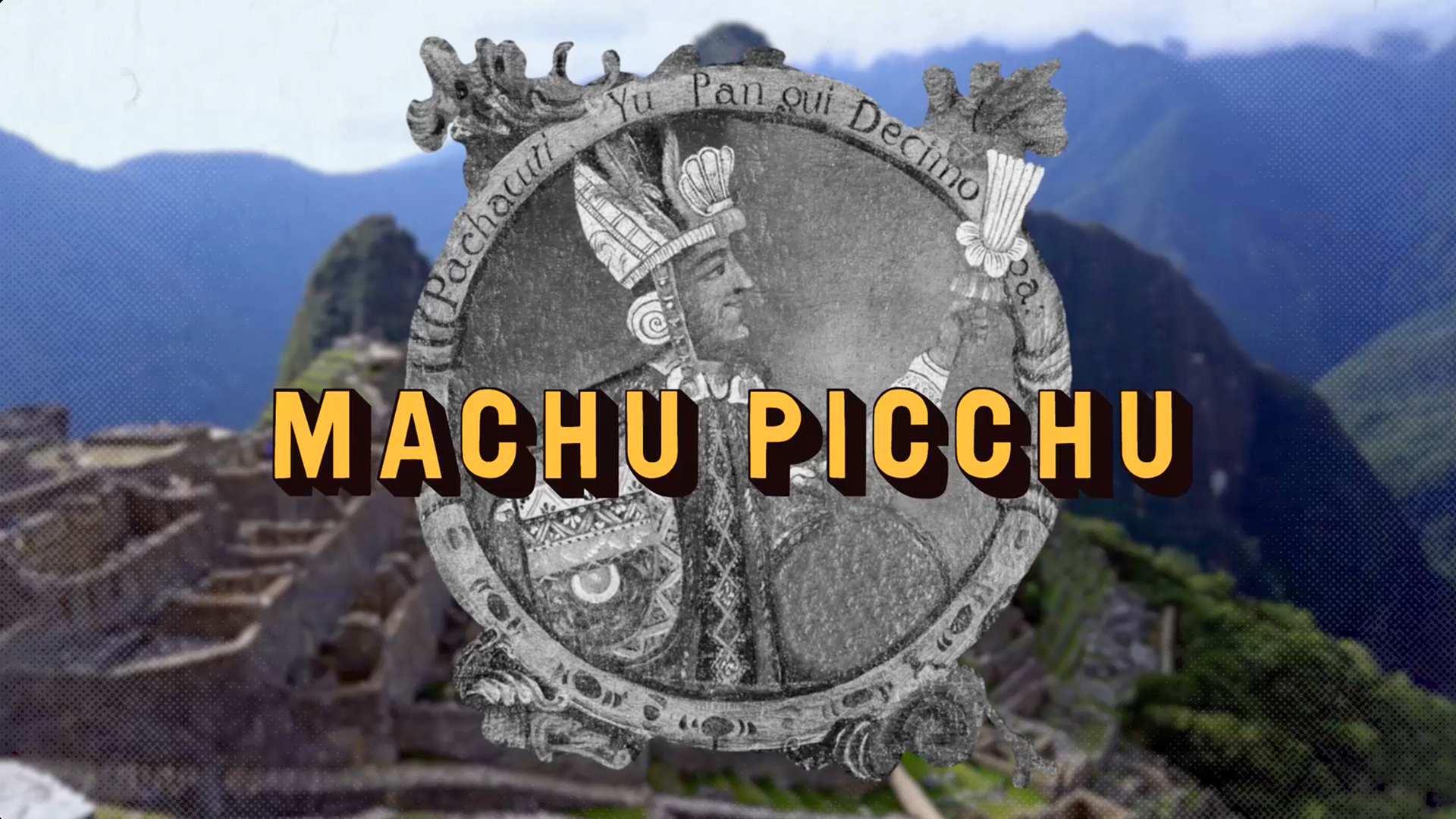
: years to complete. Let me explain. Under the ruler Pachacuti, the Inca Empire expanded dramatically,
: which made it possible to get laborers from across the region. At its height, the Inca ruled over 12
: million people who spoke 30 different languages. All of this suggests there was a highly organized
: labor system. Scholars believe that people paid their taxes not with money, but with physical
: labor, or the products of their labor. The Inca called this mandatory public service labor “Mit'a.”
: Most scholars agree that Pachacuti commissioned Machu Picchu as a royal estate to house royals
: part of the year. Some point to evidence that it was an astronomical observatory, given its location
: high in the mountains. And some think the site may have had religious or spiritual uses. Very,
: very rarely on very special occasions, the Inca probably practiced human sacrifice. But
: it wasn't scary; it was an incredible honor. Okay, wow! That's pretty neat. Royal estate.
: Spiritual uses! Human sacrifice! Yes, it IS neat! Okay, now let's zoom in. Notice how perfectly
: these stones fit together? You can't even slide a piece of paper between them. And they did that
: without modern day tools. Picture generations of workers spending nearly 100 years – pulling rocks
: the size of dump trucks up the mountain and then shaping them until they fit together perfectly.
: It's on the tippity top of a mountain, so high up that visitors today have to spend several days
: acclimating to the elevation or else they might get altitude sickness: headaches, dizziness,
: shortness of breath, vomiting. Then, when you're finally there, and you're seeing it in real life,
: you're struck by how utterly impossible it seems. The earthquake-proof structures. The whole water
: system. What water system? Oh my goodness, you're right! We haven't even gotten to the water system!
: Machu Picchu has an insanely advanced-for-its- time water system. A natural spring farther up
: the mountain feeds a canal that is carved into the rock. The canal is at a slight angle so that
: fresh water is always flowing to the city thanks to gravity. That canal feeds a bunch of fountains.
: And it's all STILL WORKING TODAY. Plus, there's underground drainage to prevent landslides,
: flooding, and erosion. Think about it: Have you ever been to a big city - or anywhere, really - and
: wondered how the sinks and toilets in all the kitchens and bathrooms get and get rid of water?
: Like, what does the plumbing system look like in New York or Dubai? It's pretty amazing to think
: about it, and that's with modern technology! Imagine all of this happening in the 1450s.
: They didn't have pipes! They didn't even have metal to make pipes! Yet, they had running water.
: On top of the mountain, with limited tools. Hmmmm. You seem less enthusiastic all of a sudden. Well,
: not to poke holes or anything, but didn't the ancient Egyptians have running water, like,
: thousands of years before the Inca built Machu Picchu? Why are we supposed to be so impressed
: with the Inca? Well, it's not a competition. The Inca had different challenges - Not that
: I'm comparing, but if I were, the Brunelleschi Dome was constructed around the same time,
: right? And the Forbidden City in Beijing. Are those wonders, too? But those feats of engineering
: aren't built on the top of a mountain in the middle of a jungle. And they had more resources!
: OK, OK. So, what we're gathering is that the wondrousness of Machu Picchu is more about what
: the ancient society was able to achieve with limited technology given the circumstances.
: Not comparing it to other cultural sites. And not considering what it looks like today. Yes.
: And there's also a lot that we don't know about the Inca and about Machu Picchu. Like I said,
: they didn't even keep written records, so most of what we think we know comes from piecing together
: evidence. Part of the allure is that Machu Picchu is so mysterious. We don't really know how they
: did it or why they did it, not 100%. So, what happened to the Inca? Where are they today? Ah,
: important question. The Inca Empire was wiped out. War, European disease, and Spanish conquests. What
: the! That's awful. I know, a lot of history isn't pretty, especially when it comes to
: the rise and fall of empires. But let me finish. The Inca story isn't over. The Inca Empire fell,
: and a lot of people died, but not all of them. Descendants of the Inca from centuries ago are
: still alive today. Many of them still speak the official Inca language, Quechua. And some Quechua
: words show up in Spanish. So the Inca live on!Amazing! Yes! I can do this just as well as
: that guy. When we look at Machu Picchu, we don't just see an intact pile of stones, we see proof of
: the Inca Empire's incredible political and social achievement. The largest empire in the Americas,
: built without money, iron tools, or the wheel, unified by centralized governance, communal labor,