Our website uses cookies to understand content and feature usage to drive site improvements over time. To learn more, review our Terms of Use and Privacy Policy.
The Meiji Restoration was about industrialization, nationalism, modernization, and…baseball? That’s right, alongside factories and military technology, Japanese leaders also imported baseball. They believed it was the ideal game for the nation, blending themes of traditional Japanese culture with strategies that would make Japan competitive on the global stage.
Think about the following questions as you watch the video
What started the Meiji Restoration?
What was the goal of the Meiji Restoration, and what were some ways Japan’s leaders wanted to accomplish this goal?
How did baseball become part of the Meiji Restoration?
What role did Ichiko school play in the story of baseball’s rise in Japan?
Why was the Russo-Japanese War important? How was it connected to baseball?
: Picture this: it's 1868, Japan just hit the "reset" button on history. For over 200 years, the country
: was basically in a self-imposed timeout, cut off from the rest of the world. Flashback to 1853.
: Four American warships sailed into Edo Harbor. Their purpose: convince Japan to trade with the
: US. Not willing to take no for an answer, six American warships returned six months later
: with gifts for the Shogun, including a working quarter-scale model train. The Americans laid
: down 330 feet of circular track, unloaded the train, and filled it with coal. The train's black smoke
: and steam whistle thrilled the crowd of invited samurai. Some of these samurai understood how far
: Japan had fallen behind technologically. Others weren't so sure letting foreigners in was a good
: idea. The Japanese reluctantly signed the Treaty of Kanagawa. More treaties soon followed, granting
: foreign nations trade concessions and extraterritorial rights. New ideas flooded in. Japanese
: elites debated about the pace of change. Some believed Japanese culture would be overwhelmed by
: the "blue-eyed barbarians." Another group believed that the only way to avoid being overwhelmed and
: colonized was to embrace change. Fighting ensued. The side looking to catch up, won, beginning the
: Meiji Restoration. Emperor Mutsuhito, just 17 years old, took control from the Shogun. Trains
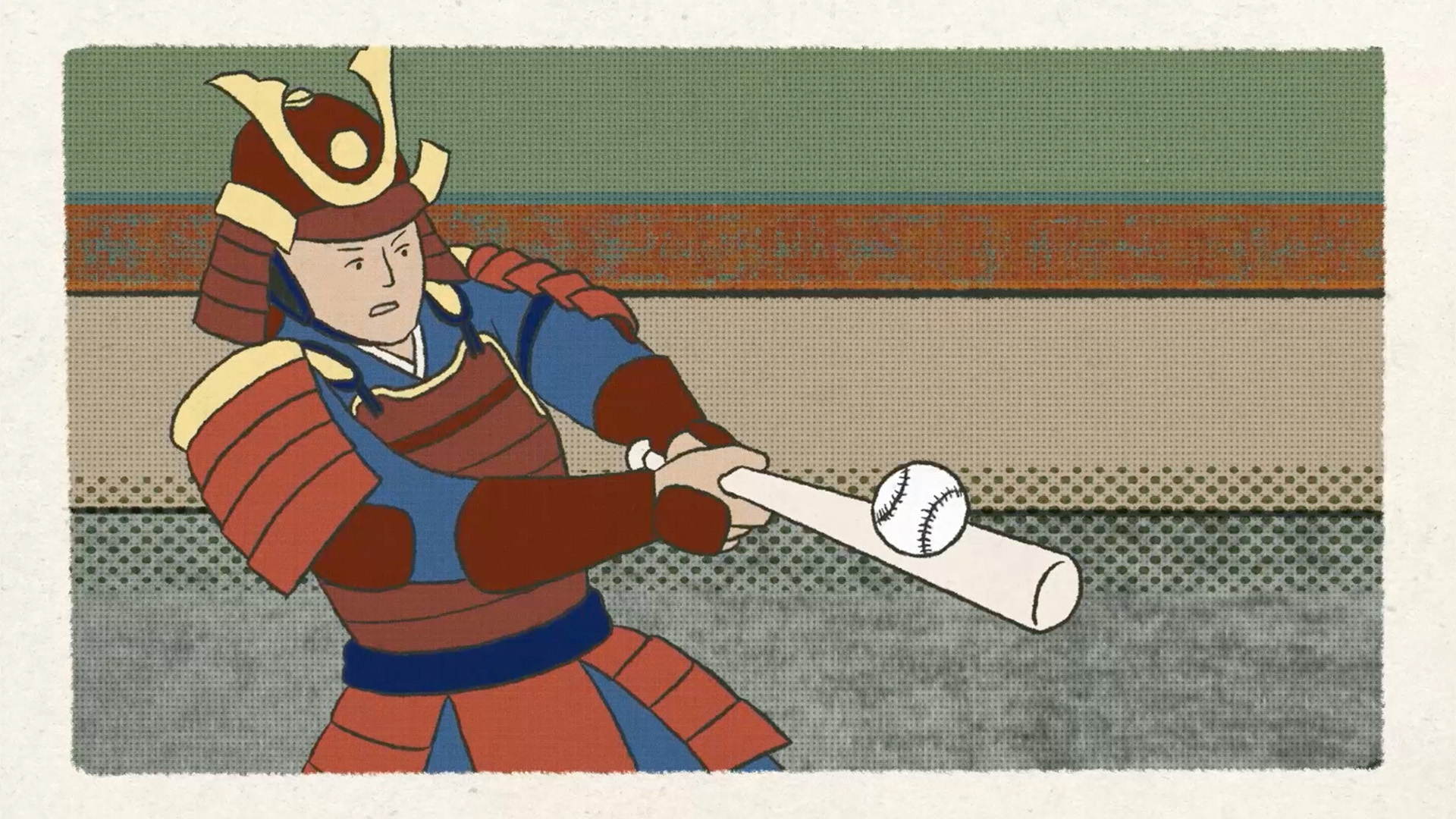
: replaced horses, business suits replaced kimonos, and, wait for it...baseball bats replaced swords.
: Yes, that baseball. America's pastime became a big part of Japan's story of modernization. Japan's
: new government had a mission: make Japan rich and strong. To do it, they invited experts from the
: West to teach them about everything, from science to democracy. But Japan did not want to become the
: West. They wanted to adopt Western techniques while preserving traditional Japanese culture
: and values, a term they called "Wakon yōsai." Enter baseball. A game all about teamwork, discipline,
: sacrifice, and constant practice. Not only are these virtues hallmarks of democracy and factory
: work, they are also samurai values in sports form. Horace Wilson, an American teacher in Tokyo,
: thought his students needed more exercise. By playing baseball, his students built character,
: learned to work as a team, and developed their pitching arms and batter's eyes. Japan
: also started sending their own students abroad to study industrial technology, political systems,
: and team sports. One of them, Hiroshi Hiraoka, studied engineering in the US and became obsessed
: with baseball. When he returned home, he didn't just bring back railroad engineering know-how,
: he brought back merch: baseball bats, gloves, and balls. He was the country's first baseball fanatic,
: and he founded Shimbashi Athletic Club, Japan's first independent team. And then there was Masaoka
: Shiki, a poet who looked at baseball and thought, "This is just modern bushido." His essays used
: combat terminology to explain baseball's rules to Japanese audiences. The batting team became
: attackers and the fielding team defenders. This blending of samurai ethics with baseball
: fundamentals became known as Yakyū. It emphasized honor and loyalty to the team over individual
: performance. Shiki's ideas, and the game, caught on. Japan's higher-level schools, modeled on western
: preparatory schools, fiercely contested the annual tournament to determine a national champion.
: One Tokyo school, Ichikō, dominated. Hoping to improve their game and disprove the stereotype
: that the "little Japanese" were culturally and physically unable to compete with "six-footed
: Americans", Ichikō's players challenged an expat American team based in Yokohama. For five years,
: the Americans ignored their challenge. Finally, in spring 1896, the foreigners agreed to a game,
: on their home field. On May 23rd, the Ichikō team, impeccably dressed in white collars and
: polished shoes, boarded the morning Yokohama bound train, their baseball gear at their side. Western
: spectators jeered and howled when these student athletes dropped pop-ups or slipped on the wet
: field during warm-ups. But after the first pitch was thrown, the Japanese players regained their
: focus and humiliated the team, winning 29 to 4. The students returned home to "banzai" cheers. They were
: national heroes. A rematch happened a week later. This time, the Yokohama team included sailors from
: two American ships. Ichikō won again, 32 to 9. One Japanese newspaper applauded the victory,
: while another delighted in reporting that Ichikō made the Americans look clumsy. English language
: newspapers downplayed the Japanese victory, claiming that Yokohama's loss was caused by their
: players inability to practice, as they had daily business to attend to. A third game was hosted
: by Ichikō. A team of sailors from the USS Detroit hoped to defend the USA's honor. Perhaps the noise
: of 10,000 rowdy Japanese fans, and the presence of Japanese government officials and American
: diplomats unnerved them, as they lost 22 to 6. A final game occurred on July 4th with the Ichikō
: nine facing off against an all-star team, consisting of players from the Yokohama Athletic Club and the
: US Navy, including a shortstop with professional experience. Having just finished their academic
: exams, the Japanese students were mentally and physically spent. The American team salvaged their
: reputation, winning 14 to 12, and demonstrating good sportsmanship by shaking the Japanese players
: hands and giving them a “hip, hip, hooray” before leaving the field. Finally, Ichikō's players felt as if they
: were on equal footing with the Americans. And it seems as if Americans agreed. Japanese college
: teams toured the USA and American college teams toured Japan. The two nations developed mutual
: respect for each other especially after Japan surprised the world by defeating Russia in 1905
: during the Russo-Japanese War, proving that it had modernized its military, government,
: and society, and established Japan as a great power on the world stage. In less than 50 years, what
: started out as foreign curiosity with no relevance to Japan, became a national obsession. The Japanese
: saw something in baseball that they could use to transform their nation, using the sport as a tool
: of foreign and domestic policy, and a metaphor for the Meiji Restoration. The Japanese took America's
: game and remixed it with their own traditional Japanese customs and values. The sports rules and
: emphasis on practice and teamwork helped develop great baseball players. Baseball's principles were
: equally useful on the factory floor, classroom, and battlefield. A 1905 song linked Japan's
: victory in the Russo-Japanese War to what Ichikō's players had accomplished on the baseball field.
: "Ah, for the glory of our baseball club! Ah, for the glitter it has cast! Pray that our