Cookie Policy
Our website uses cookies to understand content and feature usage to drive site improvements over time. To learn more, review our Terms of Use and Privacy Policy.

Unit 3 Overview
European transoceanic voyages connected the Americas and Afro-Eurasia in sustained connections for the first time, launching the first truly global networks.
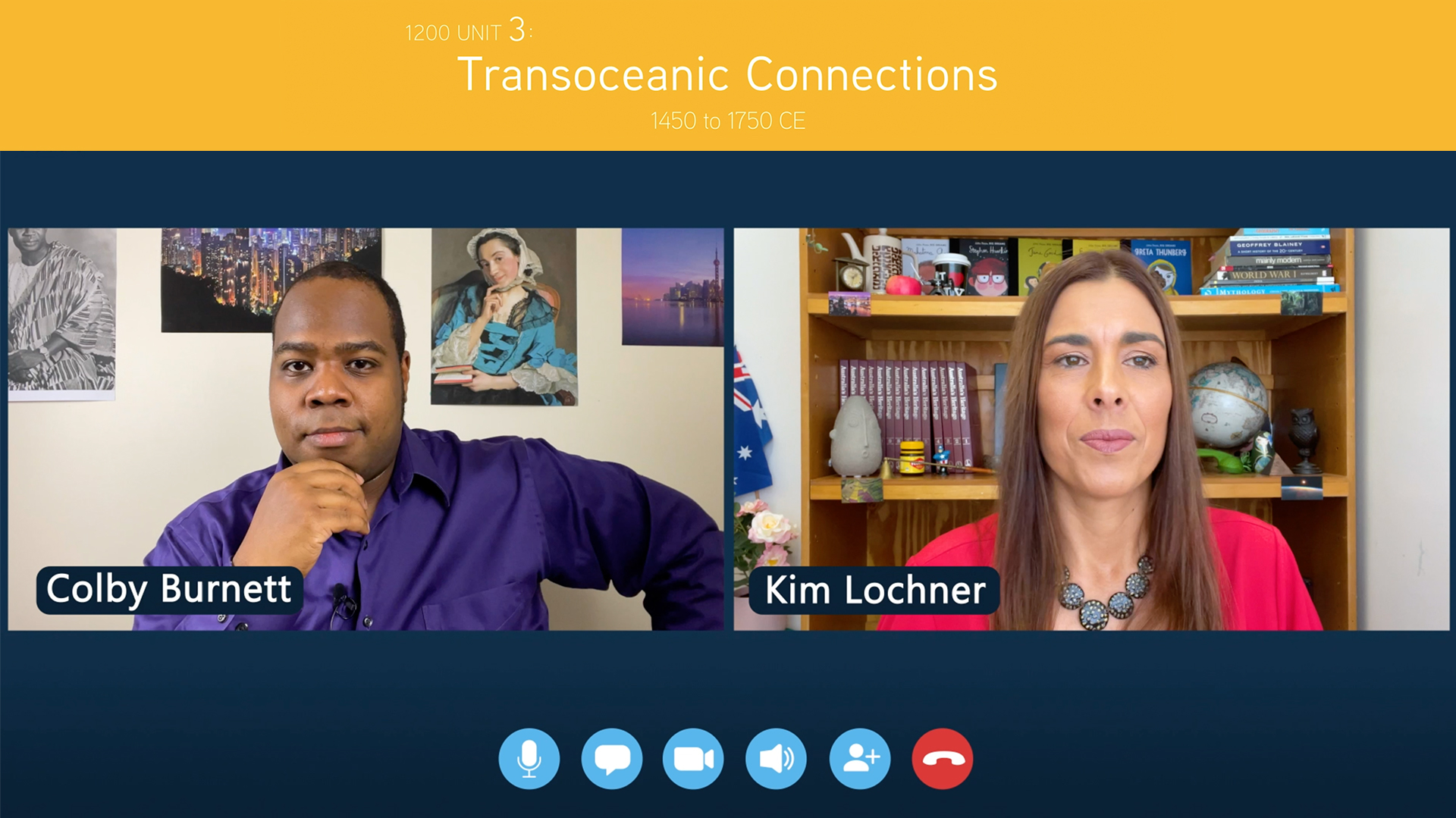
Think about the following questions as you watch the video
- How did the fall of the Mongol Empire change the way that long-distance trade networks worked after 1450?
- What were some global changes that came with the Columbian Exchange?
- What were the most powerful kinds of states during this period? What were their priorities?
- What was Manila’s role in this global trading system?
- What were some major demographic events in this era?
: Good day Colby!
: Howdy Kim! How's my favorite Australian?
: Great. Listen, I'm really excited to do the video for this overview.
: Do you know what the topic is? It's none other than...
: You froze. Are you faking? Last time you were faking.
: Did you read it?
: Your transoceanic connection is unstable. Oh because the unit is about...
: I learned how to do graphics in video calls.
: Oh that is certainly one way to keep busy during quarantine,
: but you know you're allowed to go on a walk now and then. Just saying.
: Hi, I'm Kim Lochner.
: And I'm Colby Burnett. We're introducing Unit 3: Transoceanic Connections 1415-1715.
: In the period before 1415, human communities were distinct and diverse. But they became increasingly
: linked by expanding and thickening networks of exchange. Those networks grew and collapsed
: and recovered. But in each case they transformed the societies they linked. Gradually, the global
: tapestry was taking shape. In the three centuries from 1450 to 1750 dramatic transformations and new
: connections began to weave together all the far flung threads of humanity. By 1450 Afro-Eurasian
: societies had recovered from the Black Death which devastated them in the mid-14th century.
: Trade was again growing but the new system was different. Previously, the huge Mongol
: Empire dominated most of Eurasia, imposing stability and keeping overland trade routes safe
: for merchants and other travelers. But in the period from 1450 to 1750 there was no great Mongol
: state. Instead, several large, land-based empires emerged and competed for trade,
: influence, and territory. This meant it was harder for Europeans to get the Asian luxury
: goods like silk and ceramics that they craved. So, a small number of Europeans headed west to
: find an alternate path to those goods. History's most ambitious and destructive shopping spree
: reached the Americas where these Europeans found another system of exchange already operating.
: The coming together of these two systems, one American, the other Eurasian and African was
: a turning point of world history. In the 15th and 16th centuries, oceanic travel across the Atlantic
: and the Pacific created the first truly global network--a world system.
: Often called the Columbian Exchange, it brought new economic challenges to different regions.
: And that's putting it mildly. The Columbian Exchange sent plants, animals, people, and
: diseases to completely new regions. This exchange transformed life in every part of the world,
: immediately in some places and more gradually in others. To respond to the transformations of this
: period, people had to modify their communities or build new ones. Western European states built
: empires that stretched across entire oceans as they strived to control the trade and territory
: of the new world system. Transoceanic connections certainly kicked off massive transformations,
: but this period wasn't all about European oceanic empires. In fact, the most powerful states during
: this period were land based, meaning they ruled vast territories of continuous land masses.
: These sorts of empires were generally more interested in expanding their inland frontiers
: rather than seeking out distant colonies. The mighty Ottoman Empire extended its reach
: into Eastern Europe. In China, the Ming and Qing Dynasties ruled a vast empire.
: And along with the Mughal Empire in India, these three powers were the heart of the global economy.
: Across the world, land-based empires remained a powerful force in this period. Yet, even
: these giants were transformed by the Columbian Exchange. So it becomes important to ask some big
: questions. "How did transoceanic connections transforms global economic systems and societies
: in different parts of the world?" "How global was this new economic system really?" "And
: how did people and societies in different
: can look at specific examples to answer these questions. And by we, I mean Colby.
: You mean the students, but I'll help us get started. One important part of
: the Columbian Exchange was the city of Manila in the Philippines. Prior to the Columbian Exchange
: there was only a small town in the spot that would become Manila. The capital of
: the tiny state of Tondo was a trading society with a small community of Chinese merchants.
: They sold goods to local traders who traveleld around the islands exchanging them for local
: products. Then, in the late 16th century Spanish conquistadors captured the region
: from local authorities. The Spanish saw Manila as a convenient administrative center
: ruling the surrounding islands. But, more than that, they hoped it could
: become a hub for the most important trade of all, which I'll reveal soon but not yet.
: It's silver, we're talking about silver.
: Through their oceanic travels, the Spanish had discovered the way to acquire the Asian
: luxury goods that were so desired in Europe. The route lay mainly across the Atlantic Ocean to the
: Americas and then through Spanish territories in what is now Mexico. Next, they went across
: the Pacific to Manila where Chinese merchants would bring their silk and other goods for sale.
: Fortunately for them, the Spanish found what they could give in return for those luxury goods:
: silver. In particular, silver mined in the Americas. After 1465, the main state in China
: started requiring all taxes be payed in silver. This created a huge demand for the precious metal
: in the world's largest economy. American silver revolutionized global trading in the era of the
: Columbian Exchange. Much of the world was soon drawn into this system in which American silver
: bought Asian luxury goods for a growing European consumer class. Silver mines were owned by
: the Spanish who forced indigenous Americans and enslaved Africans to work in the mines.
: In the 16th century, believe it or not, these mines produced 17,000 tons of silver. In the 17th
: century it more than doubled to 37,000 tons. In the 18th century it doubled again to 75,000 tons.
: Most of the silver found its way to China. A lot of it came through Europe, especially early in the
: era. But by the 18th century, much of it was going directly from Latin America to Manila and from
: there, to China. In the midst of all this, Manila changed a lot. And fast. Sure, it had already been
: a commercial city for hundreds of years, but now it's population exploded. New communities made
: from Europeans joined the Chinese, Malay, and other local groups. Christianity joined Islam,
: Hinduism, and Buddhism in the city. For many people, daily life hardly changed. But life under
: Spanish colonial control meant new laws, religious rules, and economic systems imposed by a distant
: empire. Manila and the Philippines would remain under the control of foreign empires for nearly
: 400 years, finally winning independence in 1946. Transoceanic connections reduced
: these kinds of transformations in many parts of the early modern world. The cumulative
: effects of the Columbian Exchange brought great prosperity to some regions and devastated others.
: While silver and empires were altering economic and political systems,
: massive demographic changes were also underway. During this era, the global population doubled
: from about 400 million people to almost 800 million. But looking more closely at this growth,
: we can see some variation in how and where it happened. While the world population was
: doubling, the Columbian Exchange caused two massive demographic events that devastated
: communities in the Americas and Africa. The first demographic event came to be known as the Great
: Dying. Europeans arriving in the Americas brought with them diseases common to Eurasia and Africa
: but which were completely alien to the Americas. Peoples of the Americas had little resistance to
: these diseases. The evidence is uncertain but perhaps as many as 20 million people died from
: these epidemics in Mesoamerica in the 50 years after the Spanish conquest. In the centuries after
: 1492, tens of millions more indigenous Americans would die in what several historians have called
: the largest genocide in world history. In some places, particularly in the Caribbean Islands,
: disease combined with warfare and slavery killed over 90% of some indigenous communities.
: The second demographic event was the Atlantic slaving system. 12 million Africans were enslaved
: and forcibly moved in the four centuries after 1440. The populations of some African regions
: significantly declined. Societies in West Africa in particular were transformed by the loss of
: so many. Enslaved Africans worked on European plantations in the Americas.
: They produced the raw materials that fueled global economic growth and helped laid the
: groundwork for a new economic system: capitalism. These demographic events, while devastating,
: did not reverse global population growth overall. That's partly because the Columbian Exchange drove
: forced and voluntary migration into areas where population had declined. The summit
: of the Americas by Europeans and enslaved Africans is one example. But more important to
: population growth was how the Columbian Exchange brought together the food systems of the world
: to make more nutrition available. Peruvian potatoes became a staple crop in Ireland and
: sweet potatoes spread rapidly to China. North American corn was quickly adopted in Africa.
: Eurasian crops like wheat spread quickly in the Americas. Near the end of this period, European
: mariners introduced cassava from the Americas to the islands of Polynesia where it became a staple
: crop. As transoceanic connections intensified, no part of the world was left untouched. But, to
: people living through this period, these massive transformations were less important than their
: own, individual experiences. Bound together for the first time in a world system, societies and
: people around the world nonetheless experienced these changes in drastically different ways. Many
: of the transformations started in this period for better and for worse continue to unfold today.
: In this unit you will explore transformations that have lasting legacies in our world
: like religious syncretism, mass migrations, the birth of capitalism, and the institution
: of slavery. "How might your own experiences be linked to connections forged over 500 years ago?"
: Wow. So if plants hadn't moved along those transoceanic connections
: my continent would be the only one farming corn.
: Why are you always in these bits with something corny.
: Wait but that was it. And now it is.
: Howdy Kim! How's my favorite Australian?
: Great. Listen, I'm really excited to do the video for this overview.
: Do you know what the topic is? It's none other than...
: You froze. Are you faking? Last time you were faking.
: Did you read it?
: Your transoceanic connection is unstable. Oh because the unit is about...
: I learned how to do graphics in video calls.
: Oh that is certainly one way to keep busy during quarantine,
: but you know you're allowed to go on a walk now and then. Just saying.
: Hi, I'm Kim Lochner.
: And I'm Colby Burnett. We're introducing Unit 3: Transoceanic Connections 1415-1715.
: In the period before 1415, human communities were distinct and diverse. But they became increasingly
: linked by expanding and thickening networks of exchange. Those networks grew and collapsed
: and recovered. But in each case they transformed the societies they linked. Gradually, the global
: tapestry was taking shape. In the three centuries from 1450 to 1750 dramatic transformations and new
: connections began to weave together all the far flung threads of humanity. By 1450 Afro-Eurasian
: societies had recovered from the Black Death which devastated them in the mid-14th century.
: Trade was again growing but the new system was different. Previously, the huge Mongol
: Empire dominated most of Eurasia, imposing stability and keeping overland trade routes safe
: for merchants and other travelers. But in the period from 1450 to 1750 there was no great Mongol
: state. Instead, several large, land-based empires emerged and competed for trade,
: influence, and territory. This meant it was harder for Europeans to get the Asian luxury
: goods like silk and ceramics that they craved. So, a small number of Europeans headed west to
: find an alternate path to those goods. History's most ambitious and destructive shopping spree
: reached the Americas where these Europeans found another system of exchange already operating.
: The coming together of these two systems, one American, the other Eurasian and African was
: a turning point of world history. In the 15th and 16th centuries, oceanic travel across the Atlantic
: and the Pacific created the first truly global network--a world system.
: Often called the Columbian Exchange, it brought new economic challenges to different regions.
: And that's putting it mildly. The Columbian Exchange sent plants, animals, people, and
: diseases to completely new regions. This exchange transformed life in every part of the world,
: immediately in some places and more gradually in others. To respond to the transformations of this
: period, people had to modify their communities or build new ones. Western European states built
: empires that stretched across entire oceans as they strived to control the trade and territory
: of the new world system. Transoceanic connections certainly kicked off massive transformations,
: but this period wasn't all about European oceanic empires. In fact, the most powerful states during
: this period were land based, meaning they ruled vast territories of continuous land masses.
: These sorts of empires were generally more interested in expanding their inland frontiers
: rather than seeking out distant colonies. The mighty Ottoman Empire extended its reach
: into Eastern Europe. In China, the Ming and Qing Dynasties ruled a vast empire.
: And along with the Mughal Empire in India, these three powers were the heart of the global economy.
: Across the world, land-based empires remained a powerful force in this period. Yet, even
: these giants were transformed by the Columbian Exchange. So it becomes important to ask some big
: questions. "How did transoceanic connections transforms global economic systems and societies
: in different parts of the world?" "How global was this new economic system really?" "And
: how did people and societies in different
: can look at specific examples to answer these questions. And by we, I mean Colby.
: You mean the students, but I'll help us get started. One important part of
: the Columbian Exchange was the city of Manila in the Philippines. Prior to the Columbian Exchange
: there was only a small town in the spot that would become Manila. The capital of
: the tiny state of Tondo was a trading society with a small community of Chinese merchants.
: They sold goods to local traders who traveleld around the islands exchanging them for local
: products. Then, in the late 16th century Spanish conquistadors captured the region
: from local authorities. The Spanish saw Manila as a convenient administrative center
: ruling the surrounding islands. But, more than that, they hoped it could
: become a hub for the most important trade of all, which I'll reveal soon but not yet.
: It's silver, we're talking about silver.
: Through their oceanic travels, the Spanish had discovered the way to acquire the Asian
: luxury goods that were so desired in Europe. The route lay mainly across the Atlantic Ocean to the
: Americas and then through Spanish territories in what is now Mexico. Next, they went across
: the Pacific to Manila where Chinese merchants would bring their silk and other goods for sale.
: Fortunately for them, the Spanish found what they could give in return for those luxury goods:
: silver. In particular, silver mined in the Americas. After 1465, the main state in China
: started requiring all taxes be payed in silver. This created a huge demand for the precious metal
: in the world's largest economy. American silver revolutionized global trading in the era of the
: Columbian Exchange. Much of the world was soon drawn into this system in which American silver
: bought Asian luxury goods for a growing European consumer class. Silver mines were owned by
: the Spanish who forced indigenous Americans and enslaved Africans to work in the mines.
: In the 16th century, believe it or not, these mines produced 17,000 tons of silver. In the 17th
: century it more than doubled to 37,000 tons. In the 18th century it doubled again to 75,000 tons.
: Most of the silver found its way to China. A lot of it came through Europe, especially early in the
: era. But by the 18th century, much of it was going directly from Latin America to Manila and from
: there, to China. In the midst of all this, Manila changed a lot. And fast. Sure, it had already been
: a commercial city for hundreds of years, but now it's population exploded. New communities made
: from Europeans joined the Chinese, Malay, and other local groups. Christianity joined Islam,
: Hinduism, and Buddhism in the city. For many people, daily life hardly changed. But life under
: Spanish colonial control meant new laws, religious rules, and economic systems imposed by a distant
: empire. Manila and the Philippines would remain under the control of foreign empires for nearly
: 400 years, finally winning independence in 1946. Transoceanic connections reduced
: these kinds of transformations in many parts of the early modern world. The cumulative
: effects of the Columbian Exchange brought great prosperity to some regions and devastated others.
: While silver and empires were altering economic and political systems,
: massive demographic changes were also underway. During this era, the global population doubled
: from about 400 million people to almost 800 million. But looking more closely at this growth,
: we can see some variation in how and where it happened. While the world population was
: doubling, the Columbian Exchange caused two massive demographic events that devastated
: communities in the Americas and Africa. The first demographic event came to be known as the Great
: Dying. Europeans arriving in the Americas brought with them diseases common to Eurasia and Africa
: but which were completely alien to the Americas. Peoples of the Americas had little resistance to
: these diseases. The evidence is uncertain but perhaps as many as 20 million people died from
: these epidemics in Mesoamerica in the 50 years after the Spanish conquest. In the centuries after
: 1492, tens of millions more indigenous Americans would die in what several historians have called
: the largest genocide in world history. In some places, particularly in the Caribbean Islands,
: disease combined with warfare and slavery killed over 90% of some indigenous communities.
: The second demographic event was the Atlantic slaving system. 12 million Africans were enslaved
: and forcibly moved in the four centuries after 1440. The populations of some African regions
: significantly declined. Societies in West Africa in particular were transformed by the loss of
: so many. Enslaved Africans worked on European plantations in the Americas.
: They produced the raw materials that fueled global economic growth and helped laid the
: groundwork for a new economic system: capitalism. These demographic events, while devastating,
: did not reverse global population growth overall. That's partly because the Columbian Exchange drove
: forced and voluntary migration into areas where population had declined. The summit
: of the Americas by Europeans and enslaved Africans is one example. But more important to
: population growth was how the Columbian Exchange brought together the food systems of the world
: to make more nutrition available. Peruvian potatoes became a staple crop in Ireland and
: sweet potatoes spread rapidly to China. North American corn was quickly adopted in Africa.
: Eurasian crops like wheat spread quickly in the Americas. Near the end of this period, European
: mariners introduced cassava from the Americas to the islands of Polynesia where it became a staple
: crop. As transoceanic connections intensified, no part of the world was left untouched. But, to
: people living through this period, these massive transformations were less important than their
: own, individual experiences. Bound together for the first time in a world system, societies and
: people around the world nonetheless experienced these changes in drastically different ways. Many
: of the transformations started in this period for better and for worse continue to unfold today.
: In this unit you will explore transformations that have lasting legacies in our world
: like religious syncretism, mass migrations, the birth of capitalism, and the institution
: of slavery. "How might your own experiences be linked to connections forged over 500 years ago?"
: Wow. So if plants hadn't moved along those transoceanic connections
: my continent would be the only one farming corn.
: Why are you always in these bits with something corny.
: Wait but that was it. And now it is.