Our website uses cookies to understand content and feature usage to drive site improvements over time. To learn more, review our Terms of Use and Privacy Policy.
Apartheid: How South Africa Ended Decades of Racial Rule
For decades, black South Africans faced repression in the form of apartheid, a system of racial segregation. It took years of protest and resistance, from within South Africa and from the international community, to finally topple the system of apartheid.
Think about the following questions as you watch the video
What was the purpose of the Wembley Stadium concert in London?
What was apartheid and why did it start?
How was Nigeria connected to South Africa?
How did people in other countries support the anti-apartheid movement in South Africa?
: On June 11th, 1988, thousands crowded into London's Wembley Stadium for an evening of
: live music. TV reporters from around the world were on scene, broadcasting to 67 countries.
: An estimated 600 million viewers tuned in to watch the star-studded lineup,
: which featured icons like Whitney Houston, Stevie Wonder, and Sting. This was no ordinary concert.
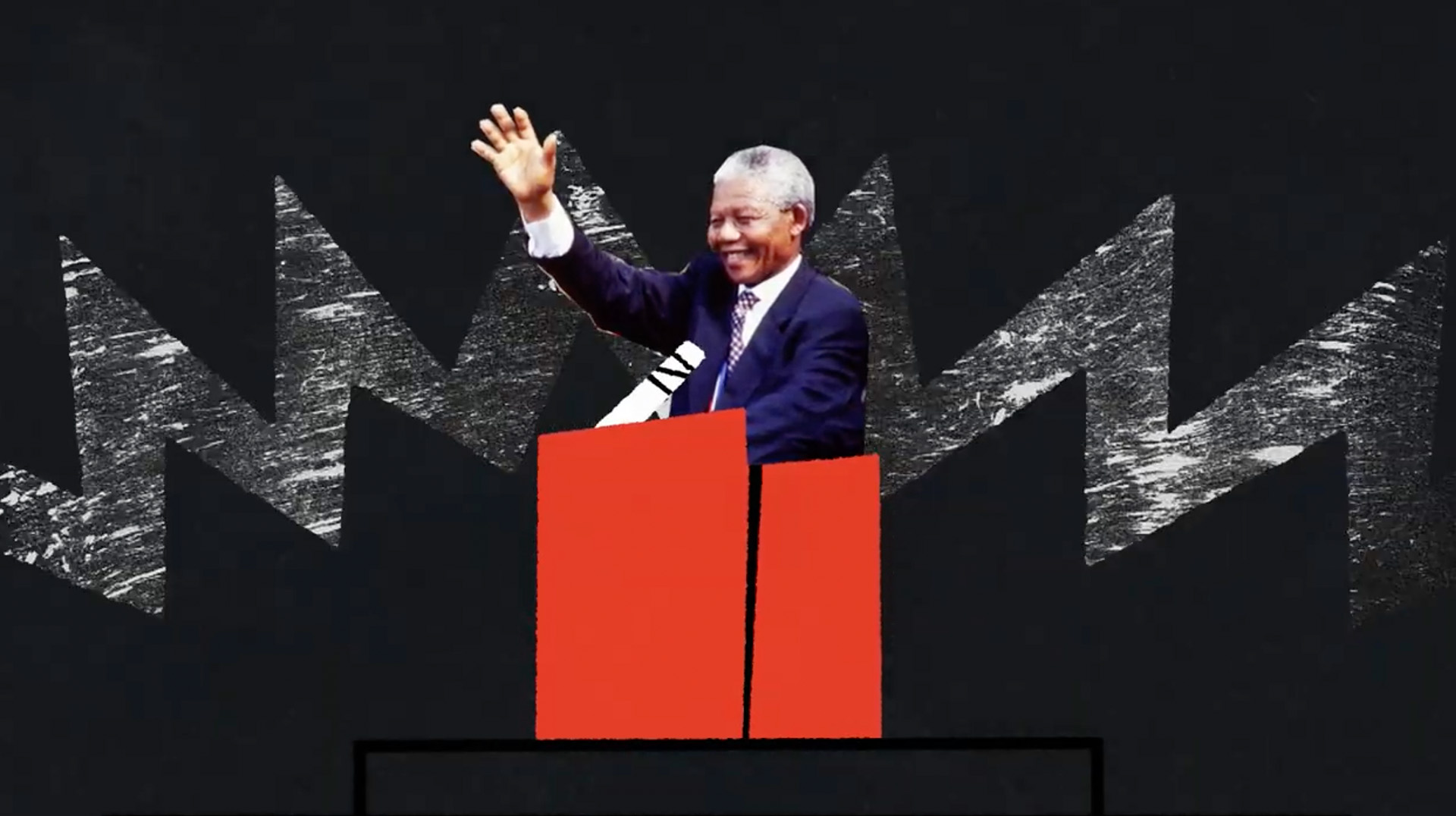
: Artists were performing to mark the 70th birthday of Nelson Mandela, a South African
: activist who had been in prison for more than two decades. His crime, organizing against apartheid,
: the system of racial segregation that ruled his home country, a system that would soon be toppled
: after decades of global activism. Starting in the early 20th century, South Africa was governed by
: a white minority known as Africaners, descendants of the Dutch colonists who began arriving in the
: 1600s to exert control over the majority population. Africaners instituted a racial
: hierarchy that limited the rights of black South Africans. This discrimination escalated when the
: far-right national party rose to power in 1948 on an agenda called apartheid. the Africans word
: for separateness. Under apartheid, interracial marriage was outlawed. Segregation was mandated
: and any form of protest was a punishable offense. But as South Africa grew increasingly unequal,
: much of the rest of the world was breaking free from centuries of oppression.
: World War II weakened Europe's colonial powers and gave rise to new ideas about self-determination
: and human rights, fueling independence movements around the globe. In Nigeria, activists saw clear
: parallels between their British colonial rulers and the apartheid government. Like South Africa,
: colonial Nigeria was governed by a white minority that enforced segregation and denied political
: rights to the majority population. Though these injustices manifested in different ways,
: they were all part of the same oppressive system. As a result, Nigerians came to see decolonization
: as intrinsically linked to the fight against apartheid. In 1960, after decades of struggle,
: Nigeria became an independent nation. That same year, 69 South African activists were killed by
: police during a protest against pass laws, which restricted black people from entering
: designated white areas. After this violent conflict known as the Sharpville Massacre,
: Nigeria became an important financial backer of the African National Congress or ANC, a South
: African political party working to dismantle apartheid. With the help of these donations,
: ANC leaders organized strikes, demonstrations, and boycots of white-owned businesses. They also used
: the funds to finance their paramilitary wing, which carried out attacks on public facilities
: and military installations. Many of these fighters received their training in the frontline states,
: a coalition of neighboring African countries, including Batswana, Zambia, and Tanzania, that
: offered shelter and military support to the ANC. Meanwhile, a continent away, another resistance
: movement was growing. Once the colonial ruler of South Africa, the United Kingdom had remained the
: country's largest trading partner and foreign investor. When South African exiles arrived
: in London, seeking refuge, they partnered with students, trade unionists, and leftist political
: parties to styy this economic relationship. But what began as a consumer boycott of South African
: goods expanded dramatically after the Sharpville massacre. Through protest and political campaigns,
: the UK's anti-aparttheid movement successfully petitioned to have South Africa forced out of the
: British Commonwealth, their athletes barred from the Olympics and their scholars excluded from the
: academic community. Still, the South African government was unrelenting. As international
: backlash grew, they cracked down even harder on anti-aparttheid protesters, imprisoning thousands
: and banning black political parties like the ANC. The brutality came to a head in 1976 when police
: in Soetto shot and killed 176 students during a protest against the enforced use of Africans in
: school. The Soetto massacre incited outrage around the world. Many countries imposed sanctions that
: made it illegal to invest in South Africa or import their products. In what was widely known
: as the Mandela tax, all civil servants in Nigeria gave up to 2% of their salaries to fund the South
: African resistance. The UK's anti-aparttheide movement worked with exiled ANC leaders to spread
: awareness through marches, rallies, boycots, and music. In the United States, where the
: recent civil rights movement had defeated the Jim Crow regime, students at historically black
: colleges and universities became leaders in the fight against apartheid. They staged protests,
: held teachings, and raised money for the ANC. Students at other schools quickly followed suit
: on campus lawns across the country. students built shanty towns designed to reflect the conditions of
: Bontestines, the poor, overcrowded territories where black South Africans were forced to live.
: They also demanded that their institutions divest from companies doing business in South Africa,
: hoping to weaken the economy and force an end to apartheid. And it worked. Eventually,
: trade embargos and divestment campaigns sent the South African economy into a tail spin.
: While events like Nelson Mandela's 70th birthday tribute in 1988 galvanized support for the
: anti-aparttheid movement, by 1990, the civil unrest, global isolation, and financial turmoil
: were overwhelming, and South African leaders were forced to acknowledge that a segregated society
: was no longer tenable. They started working with the ANC leaders, many newly released from prison,
: to repeal apartheid laws and draft a new constitution. In 1994, just 6 years after
: the concert that made him a household name, Nelson Mandela was voted president in South
: Africa's first multi-racial elections. Through internal resistance and international pressure,