Our website uses cookies to understand content and feature usage to drive site improvements over time. To learn more, review our Terms of Use and Privacy Policy.
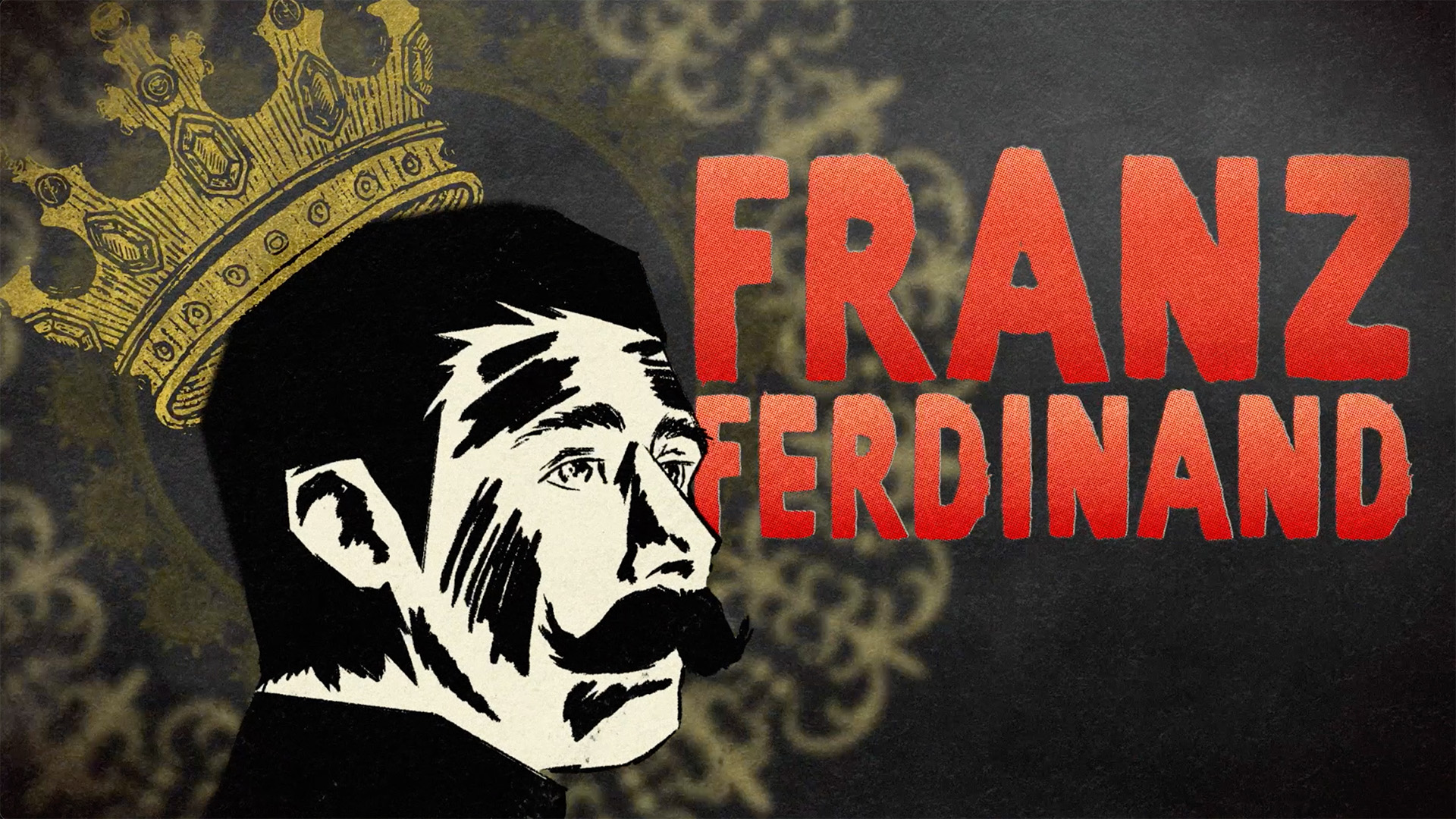
The assassination of Archduke Franz Ferdinand launched the First World War. But what if the assassin's bullet had missed? Well, it turns out, it did…a few different times. If he had escaped, would the war still have happened?
Think about the following questions as you watch the video
What is the Balkans and why was it important in the nineteenth century?
Who was Gavrilo Princip and what did he want?
What were the fateful mistakes that the Archduke and his staff made that ended in his assassination?
How did the killing of the Archduke lead to World War I?
What were some other causes of World War I other than the assassination?
: One June morning, a guy by the name of Franz Ferdinand, who just happened to be the heir to
: the powerful Austro-Hungarian Empire, went for a ride in an open-topped car. Little did he know,
: that choice would ultimately cost him his life- and plunge much of the world into World War I.
: But wait, that's only half the story, because the assassination of Franz Ferdinand almost didn't
: happen. So, we have to ask: if Franz Ferdinand hadn't been assassinated that fateful day,
: would World War I have happened at all? It all started in Bosnia, in the Eastern
: European region of the Balkans, which also included countries like Serbia, Albania,
: and Bulgaria. The Balkans were a hot topic in Europe, and had been for decades, because
: basically everybody wanted to control them- including Bosnians themselves. In the mid 1800s,
: there was tons of war and conflict over the
: all the biggest powers in Europe tried to solve it with some reshuffling. Like giving Russia's
: ally, Serbia, independence from the declining Ottoman Empire. But also handing its neighbors
: Bosnia and Herzegovina over to Austria-Hungary, so Russia wouldn't get too powerful over there.
: Which the people who lived there had some hard feelings about. So when Austro-Hungarian Franz
: Ferdinand showed up in Bosnia on June 28th, 1914, things were kind of tense. Nineteen-year-old Gavrilo
: Princip certainly thought so. Princip was from Bosnia, but he was also a Serb, a member of a
: Slavic ethnic group that lived in Serbia and other parts of the Balkans. And when he heard about
: Franz Ferdinand's upcoming visit to Sarajevo, the capital of Bosnia, he was not interested in giving
: him a warm welcome. See, Princip was believed to be a member of the Black Hand, a secret society
: that wanted to undermine Austro-Hungarian rule by unifying the Balkans under Serbian rule instead-
: and they weren't afraid to use violence to do it. So when he got wind of Franz Ferdinand's upcoming
: visit, Princip, along with Black Hand member Nedeljko Cabrinovic, came up with a plan to stop him. Now,
: the Black Hand's specific involvement in the incident is somewhat debatable,
: but we do know they provided both weapons and training to Princip and Cabrinovic,
: as neither were trained assassins. Or had any experience in combat, for that matter. But they
: got a lucky break: the archduke's travel route through Sarajevo was published in the papers before
: the diplomatic tour kicked off. It was a golden opportunity for Princip and his collaborators-
: and the first in a series of fateful mistakes that changed history. Together, the would-be assassins
: examined the archduke's route and planned out a series of assassination attempts that would occur
: at different points along the tour down the Appel Quay. Before they knew it, it was the big day:
: June 28th. As the assassins made their way through the streets of Sarajevo that morning,
: Princip and Cabrinovic were taking a huge risk. The archduke's tour was so unpopular with
: the locals that the government, police, and even Franz Ferdinand himself feared that there might
: be assassins lying in wait for him. But instead of beefing up security, in an effort to make the
: Bosnian people feel safe, welcomed, and close to the crown, Franz Ferdinand and his team minimized
: the police and military presence, stationing a measly 150 or so police officers across the entire
: four-mile parade route. Fateful mistake number two. As the archduke's open-topped car drove past
: the crowds- another terrible idea! Cabrinovic saw his opportunity. He threw a grenade, which
: bounced off the back of the archduke's car and exploded, injuring members of the entourage and
: innocent bystanders. But, like something out of a slapstick cartoon, Franz escaped without
: a scratch, while his wife, Sophie, suffered only a cut on her cheek. Even though they were shaken,
: Franz and Sophie attended a scheduled reception, then visited those wounded in the attack at the
: hospital. Afterward, they continued the tour, but decided to change up the route to throw potential
: attackers off their trail. But in Fateful Mistake Number Three, after they left the hospital,
: for some reason the drivers went back to the original route. You know, the one full
: of assassins. By the time they figured out they'd made a mistake, it was too late. Princip was still
: laying in wait. He took aim at pointblank range, fired two shots, and killed Franz and
: Sophie nearly instantly. And from there, things got really ugly really quickly. On July 28th,
: 1914, exactly one month after the assassination of Franz and Sophie, the Austro-Hungarian Empire
: officially declared war against Serbia, who they blamed for killing their future emperor. Like
: dominoes, political allies on either side quickly joined in the fray, with Russia backing Serbia, and
: Germany backing Austria-Hungary, and France backing Russia, and Britain backing anyone but Germany, and
: then the Ottomans backing anyone but Russia- and before you knew it, a series of little mishaps on
: one morning in June blew up into a world war. So, looking back, it definitely seems like Princip's
: assassination of Franz Ferdinand that day caused the whole mess that was World War I. But the
: assassination itself was kind of a mess. So, what if it hadn't worked out? What if the Austrians
: hadn't published the archduke's travel route beforehand? Or the assassins had been caught by
: the police? Or Princip had missed? Would World War I just never have happened at all? To answer that,
: we need a little more context on exactly what was going down at the time. Cause remember, the
: whole region of the Balkans around the turn of the 20th century was pretty messy. See, in the early
: 20th century, the Second Industrial Revolution was launching the world into the modern era and
: putting major pressure on the empires of Europe who needed ever increasing resources to fuel
: their industrial growth. Expansionism was the name of the game, with Great Britain, France, Germany,
: the Ottoman Empire, Russia, and Austria-Hungary all in fierce competition for territories. Empires
: built more ships and weapons to do all their conquering, made alliances in case they had to
: go to war with other empires, and pushed around borders- especially in the Balkans. And handing
: Bosnia over to Austria-Hungary didn't really help matters. By 1914, places like Bosnia and Serbia
: had been tossed back and forth between empires for literally hundreds of years. And they were sick of
: it. To push back, a lot of them turned toward nationalism- the idea that countries should be
: made up of- and governed by- people with shared culture, history, and identity. Nationalists
: thought people groups- like, say, Serbs- should unite under a common government without
: interference of empires like Austria-Hungary. Some groups, like the Black Hand, thought they should
: do it by any means necessary. It was a recipe for violence, and on that fateful day in 1914, that's
: exactly what it created. But as imperial rivalries pushed against rising nationalism, violence was
: in the cards for Austria-Hungary and the Balkans long before Franz Ferdinand booked his ticket for
: disaster. And even if Princip hadn't managed to assassinate the archduke, in the face of Serbian
: nationalism, the threat of Russian expansion, and the general vibe of impending imperial rivalry,
: one empire or another probably would have found some other reason to declare war. All of which
: means World War I could have happened anyway, no matter the precise spark that lit the powder
: keg. World War I raged on for four years, from 1914 to 1918, resulting in staggering death tolls of
: nearly 10 million soldiers and around 13 million civilians. All this thanks to the assassination
: of one man- and years of bubbling tensions and bad political decisions, of course. And that's how a
: lot of history's biggest moments have played out: in a perfect interplay of long simmering tensions,
: poor decisions, and surprising coincidences, where a single spark, like the assassination of