Anthropocene

Driving Question: How has human activity changed our planet?
Data from the last 250 years suggests that the biosphere is changing, and humans are the ones causing that change. In response, some scientists believe we are living in a new geological epoch—the Anthropocene.
Learning Objectives:
- Describe the key features of the Anthropocene.
- Evaluate the impact of humans on our climate and planet.
- Explain the causes and impacts of climate change.
Vocab Terms:
- Anthropocene
- climate
- environment
- globalization
- population
- technology
The Anthropocene holds some real challenges for humanity. To understand it, we must start by thinking once again about energy.


When learning about the Anthropocene, it’s easy for students to get bogged down in the negatives. Help them regain a sense of optimism with this lesson in OER Project: Climate.
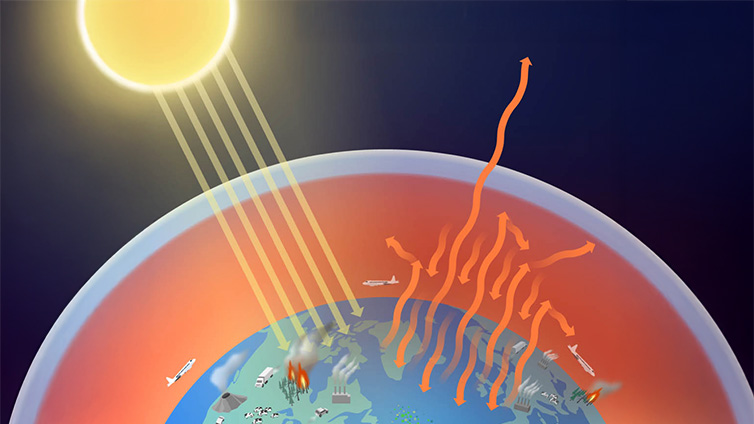
It might seem impossible that humans could change the weather of the vast planet we live on. But, as this slideshow and activity show, even the smallest actions can have big consequences down the line.
The Anthropocene Explained




Give students ideas about the solutions we have and the ones they one day might help create in Lesson 4.2 from OER Project: Climate.
Climate change is the greatest challenge of our time. But it’s not a lost battle. Let’s explore how it’s happening, and what we can do about it.
-
Guiding Questions
-
Before you read
Preview the questions below, and then skim the article. Be sure to look at the section headings and any images.
While you read
Look for answers to these questions:
- How did Earth’s changing climate impact the Agricultural Revolution?
- What is the Holocene epoch?
- What causes climate change?
- What does decarbonization mean?
After you read
Respond to this question: What steps could you take to help combat climate change?

We’re doing math in a social studies class? Absolutely! Students learn about the history of maize, globalization, and the Anthropocene before they break out their math skills to calculate the distances their food travels.
The first question complex societies had to answer to become more stable and prosperous was how to reliably grow food. It might also be the most important question we’ll need to answer if we’re going to survive the Anthropocene.
-
Guiding Questions
-
Before you watch
Preview the questions below, and then review the transcript.
While you watch
Look for answers to these questions:
- How did maize transform societies in the Americas?
- How did maize transform societies in Afro-Eurasia?
- How has maize/corn become an essential crop in our world today?
- How might maize/corn help sustain food production in an era of climate change?
- What does Michael Blake mean when he says, “Humans grow maize and maize grows humans”?
After you watch
Respond to this question: How does the history of maize help you understand both the increasing complexity and fragility of the world’s food supply?

The Unit Notebook is a great opportunity to formatively assess students’ understanding of the core concepts in the unit. They also get to practice informal writing. For more support on informal writing, including its benefits, check out the first two pages of the Writing Guide.
You know the drill: It’s time to sum up what you’ve learned about the most eventful period in human history. No sweat, right?