
“Up the long, delirious, burning blue”: A history of humanity’s cosmic aspirations
Humanity just boldly went where no one has gone before…
A bit.
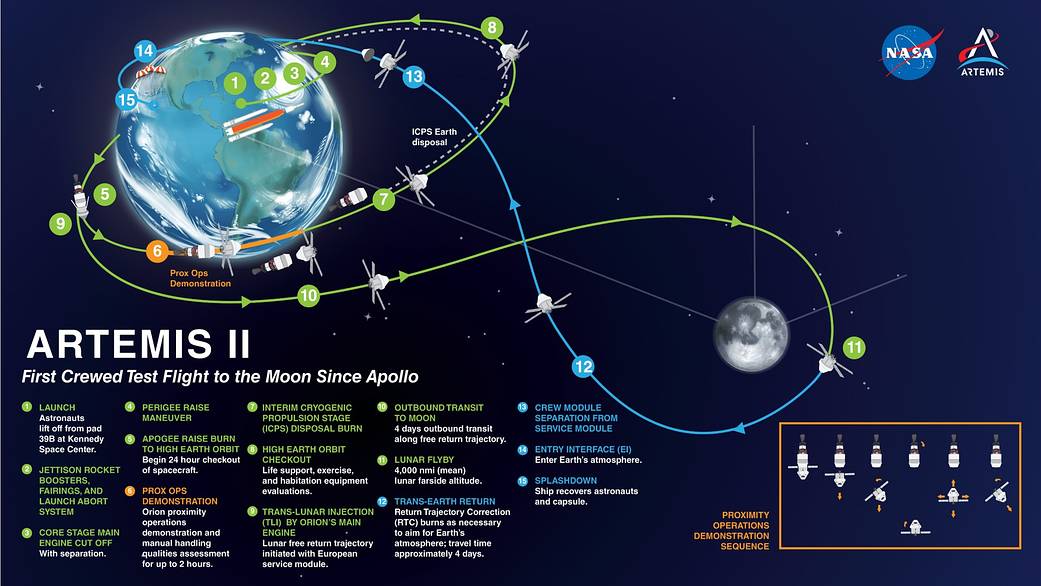
On April 1, the Artemis II spacecraft set out on a voyage to the Moon—the first crewed flight there in 50 years. This voyage, which includes a circuit around the Moon, is the farthest a human has ever traveled into space. It’s been more than 55 years since humans first stepped on the Moon. And yet, despite all our remarkable technological progress, humans have traveled no farther than that. In fact, no human has left low Earth orbit since 1972. Until Artemis II, the farthest we’ve ever traveled from Earth was during Apollo 13’s slingshot around the Moon—and that was an unplanned, desperate maneuver.
Artemis II is a test. It’s part of NASA’s attempt to prove that we can still land and bring home a crewed Moon mission. (You know, like we did half a century ago.) Four astronauts—three Americans and a Canadian—took 10 days to fly around the dark side of the Moon and back. They ran observations and experiments on the effects of space travel on humans and tested life-support systems.
But why?
Why go to the Moon? Why spend money, time, resources, and risk human lives on space exploration when there are monumental challenges here, on this planet? But also, why have our cosmic horizons stalled? Why have we taken this long to return humans to the Moon? Why haven’t we reached Mars?
If you’re teaching Unit 7 of Big History or teaching about the Cold War Space Race, this is a great question to pose to your students, and the Artemis launch provides a nice current-events hook. To grapple with the questions around the “why” of space travel, funding, and science, it’s useful to look at the long history of how humans have imagined our place in space and the methods we might use to get there.
From imagining to reality: The long history of space travel
All human cultures have looked to the skies and imagined what the cosmos holds. One answer to “Why do we go to space?” is that it is somehow in our nature—that our species has, for a very long time, imagined what it would mean to stand in a lunar crater or meet strange creatures at the summit of Olympus Mons.1 For almost all human history, the stars, planets, and moons of our Universe were lights in the sky that we could not grasp.
The Moon in particular has held the imagination of writers. Lucian of Samosata’s A True History, the Chinese story of Chang’e, and the Japanese Tale of the Bamboo Cutter each offer mythical imaginings of lunar travel. Many other ancient and medieval authors imagined fantastical voyages to the Moon and beyond.
The Scientific Revolution changed how humanity saw space. Galileo’s improvements to the telescope literally changed how we saw the Solar System, revealing craters on the Moon and more. The advances of this era transformed space from a mythical heaven reserved for gods into a physical place governed by natural laws—a place that could be studied and visited by humans acting on their own devices. In his 1608 novel Somnium, the German astronomer Johannes Kepler wrote about travel to the Moon. His narrator describes the view of the Earth from the lunar surface. In 1656, Athanasius Kircher wrote Itinerarium Exstaticum, in which the narrator conducts a tour of binary stars on circular orbits.
A major turning point was Cyrano de Bergerac’s seventeenth-century novel, Comical History of the States and Empires of the Moon. This early work of science fiction was the first to imagine rocket-powered spaceflight, and it was the first to depict travel on a human-made machine rather than via supernatural phenomenon. In contrast, Kepler’s voyage was powered by demons and Kircher’s by angels.
During the nineteenth century, science fiction took flight, and writers began to theorize about the physical processes it would take to get to the Moon and back. In 1865, Jules Verne wrote From the Earth to the Moon. In this prescient story, three astronauts take off from Florida in an aluminum capsule blasted from a large cannon. They orbit the Moon and return to Earth, where they splash down in the Pacific Ocean. Meanwhile, writers like H.G. Wells and Thea von Harbou began to imagine the basics of rocketry.

.jpg#/media/File:Around_the_Moon_(151484266).jpg)
By the early twentieth century, thinkers were grappling with the realities of space travel. Konstantin Tsiolkovsky and others in the cosmism movement were advocating for space colonization. Tsiolkovsky’s 1903 Exploration of Outer Space by Means of Rocket Devices laid the theoretical foundations for cosmonautics and the Soviet space program. Tsiolkovsky devised theoretical designs for airlocks, multistage rocket boosters, and life-support systems.
In 1926, inspired by science fiction authors like H.G. Wells, Robert Goddard invented and launched the first liquid propellant rocket in Massachusetts, pioneering the designs that would send NASA to the Moon 40 years later. At the same time, German scientists like Hermann Oberth were designing the rockets coveted by Hitler. After 1945, Oberth, along with 1,600 other former Nazi scientists, including Wernher von Braun, arrived in the US during Operation Paperclip to work for NASA.
The work of imagining space exploration continued on the page—and on the screen, with TV programs and movies like Star Trek and Star Wars. But by the second half of the twentieth century, space exploration had become reality.
The dawn of the Space Age
In 1957, the Soviet Union sent Sputnik 1 into orbit, launching the Space Age. In 1961, Yuri Gagarin became the first human to enter space. He was preceded by other terrestrial life forms, including fruit flies, a monkey, a chimpanzee, and a very good dog.2
During the Space Race between the US and USSR, each nation sought the prestige and strategic leverage of extraterrestrial superiority. Two images emerged from the Space Race that forever transformed how we saw ourselves and our fragile world. First, in 1968, astronauts aboard Apollo 8 snapped the photo called “Earthrise”—humanity’s first selfie. The other photo, called “The Pale Blue Dot,” was taken in 1990 by Voyager 1, from 3.7 billion miles away. It shows Earth as a tiny speck. Carl Sagan wrote, “That’s here. That’s home. That’s us. On it everyone you love, everyone you know, everyone you ever heard of, every human being who ever was, lived out their lives… on a mote of dust suspended in a sunbeam.”
But, why?
Why explore space? Why return to the Moon at all? From rocket fuel’s impact on the environment and the overwhelming amount of space debris already in orbit to the dangers posed to human life and the very real threat that more space exploration could lead to the militarization of space, there are plenty of reasons not to go. One claim that gets thrown around a lot is that space exploration is too expensive. But most people drastically overestimate this. In truth, NASA funding is a fraction of the federal budget—just 0.35% in 2025. The 2008 bank bailout was more expensive than funding NASA—for its entire 50-year existence up to that point.
There are plenty of good reasons why proponents—like Bill Nye and the Planetary Society—argue we should continue space exploration. First, in 1 billion years, our Sun is going to expand and strip Earth of everything that makes it habitable. Eventually, humanity will need a couch to crash on. Of course, our species is notoriously short-sighted, and the eventual heat death of our distant descendants is unlikely to motivate us.
There are other, more sanguine reasons why we should reach for the stars: We need to track and defend against the many asteroids and comets that could threaten Earth. Space holds vast wealth for those able to grasp it. Asteroid mining could offer solutions to shortages here. Tourism and private profit have long provided motivations for development. And though there is lots of talk about national security, the Space Force, and the weaponization of space, there is also opportunity for international cooperation. The harsh realities and untold potential of space travel sometimes inspires our better nature. Today, in 2026, Russian cosmonauts and American astronauts work side by side aboard the International Space Station, even as their governments fight proxy wars on the ground below.
The most convincing argument in favor of space exploration is the scientific advances it has already produced. Consider this, the next time you wonder what’s the point of space travel: In the seven decades that humans have been able to travel to space, we have spent a total of just 12 days on the Moon. And yet, thanks to the Apollo missions, we have CAT scans, MRI machines, and mass-produced microchips. Even dustbuster vacuums were based on a tool invented for lunar exploration. Humans have never visited Venus, but our probes have, and in the 1970s, the data they returned led to the discovery that chlorine destroys ozone and that CFCs (the stuff used in twentieth-century refrigerants and aerosols) were creating a hole in Earth’s ozone layer. By the early 2000s, CFCs were banned, and the hole started to shrink.
Last, but certainly not least, is the argument that space travel is just inspiring. The Moon landings of the twentieth century inspired a generation of scientists—not to mention some great music. From Lucien and Kepler to Jules Verne and Carl Sagan, the promise of the stars and the Moon has inspired humanity to create works of art, and has pushed our collective knowledge across new boundaries. In September 1962, at the very height of the Cold War, President Kennedy explained the “why” of space exploration:
“We choose to go to the Moon. We choose to go to the Moon in this decade and do the other things, not because they are easy, but because they are hard, because that goal will serve to organize and measure the best of our energies and skills…”
It can be tough to get jazzed about another trip around the Moon. Telescopes like James Webb have given us a window into the early Universe and shown us close-ups of galactic marvels. Hundreds of our robots and probes have visited the surfaces and atmospheres of the planets and Moons of our Solar System. But we humans have remained tethered to Earth’s orbit. We were supposed to have done more by now.
In some ways, space feels farther away than it did 50 years ago. In the late 1980s, NASA imagined a permanent lunar base by the early twenty-first century, with ambitions of using it as a way station on the journey to Mars. In 2026, does achievement of that dream seem any nearer? The average American middle schooler today holds millions of times more processing power in their pocket than Neil Armstrong used to land on the Moon. And yet, it seems we have lacked the political will to dedicate our accelerating technology to the task of space travel. Will the Artemis missions spark a new imagination and galvanize our political will to explore?
1 Not all cultures value exploration. A great many have suffered because of explorers arriving on their shores. Still, humans move. All our ancestors migrated to new places in search of food and safety.
2 RIP, Laika.
About the author: Bennett Sherry holds a PhD in history from the University of Pittsburgh and has undergraduate teaching experience in world history, human rights, and the Middle East. Bennett writes about refugees and international organizations in the twentieth century and is one of the historians working on the OER Project courses.