Assessing the Dark Ages

Driving Question: Did Europe go through a dark age after the fall of the Roman Empire?
When historians call this period the “Dark Ages,” they’re usually talking about Europe. And that’s where we’ll start—but there’s a big world beyond Europe. We’ll try to figure out if the medieval period in Europe was really a dark age and evaluate how other societies around the world responded to collapse.
Learning Objectives:
- Analyze the extent to which Europe experienced a period of societal collapse following the fall of the Roman Empire.
- Evaluate historical debates surrounding the Dark Ages in Europe and beyond.
Vocab Terms:
- administrative
- aristocracy
- bureaucrat
- clergy
- feudalism
- pluralism
- province
You’ve heard the term Dark Ages before, but what does it mean? Was it truly dark, or is the story more complicated?


Fun fact: Most medieval historians hate the terms Dark Ages and feudalism, with some calling the latter “the F word” because they think it’s a misleading and overly simple term.
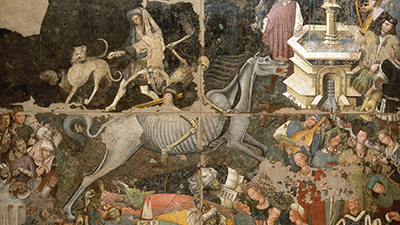
There’s a common misconception that after the fall of Rome, Europe descended into darkness and chaos, and that all learning was lost. But this myth has its origins in thinkers of the Renaissance and Enlightenment periods. Those thinkers thought of themselves as reviving the glory of the ancient Greeks and Romans. So they portrayed the medieval period as “dark” and “backward” to make their own era look more advanced. In reality, medieval Europe had major developments, including universities, technological advances, stunning architecture, and legal systems.
Evaluate the evidence you’ve encountered in this lesson and take sides in the debates about the Dark Ages.
-
Guiding Questions
-
Before you read
Preview the questions below, and then skim the article. Be sure to look at the section headings and any images.
While you read
Look for answers to these questions:
- Who first described Europe after the fall of Rome as being “dark,” or backward?
- What was Edward Gibbon’s contribution to the idea of a “dark age?”
- How might English Heritage’s description of Tintagel Castle provide evidence against the idea of a “dark age”?
- What does Alban Gautier think of the term Dark Ages?
- How were the views of eighteenth-century authors such as Edward Gibbon shaped by the times they lived in?
After you read
Respond to this question: Can you think of any ways that people today might use the idea of a dark age (or golden age) to suit their own agendas?

-
Guiding Questions
-
Before you read
Preview the questions below, and then skim the article. Be sure to look at the section headings and any images.
While you read
Look for answers to these questions:
- What were the political effects of the fall of the Western Roman Empire?
- What intellectual achievements occurred during the medieval period?
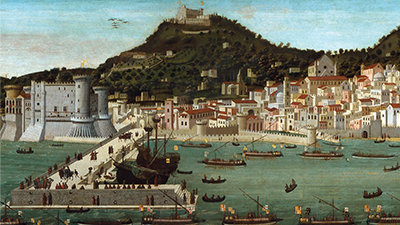
- How do cities provide evidence that medieval Europe wasn’t experiencing a dark age?
- Did China have a dark age?
- How did the Afro-Eurasian population change from 476 to 1176 CE?
After you read
Respond to these questions: Do you think labeling the medieval period a “dark age” is useful or accurate? Why or why not?


Are you looking for a little background information on the Viking Age? Check out this blog post. The Viking Age is a great place to help students think through the historical debates about the Dark Ages. On the one hand, these were really bad times for many people as migrations pushed raiders into Europe from the north, south, and east. At the same time, these often-brutal interactions also forged new connections and kicked off monumentally important social changes in European society.
To help support you, we also have a detailed map that explores the long-distance connections of the Viking Age. Also, check out the Swedish History Museum’s great online resource that features digital explorations of several types of Norse artifacts.
The Vikings may have gotten a bad rap. It’s your turn to evaluate their accomplishments and decide if they need a new publicist.
-
Guiding Questions
-
Before you watch
Preview the questions below, and then review the transcript.
While you watch
Look for answers to these questions:
- How were the Vikings able to quickly maneuver along waterways to strike unsuspecting cities?
- Why is the 930 CE creation of Iceland’s Althing important?
- Where did the Vikings travel, colonize, raid, and trade?
- What did the Vikings trade with the Abbasid Caliphate?
- How did the Vikings impact medieval Europe?
After you watch
Respond to this question: Why do you think the Vikings are remembered mainly for their raiding rather than their exploration, settlements, and trade?

You’ve learned about debates surrounding the so-called Dark Ages. In this activity, it’s your turn to weigh in—did Europe experience a dark Age after the fall of Rome?