Our website uses cookies to understand content and feature usage to drive site improvements over time. To learn more, review our Terms of Use and Privacy Policy.
The Vikings are best known for their violent raids throughout Europe, but their accomplishments extend far beyond raids, and their influence extends thousands of miles from their Scandinavian homeland.
Think about the following questions as you watch the video
How were the Vikings able to quickly maneuver along waterways to strike unsuspecting cities?
Why is the 930 CE creation of Iceland’s Althing important?
Where did the Vikings travel, colonize, raid, and trade?
What did the Vikings trade with the Abbasid Caliphate?
How did the Vikings impact medieval Europe?
: Picture a bloodthirsty, axe-wielding barbarian in a horned helmet, ready to pillage and plunder,
: and you've got yourself the classic image of a Viking. But it's almost entirely wrong. An
: account written by their victims. Yes, they were terrifying raiders, but the real Norse
: were master engineers, farmers, and merchants who rewired Europe's political map and forged
: trade highways all the way to the Silk Road. I'm Stu from Debunked, and we've teamed up with the
: OER Project to explore the real Viking Age. In 793, Viking raiders made an everlasting mark in
: the history books when they brutally ransacked a monastery in England, sending shockwaves through
: Christian Europe, and solidifying the notion of the Vikings as bloodthirsty marauders for centuries to
: come. Indeed, there are many similar recorded raids all along the Northern coast of Europe,
: right down to Southern Spain. Monasteries and other religious institutions, being both rich
: in material wealth and often poorly defended, were frequently targeted. A major assault happened in
: the year 843 when several shipfuls of Vikings journeyed up the Loire River and ransacked the
: entire Fankish city of Nantes, and just over 40 years later, in 885, thousands of Vikings laid siege to
: the then tiny city of Paris. Part of the reason the Vikings were able to carry out these raids was
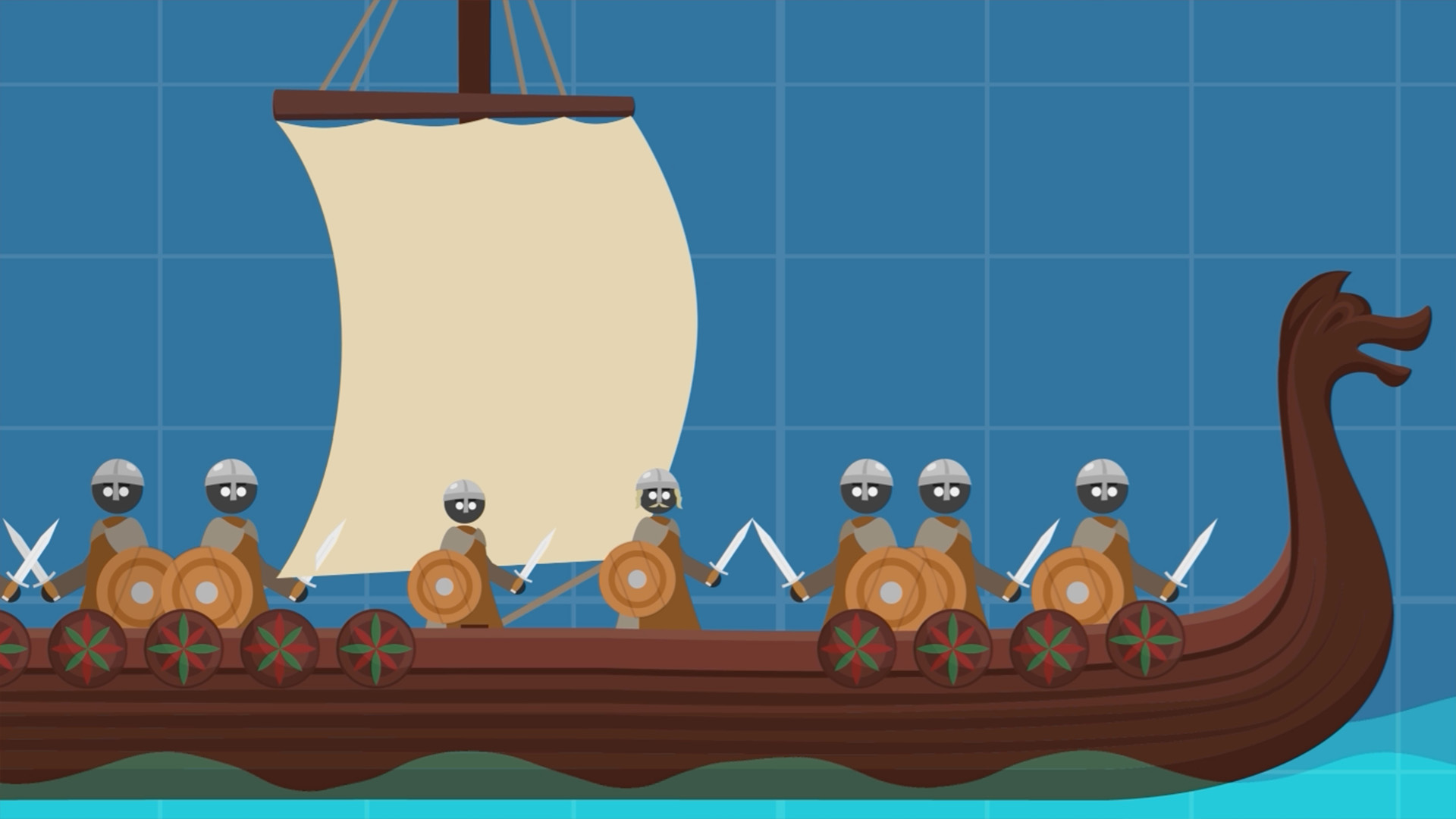
: due to their innovative ship-building capabilities that led to the development of the classic Viking
: longships. These vessels were built to be lightweight, speedy, and incredibly versatile.
: Massive sails took them across the open ocean, while a flat, shallow draft let these heavy
: warships glide over coastal sandbars and travel hundreds of miles inland up shallow rivers. If
: the wind died down, they rowed against the current. They were also double-ended, allowing them to
: easily reverse direction without the need to waste time turning around. These attributes
: were key to the Viking's smash-and-grab raiding strategy, making it possible to sail deep inland,
: strike without warning, and escape well before reinforcements could arrive. Still, raiding and
: pillaging isn't all there was to the Vikings. The word 'Viking' is actually an exonym—an occupational
: description for piracy. Calling all Norse people 'Vikings' is a little like calling everyone in 19th-
: century America 'Cowboys.' 'Viking' also does not denote a single ethnicity; of the Old Norse
: people who originally made up their ranks, there were many different groups, tribes, cultures,
: and communities taking part. Most Norsemen spent their lives as farmers, fishermen, or craftsmen.
: And those who did go raiding usually did so as a seasonal activity, often only once or twice in
: their lives. The expert sea-faring of the Vikings was not just useful for carrying out violent
: raids. Their shenanigans in and around Europe are pretty well-known, but you might be surprised
: to hear how far they actually got. Sailing westwards, the Vikings settled and colonized
: a largely uninhabited Iceland in the late 9th century. And they didn't just build farms there—
: they built a democracy. In 930, they established the Althing, which is widely considered the
: oldest surviving national parliament in the world. Journeying further, after Erik the Red was exiled
: from Iceland, they reached Greenland. Now, you've probably heard that the Vikings swap the names of
: Iceland and Greenland to confuse enemies. Great story, but a total myth. Iceland got its name from
: a Norseman named Flóki who survived a terrible winter there, saw a fjord full of drift ice
: (ironically from Greenland), and named the island as he saw fit. Greenland's name, on the other hand,
: was a deliberate trick, by Erik the Red, he wanted to be a king not a castaway, and so lured
: land-hungry settlers to his inhospitable land, establishing the first Norse settlement in 986.
: Shortly after, around the turn of the millennium, Erik's son, Leif Eriksson, sailed further west,
: ultimately becoming the first European to step foot in continental North America. His arrival
: predates the famous voyage of Christopher Columbus by nearly 500 years. Their expansions elsewhere
: are less well-known, but equally impressive. First reaching the Northern coast of Africa. Then
: stretching eastward, navigating deep inland via rivers like the Dnieper (nee-puh) and Volga, groups carried out
: raids and forged trade networks reaching the Black and Caspian Seas. These trade routes connected
: them to the Far East. In fact, archaeological excavations in Sweden have unearthed an Egyptian
: christening scoop, Chinese silk, and even a 6th-century Buddha statuette from Kashmir, in what is
: now India. This material evidence of the Vikings' reach across multiple continents provides a more
: expansive and less sensationalized account of the Viking Age. But beyond exotic artifacts, the true
: economic engine driving this eastern expansion was a massive flow of Islamic silver. In fact,
: over the last few centuries, archaeologists have pulled more than 200,000 silver dirhams in various
: hoards across Scandinavia, and it's estimated that over a billion coins may have flowed into
: the Viking world. By trading furs and enslaved people to the Abbasid Caliphate, Norse merchants
: weren't just raiding, they were building a highly lucrative transcontinental network.
: While their reputation as bloodthirsty warriors certainly has foundation in truth,
: many of the people we would today collectively refer to as 'Vikings' were not just violent raiders,
: but farmers, merchants, and explorers, establishing vast trade networks and exploring a
: then unknown world. While some globetrotting cultures made a point of not mingling with the natives,
: the Vikings suffered from no such hang-ups. Many Vikings eventually settled permanently outside of
: their traditional homelands, intermarrying with the locals and adopting parts of their culture, if not
: assimilating completely. These voyaging Vikings founded cities, various early states, and a number
: of kingdoms; while some of these, like Danelaw, the Kingdom of the Isles, or the short-lived North Sea
: Empire no longer exist, many still survive to this day. The European cities of York, Dublin,
: and Novgorod were all founded by Vikings, and large areas of Eastern Europe were also settled
: by Norse people, especially those from Eastern Sweden. These Viking warriors came to be known
: as Varangians, many of whom served as mercenaries in the Byzantine Empire and even helped found the
: Kievan Rus, from which several countries like Russia, Belarus, and Ukraine ultimately descend.
: The longest lasting impact they had on medieval Europe wasn't through direct settlement, however.
: The frequency and ferocity of Viking raids like the attack on Lindisfarne compelled a response
: from the kings and rulers of Europe, who were forced to invest in defense and raise armies. This
: often led to political centralization as smaller political entities united simply as a means to
: protect themselves, and in turn, precipitated the development of modern nation-state. If that
: wasn't enough to convince you of the Vikings' influence on the medieval and modern worlds,
: consider the British monarchy. Which ultimately traces its lineage back to the Norman conquest
: led by William the Conqueror. The Normans were themselves the descendants of Norsemen. The clue
: is in the name. With William a direct descendant of Rollo, one of the Viking leaders who carried
: out the 885 Siege of Paris. The Vikings were, without doubt, a formidable force in
: the early medieval period. Though their fearsome reputation is well-deserved,
: the Vikings were more than just the stereotypes we now associate with them. Their technological
: innovations in both ship-building and sea-faring, took them further than any European had ever
: been at the time, and wouldn't again for centuries. While their far-reaching trading routes, efficient