Welcome to Big History


Driving Question: How does learning about the history of the Universe help us understand the world today?
Big History covers the 13.8-billion-year story of the Universe—that’s a lot of time and space! But what does that have to do with today? Let’s explore how Big History is different from other history courses.
Learning Objectives:
- Evaluate how Big History is unique.
- Define thresholds of increasing complexity.

Openers are quick, fun ways to activate prior knowledge, reveal student misconceptions, and prepare students for what’s coming in the lesson. In this short opener, they’ll decide what history means to them. Remind them that there’s no “correct” answer here!
Okay sure, so this is a different kind of history class—but what is history anyway?


The Unit Notebook is a great opportunity for informal writing. Informal writing helps solidify ideas and support retention and understanding of concepts, events, and eras. For more support on informal writing, including its benefits, check out the first two pages of the Writing Guide.
You’re going to learn a lot in this course—and you’ll use the Unit Notebook to keep track of how your thinking is changing. Let’s see how!


Did you know that each article in the course is available in multiple Lexile levels and has an audio version to help support student learning and literacy? Choose different Lexile levels using the Version drop-down menu in the upper-left corner of the article, and access the audio by clicking on the speaker icon in the upper-right corner. Find more reading supports on pages 3–5 of our Reading Guide.
What makes Big History so, well, big? Dig into the activities and article below and ask some important questions.

-
Guiding Questions

Understanding and remembering the Big History thresholds can be challenging for students. In this community post, Big History teachers share ideas and resources to help students remember this core concept, including ways to get kids moving around the classroom and sharing the thresholds with others, and a threshold goal-setting activity to help this concept stick.
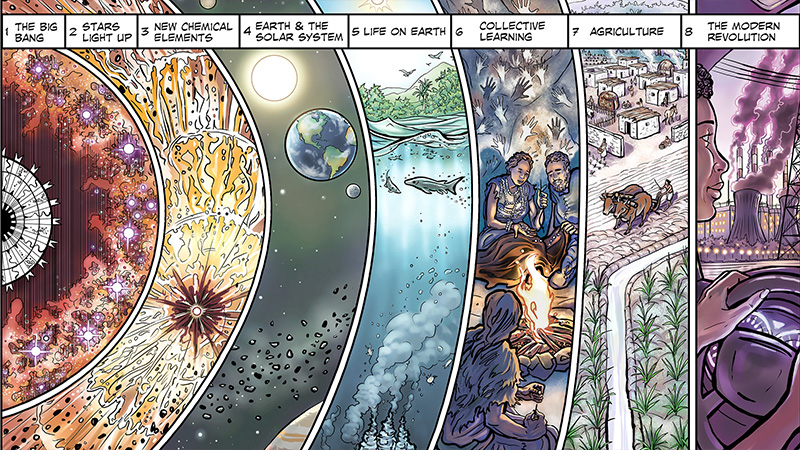
The Universe today is pretty complicated: stars, planets, plants, people, you. But it used to be very, very simple. Examine the images and comic below and consider: what changed?
The Thresholds Gallery


Thresholds aren’t just for Big History. Think through the thresholds that have shaped your life and made you more complex.

Want to inject a little more fun into this closer? Ask students to make a tagline for the threshold they created in the My Threshold activity. Then, have them create a movie trailer using their threshold and tagline.
Companies create catchy taglines to promote their products. What’s your Big History tagline?