Cookie Policy

Our website uses cookies to understand content and feature usage to drive site improvements over time. To learn more, review our Terms of Use and Privacy Policy.

OER Logo

Lesson 3.2 Vocab

  • a
  • b
  • c
  • d
  • e
  • f
  • g
  • h
  • i
  • j
  • k
  • l
  • m
  • n
  • o
  • p
  • q
  • r
  • s
  • t
  • u
  • v
  • w
  • x
  • y
  • z
adaptation
Jump To Navigation
Definition

Responding to the current and future impacts of climate change to minimize harm.

Use In A Sentence

Being able to blend into the environment is an adaptation called camouflage.

aquaculture
Jump To Navigation
Definition

The breeding and harvesting of fish, shellfish, and other aquatic organisms for food and other purposes.

Use In A Sentence

The Earth’s changing climate is creating a lot of problems for aquaculture, especially for less wealthy farmers in regions most severely impacted by the climate crisis.

Climate Information Services (CIS)
Jump To Navigation
Definition

Tools that collect and share regional climate information so people can manage local risks and problems and adapt practices.

Use In A Sentence

Using Climate Information Systems, researchers work together with farmers to establish climate-smart procedures to make farming more resilient and sustainable.

geothermal
Jump To Navigation
Definition

An energy source or heating and cooling system that uses the Earth’s natural heat.

Use In A Sentence

Geothermal heating systems can reduce reliance on fossil-fuel-powered systems.

resilience
Jump To Navigation
Definition

The ability to withstand, adapt to, and recover from challenges or disruptions.

Use In A Sentence

A community facing sea-level rise could relocate critical infrastructure—like energy generation plants or transportation networks—to higher ground to increase resilience.

weatherization
Jump To Navigation
Definition

The process of sealing and insulating building envelopes to regulate building temperature during extreme weather and reduce a building’s energy needs.

Use In A Sentence

Through the process of weatherization, old buildings can often be renovated to be more insulated and let less heat in and out.

Climate Change Adaptation

Driving Question: How can we adapt to climate change?

Explore the ways that we can respond to the impacts of a warming planet. Research and assess adaptation solutions to decide where to focus our efforts to make the biggest difference in reducing the impacts of climate change.

Learning Objectives:

  1. Evaluate different adaptation strategies.
  2. Identify solutions that will benefit the most people.
  3. Research and advocate for an adaptation strategy.
STEP 1

Opener: Climate Change Adaptation

How can we effectively address the impacts of climate change? Explore the connections between climate effects and the strategies designed to tackle them.

STEP 2

Where Can We Adapt?

Teaching Tools

This visual aid will help students with the activity—but it can also be a helpful reference as students explore additional adaptation solutions throughout the lesson.

What do we mean when we talk about adaptation? Use the graphic to help answer the questions in the activity.

STEP 3

How Should We Adapt?

Teaching Tools

In this course, we evaluate climate solutions based on the criteria of time, cost, and impact potential.

The article “How Can We Take On Climate Change? External link ” from the previous lesson helps students understand the difference between adaptation and mitigation solutions.

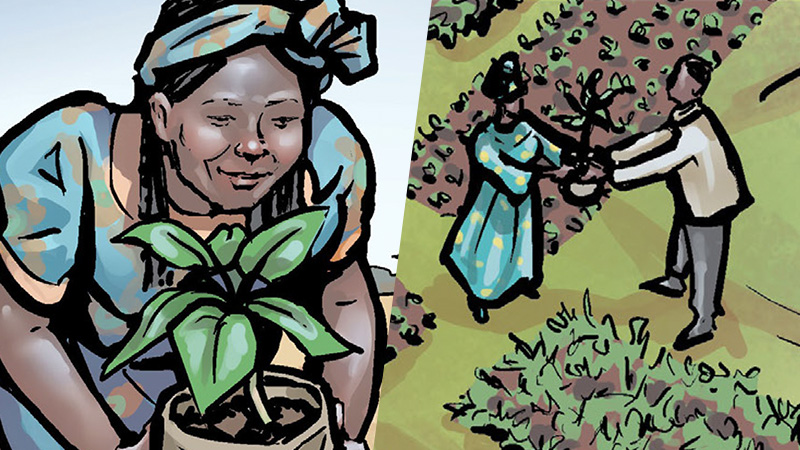
We’re already feeling some impacts of climate change, so what can we do? Read the article and graphic biography to explore adaptation solutions, and then apply what you’ve learned as you evaluate solutions in the activity.

STEP 4

Weather Intelligence

Teaching Tools

If you haven’t already done the activity Claim Testing: Evaluating Authority, we recommend you complete that intro lesson before completing this activity.

Watch the video to explore one promising adaption solution to build economic and food security for people most at risk to climate change. Then, use the activity to practice testing the claims you heard.

Why Fish Farmers Need a Better Weather Forecast External link

Can more-accurate weather forecasts help some communities build resiliency? SciShow digs into how innovations can help aquaculture overcome obstacles caused by climate change.
STEP 5

Adapting Urban Spaces

Teaching Tools

Not just New York…urban areas around the world are seeing skyrocketing rat populations External link . Thanks to rising temperatures that boost rats’ reproductive rate and extend their breeding season, these rodents are thriving.

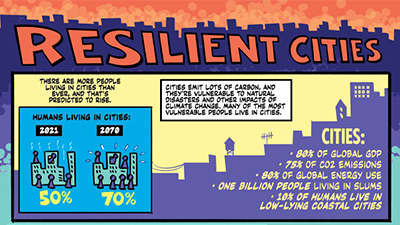
Our communities must adapt in order to respond to climate impacts. Study the infographic to explore the best strategies for building a climate-ready future, and then use your creativity to rise to the challenge in the activity.

STEP 6

Investigating Adaptation Solutions

This lesson has provided plenty of examples of adaptation solutions, but we certainly haven’t covered them all. Time for some research.

STEP 7

Closer: Climate Change Adaptation

Communities are experiencing the impacts of climate change in different ways, which means they need different solutions to address those impacts.