Cookie Policy

Our website uses cookies to understand content and feature usage to drive site improvements over time. To learn more, review our Terms of Use and Privacy Policy.

OER Logo

Lesson 2.1 Vocab

  • a
  • b
  • c
  • d
  • e
  • f
  • g
  • h
  • i
  • j
  • k
  • l
  • m
  • n
  • o
  • p
  • q
  • r
  • s
  • t
  • u
  • v
  • w
  • x
  • y
  • z
Big Bang
Jump To Navigation
Definition

a theory, first articulated in the 1920s, proposing that the universe started out extremely hot and dense and gradually cooled off as it expanded

Use In A Sentence

The theory of the Big Bang is widely accepted in the scientific community.

collective learning
Jump To Navigation
Definition

the process, specific to the human species, of sharing and accumulating knowledge over multiple generations and across regions

Use In A Sentence

Only through collective learning were we able to develop the sophisticated technologies we have today.

complexity
Jump To Navigation
Definition

the quality of being intricate and compounded

Use In A Sentence

Organic compounds are not only unique in their complexity, they are also unusually numerous.

Earth
Jump To Navigation
Definition

a rocky planet that supports life; the third planet from the Sun in our Solar System

Use In A Sentence

Earth is home to numerous species of plant and animal life.

element
Jump To Navigation
Definition

a substance that that cannot be broken down into simpler substances by ordinary chemical processes. Each element is distinguished by its atomic number, or, the number of protons in its nuclei.

Use In A Sentence

Some of the more well-known elements are lead, zinc, hydrogen, and gold.

solar system
Jump To Navigation
Definition

the Sun and the objects that orbit it; the area in space in which the Sun’s gravitational pull is the dominant force

Use In A Sentence

Newton's great contribution to the science of mechanics was the discovery that the same laws of nature are valid throughout our solar system.

star
Jump To Navigation
Definition

any of a vast number of celestial bodies other than the moon visible from Earth as points of light in the night sky

Use In A Sentence

My neighbor has a telescope on his roof that he uses to look at the stars on clear, dark nights.

Big Bang to Earth

Driving Question: How can thresholds of increasing complexity help us understand the formation of the Universe, our Solar System, and Earth?

Big History’s thresholds of increasing complexity explain how a Universe composed mainly of hydrogen and helium became one filled with billions of stars and planets.

Learning Objective:

  1. Explain how complexity increased from the origins of the Universe to the formation of the Earth.
STEP 1

Opener: Big Bang to Earth

Teaching Tools

The Unit Notebook is a great opportunity for informal writing. Informal writing helps solidify ideas and support retention and understanding of concepts, events, and eras. For more support on informal writing, including its benefits, check out the first two pages of the Writing Guide External link .

What do you already know about the Universe, our Solar System, and Earth? Put your knowledge to the test!

STEP 2

Unit 2 Overview

You’re about to learn almost 10 billion years of history. Luckily, it won’t take anywhere near that long to learn how our Universe went from being really simple to really complex.

STEP 3

The First Four Thresholds

Teaching Tools

While the audio story of the first four Big History thresholds is short, it’s packed with information. We’ve paired the audio with a graphic transcript, but you could also set up learning stations in your classroom and have small groups complete the transcript for one threshold, sharing out with the class when everyone is finished.

The Universe is like life: it starts simple, but it gets complicated fast! The next steps show you how it happened.

Thresholds 1–4 External link

Listen to a story that will take you on a journey through time and space. It’s a story that begins with the Big Bang and ends with you.
04:31
live
CC

Subtitles

×
HD

Quality

×
STEP 4

Closer: Big Bang to Earth

Teaching Tools

Closers often prompt students to engage in informal writing and can be used to preview content for upcoming lessons, but most important, they provide you with excellent opportunities to quickly check for understanding.

Get students’ creative juices flowing by extending this closer and having them make a threshold commercial with their jingle.

How did the Universe change during its first 10 billion years of existence? Show off your musical talents, and your new knowledge, by writing a song about the early days of the Universe.

Extension Materials
Checkmark Alert Banner
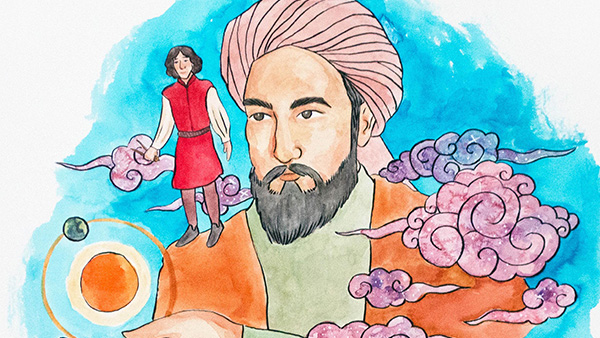
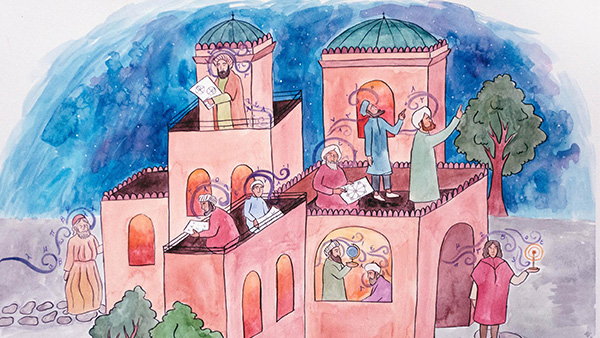
You don’t have “knowledge” without humans to make the discoveries. Meet the brilliant Islamic scholars who set the foundation for modern science centuries ago.
...

Scientific Giants of the Islamic World

Teaching Tools

The history of science is often dominated by European contributions. Expand the story by highlighting the work of Islamic scholars and the discoveries that led to new models of the Universe.

We often think of scientists as lone geniuses who had “aha!” moments and discovered the secrets of the Universe. In reality, scientific breakthroughs happen thanks to information shared across generations.

...

The Missing Link?

You would not believe how many fights there have been over whether the Sun orbits the Earth, or the Earth orbits the Sun. Learn how Muslim scholars contributed to settling the question once and for all!