
DBQ – The Columbian Exchange
STUDENT MATERIALSSTUDENT MATERIALSS-1DBQ—THE COLUMBIAN EXCHANGEWORLD HISTORY PROJECT ORIGINS / LESSON 5.5 ACTIVITYPreparation• Have the Comparison, CCOT, and Causation tools available (find all resources on the Student Resources page)• Download the WHP Writing RubricPurposeThis DBQ is another opportunity to get a sense of your progress in developing your historical thinking and writing skills. Additionally, writing DBQs will help prepare you to be successful on the written portion of standardized tests. ProcessDay 1 It’s time for another DBQ. This time, you’ll be thinking about the Columbian Exchange. The DBQ prompt is: Evaluate the extent to which the Columbian Exchange transformed the Americas from c. 1500 to 1750 CE. Start out by using the Question Parsing Tool to help you figure out what this question is really asking, so you can write an appropriate response. Take out the Columbian Exchange DBQ and skim the documents quickly. Then, pick the thinking tool you want to use to help you analyze the documents (comparison, causation, or CCOT). Once you’ve picked a tool, read each document a bit more closely and write down or underline the information you think you might use in your essay, along with any additional sourcing you have time for. Write your ideas on your chosen tool as you work through the documents. Next, create a major claim or thesis statement that responds to the prompt. The notes you have taken should help you form a defensible thesis statement. Finally, it’s time to contextualize. As you likely know, all historical essays require this. If needed, you can use the Contextualization Tool to help you decide what to include.Day 2 This second day is your writing day. Feel free to use your tools and notes from any prewriting work you completed as you craft your essay response. Make sure you have a copy of the WHP Writing Rubric available to remind you of what is important to include in your essay. And don’t forget to contextualize: Think of the entire time period, not just the time immediately preceding the historical event or process you are writing about. Your teacher will give you a time limit for completing your five- to six-paragraph essay responding to the DBQ.
STUDENT MATERIALSSTUDENT MATERIALSS-2DBQ—THE COLUMBIAN EXCHANGEWORLD HISTORY PROJECT ORIGINS / LESSON 5.5 ACTIVITYDBQDirections: Write a five- to six-paragraph essay in response to the prompt below. Make sure to use the documents provided to help support your argument. In addition to trying to meet the criteria on the WHP Writing Rubric, make sure to address the most relevant of these historical thinking skills in your response: comparison, causation, or CCOT. Finally, make sure you contextualize, or describe the broader historical context relevant to the prompt. We suggest you spend 10-15 minutes reading these documents and 35-45 minutes writing. Sources are edited for brevity and clarity.Evaluate the extent to which the Columbian Exchange transformed the Americas from c. 1500 to 1750 CE.
STUDENT MATERIALSSTUDENT MATERIALSS-3DBQ—THE COLUMBIAN EXCHANGEWORLD HISTORY PROJECT ORIGINS / LESSON 5.5 ACTIVITYDocument 1Source:Florentine Codex (1540–1585), collected by Franciscan Friar Bernardino de Sahagún, Book XII folio 54 [detail]. English quoted texts translation from James Lockhart, We People Here: Nahuatl Accounts of the Conquest of Mexico (Berkeley: University of California Press, 1993), 181–185. https://commons.wikimedia.org/wiki/File:FlorentineCodex_BK12_F54_smallpox.jpgThis is an illustration from the “Florentine Codex,” a sixteenth-century collection of materials and information based on Aztec and Nahua history. The drawing shows Nahuas infected with smallpox. The accompanying text reads in part:The disease brought great desolation: a great many died of it. They could no longer walk about, but lay in their dwellings and sleeping places, no longer able to move or stir. They were unable to change position, to stretch out on their sides or face down, or raise their heads. And when they made a motion, they called out loudly. The pustules that covered people caused great desolation; very many people died of them, and many just starved to death; starvation reigned, and no one took care of others any longer. On some people, the pustules appeared only far apart, and they did not suffer greatly, nor did many of them die of it. But many people’s faces were spoiled by it, their faces were made rough. Some lost an eye or were blinded.

STUDENT MATERIALSSTUDENT MATERIALSS-4DBQ—THE COLUMBIAN EXCHANGEWORLD HISTORY PROJECT ORIGINS / LESSON 5.5 ACTIVITYDocument 2Source: Bernal Díaz del Castillo, The Discovery and Conquest of Mexico, 1517–1521, (trans. A.P. Maudslay (London: George Routledge, 1928), 269–270. (This book is an abridged version of the author’s memoir, The True Story of the Conquest of New Spain, first published in 1576.)https://archive.org/details/in.ernet.dli.2015.81431/page/n9. This source has been edited for brevity and clarity. Bernal Díaz del Castillo (1492–1584) was a soldier under Hernán Cortés (1485–1547) and later wrote in his memoirs about viewing Tenochtitlan (present-day Mexico City) and surrounding cities before they were conquered. It was destroyed by Cortés and his forces soon after the scene described here.When we saw so many cities and villages built in the water and other great towns on dry land and that straight and level causeway going towards Mexico [Tenochtitlan], we were amazed and said that it was like the enchantments they tell of in the legends ... And then when we entered the city of Iztapalapa [to the southeast of Tenochtitlan], the appearance of the palaces in which they lodged us! How spacious and well built they were, of beautiful stone work and cedar wood, and the wood of other sweet scented trees, with great rooms and courts, wonderful to behold, covered with awnings of cotton cloth. ...Of all these wonders that I then beheld to-day all is overthrown and lost, nothing left standing.Document 3Source: Reprinted in Miguel León-Portilla, The Broken Spears (Boston: Beacon, 1962), 137–138.This poem was written by an Aztec poet after the 1521 conquest of Tenochtitlan.Broken spears lie in the roads;We have torn our hair in our grief.The houses are roofless now; and their walls are red with blood.Worms are swarming in the streets and plazas,And the walls are spattered with gore.The water has turned red, as if it were dyed.And when we drink of it,It has the taste of brine.We have pounded our hands in despair against the adobe walls.For our inheritance, our city, is lost and dead.The shields of our warriors were its defense,But they could not save it.We have chewed dry twigs and salt grasses;We have filled our mouths with dust and bits of adobe,We have eaten lizards, rats and worms.
STUDENT MATERIALSSTUDENT MATERIALSS-5DBQ—THE COLUMBIAN EXCHANGEWORLD HISTORY PROJECT ORIGINS / LESSON 5.5 ACTIVITYDocument 4Source: Nathan Nunn and Nancy Qian, “The Columbian Exchange: A History of Disease, Food, and Ideas,” The Journal of Economic Perspectives 24, no. 2 (Spring 2010), 183–184. This source has been edited for brevity and clarity.This excerpt summarizes some of the human benefits and costs of the Columbian Exchange.The Americas provided soils that were very suitable for the cultivation of a variety of products, like sugar and coffee. The increased supply lowered the prices of these products significantly, making them affordable to the general population for the first time in history. The production of these products also resulted in large inflows of profits back to Europe. ... Potatoes were embraced by the Irish and the eastern European societies, chili peppers by the cultures of South and Southeast Asia, tomatoes by Italy and other Mediterranean societies, and tobacco by all nations of the world.The exchange also had some extremely negative impacts. Native American populations were decimated by Old World diseases. This depopulation [of Native Americans] along with the production of valuable crops like sugar cane and coffee then fueled the demand for labor that gave rise to the transatlantic slave trade. The result was the forced movement of over twelve million slaves from Africa to the Americas and devastating political, social, and economic consequences for the African continent.Document 5Source: Ned Blackhawk, “Teaching the Columbian Exchange,” OAH Magazine of History 27, Issue 4 (October 2013), 31–34. https://academic.oup.com/maghis/article-abstract/27/4/31/1113970. This excerpt has been edited for brevity.Ned Blackhawk, professor of history at Yale and a member of the Te-Moak tribe of the Western Shoshone, wrote this excerpt:Native peoples continued to control North America’s interior. They played an important part in shaping colonial influence outside of the immediate areas of European settlement. The Iroquois Confederacy in the Northeast, the Algonquian-speaking alliances of the Great Lakes, and the equestrian powers across the Plains are just a few examples of enduring Indigenous powers.We must pay attention to such enduring forms of Indigenous authority. While they were devastated by waves of European pathogens, land theft, warfare, and religious impositions, still, Indigenous communities also adapted to the challenges of colonialism’s onslaught by drawing on familiar as well as new ideas. Particularly in North America, forms of Indigenous self-rule continued throughout the sixteenth, seventeenth, and eighteenth centuries. For the United States, treaties and federal patterns of diplomacy bound the new nation with the continent’s oldest confederations and peoples.
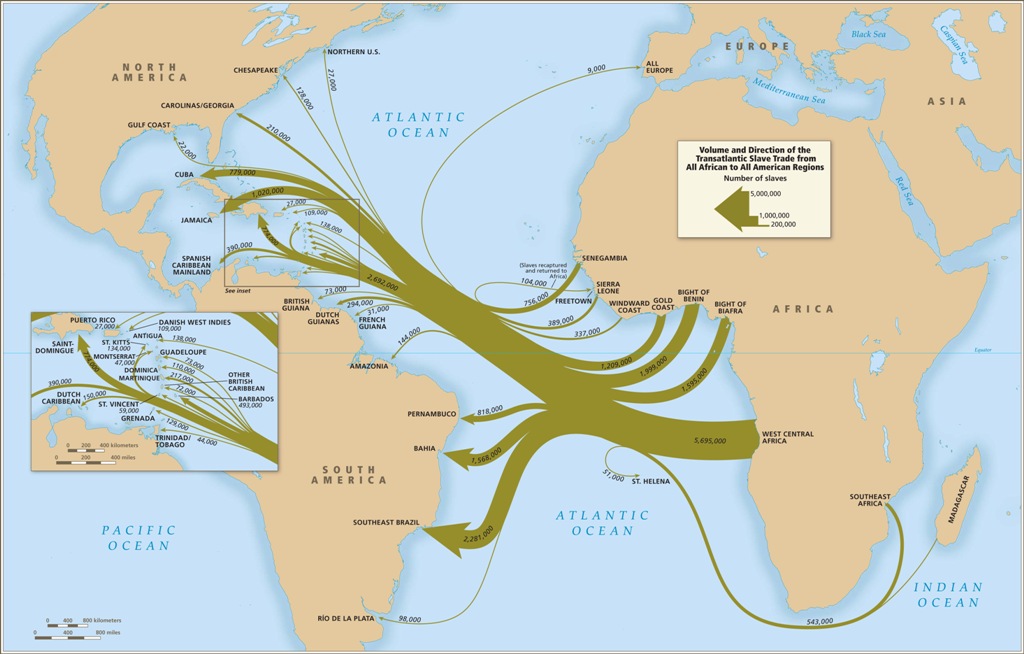
STUDENT MATERIALSSTUDENT MATERIALSS-6DBQ—THE COLUMBIAN EXCHANGEWORLD HISTORY PROJECT ORIGINS / LESSON 5.5 ACTIVITYDocument 6Source: Slave Voyages, Emory University (2019), the Trans-Atlantic and Intra-American slave trade interactive database. https://www.slavevoyages.org/static/images/assessment/intro-maps/09.jpg.
STUDENT MATERIALSSTUDENT MATERIALSS-7DBQ—THE COLUMBIAN EXCHANGEWORLD HISTORY PROJECT ORIGINS / LESSON 5.5 ACTIVITYDocument 7This eighteenth-century anonymous painting shows the casta (lineage/race) or racial types and combinations.Source: Anonymous painting, Las Castas, Museo Nacional del Virreinato, Tepotzotlán, Mexico.https://commons.wikimedia.org/wiki/File:Casta_painting_all.jpg

Name:Date:Name:Date:STUDENT MATERIALSS-8DBQ—THE COLUMBIAN EXCHANGEWORLD HISTORY PROJECT ORIGINS / LESSON 5.5 ACTIVITYQuestion Parsing ToolDirections: Follow the steps to parse the prompt you are presented with. Use the key at the bottom to help you with the historical reasoning practice and composition questions.1. Prompt: 2. Rewrite the prompt in your own words:3. Periodization: What is the time period you are being asked to consider? Write out the years if you are given something in terms of century (for example, twentieth century = 1900s).4. Location: What areas of the world are included in this prompt?5. Topic: What is the main topic being asked about in this prompt?
Name:Date:Name:Date:STUDENT MATERIALSS-9DBQ—THE COLUMBIAN EXCHANGEWORLD HISTORY PROJECT ORIGINS / LESSON 5.5 ACTIVITY6. Historical reasoning practice: What historical reasoning practice is this prompt asking you to engage in? Provide justification for why you chose the one you did.7. Composition: What is the prompt stem asking you to do as part of your response? Remember the prompt stem is usually a verb.KeyHistorical Reasoning PracticeWords/Phrases to Look ForCausationCause, effect, led to, lead to, emergence, resulted, bring about, give rise to, be the cause of, result in, produce, generate, spawn, precipitate, prompt, induce, promote, foster, provoke, triggerComparisonSimilarities, differences, compare, contrast, set side-by-side, juxtapose, differentiate, liken, equateCCOTContinuities, changes, continuation, persistence, consistent, over time, two points in time Prompt Stem ExamplesWhat It’s Asking in Simpler LanguageTo what extentWeigh, evaluate, assess Evaluate, assessHow much—needs a quantitative answer/thesis/claim (Note: A quantitative answer is one that includes an amount or a number. For example: a lot, a little) Analyze, developDescribe and explainArgue, argumentMake a claim