
DBQ 0

WHP 1200 / LESSON 1.4STUDENT MATERIALSASSESSMENT—UNIT 1 DBQ1 Unless otherwise noted, this work is licensed under CC BY 4.0. Credit: “Assessment–DBQ 0”, OER Project, https://www.oerproject.com/Preparation •Download the WHP Writing RubricPurposeDBQ 0 is the baseline writing assessment for the course. Your teacher will use it to provide you with an understanding of your ability to use a range of texts to construct an evidence-based, well-structured explanation or argument. Although you should do the best you can, don’t worry about your score on this assignment. You will retake this same DBQ later in the course, which will give you an opportunity to see your growth.ProcessYou’re going to use today’s class period to take the baseline assessment for the course. Your teacher may score your essay, but this won’t be a grade that “counts”—it’s just to give you an idea of where you are in your writing right now. However, it’s really important to take this essay seriously for a few reasons. First, it will help your teacher decide what to focus on teaching this year in order to help you become a better writer. Second, since it’s early in the course and you’ll be working on writing a lot, at the end of the year you’ll most likely see a big improvement in your writing abilities, which is always satisfying. Take out the DBQ and follow the directions. You also might want to look through the WHP Writing Rubric so you have a clear sense of the goals you are trying to meet.
WHP 1200 / LESSON 1.4STUDENT MATERIALSASSESSMENT—UNIT 1 DBQ2 Unit 1 DBQDirections: Write a five- to six-paragraph essay in response to the prompt below. Make sure to use the documents provided to help support your argument. In addition to trying to meet the criteria of the WHP Writing Rubric, make sure to address the most relevant of these historical thinking skills in your response: comparison, causation, or CCOT (change and continuity over time). Finally, make sure you contextualize (describe the broader historical context) relevant to the prompt.We suggest you spend 10-15 minutes reading these documents and 35-45 minutes writing. Sources are edited for brevity and clarity.Evaluate the extent to which globalization since the Second World War has benefited everyone.Name:Date:
WHP 1200 / LESSON 1.4STUDENT MATERIALSASSESSMENT—UNIT 1 DBQ3 Document 1Source: Max Roser, “The Short History of Global Living Conditions and Why it Matters That We Know It,” Our World in Data, University of Oxford. https://ourworldindata. org/a-history-of-global-living-conditions-in-5-charts?linkId=62571595. This chart is taken from the website “Our World in Data,” a project involving thousands of scholars and based in the University of Oxford’s Oxford Martin Programme on Global Development. The aim of the organization is to collect, compile, and share this data as a public service, using the research of a global community of scholars to show how long-term global trends are connected. The organization’s mission statement emphasizes the ways in which global living conditions have improved over the past two centuries.
WHP 1200 / LESSON 1.4STUDENT MATERIALSASSESSMENT—UNIT 1 DBQ4 Document 2Source: Steven Pinker, Enlightenment Now: The Case for Reason, Science, Humanism, and Progress (New York: Viking, 2018). Excerpts are lightly edited and combined, taken from pages 249, 251, 257, 259, 261. These excerpts are taken from the book Enlightenment Now: The Case for Reason, Science, Humanism, and Progress, by popular science author Steven Pinker.In 1870, Western Europeans worked an average of 66 hours a week, while Americans worked 62 hours. Over the past century and a half, workers have increasingly been emancipated from their wage slavery, more dramatically in social-democratic Western Europe (where they work 28 fewer hours a week) than in the go-getter United States (where, on average, they now work 22 fewer hours).In 1919, and average American wage earner had to work 1,800 hours to pay for a refrigerator; in 2014 they had to work fewer than 24 hours. As utilities and appliances penetrated American households during the twentieth century, the amount of life that people lost to housework fell almost fourfold, from 58 hours a week in 1900 to 15.5 hours in 2011.In 2015 American men reported 42 hours of leisure per week, around 10 more than their counterparts did 50 years earlier, and women reported 36 hours, more than 6 hours more.In 1974, it cost $1,442 (in 2011 dollars) to fly from New York to Los Angeles; today it can be done for less than $300.Grocers have broadened their offerings as well, from a few hundred items in the 1920s to 2,200 in the 1950s; 17,500 in the 1980s; and 39,500 in 2015.We have, at our fingertips, virtually all the works of genius prior to our time. Better still, it is all available not just to the rich, but to anyone who is connected to the vast web of knowledge, which means most of humanity, and soon all of it.
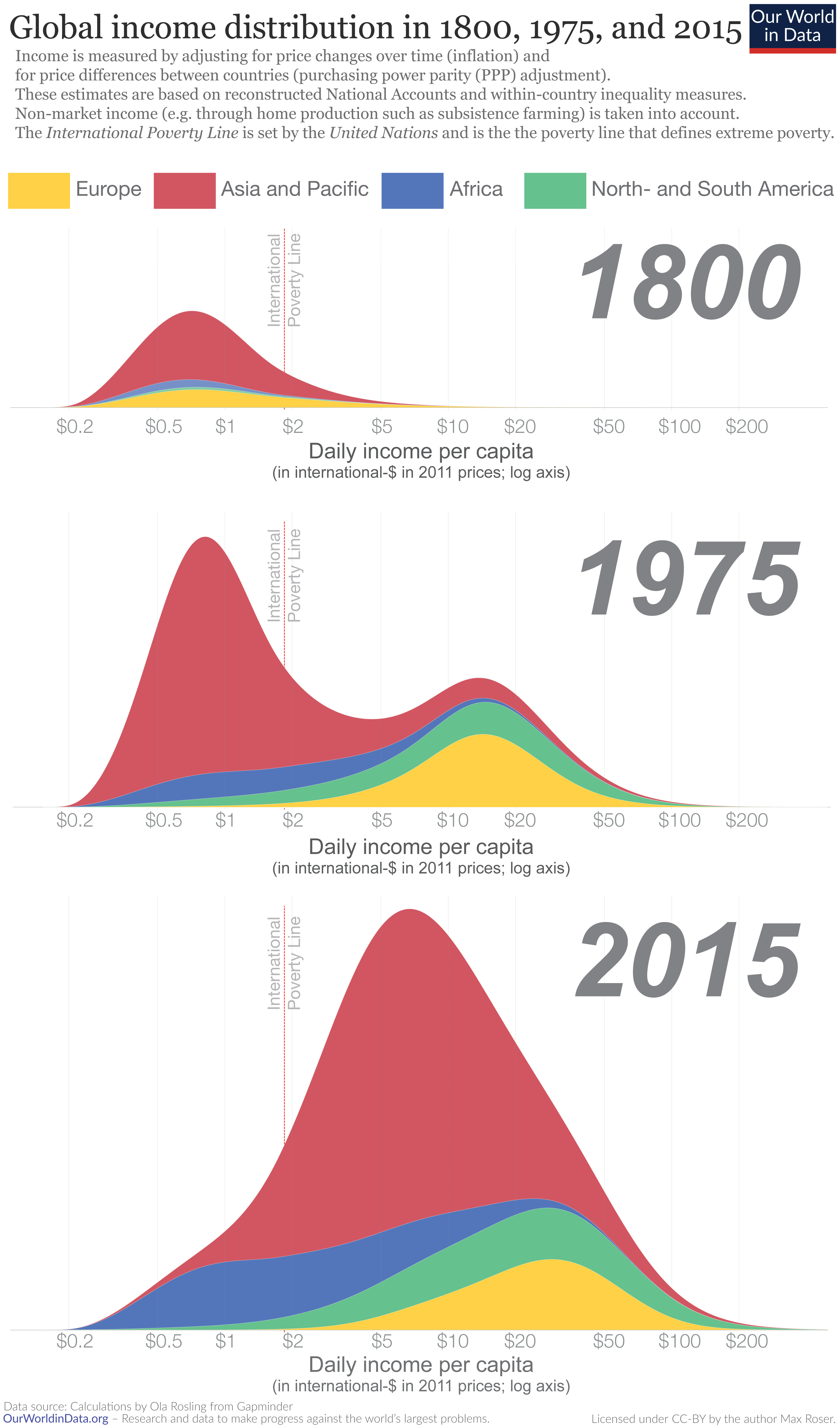
WHP 1200 / LESSON 1.4STUDENT MATERIALSASSESSMENT—UNIT 1 DBQ5 Document 3Source: Our World in Data, University of Oxford, , University of Oxford, calculations by Ola Rosling from Gapminder. https://ourworldindata.org/uploads/2019/10/Global-inequality-in-1800-1975-and-2015.png. Like Document 1, this chart is taken from the website “Our World in Data,” and shows shifts in income distribution around the world at three dates.
WHP 1200 / LESSON 1.4STUDENT MATERIALSASSESSMENT—UNIT 1 DBQ6 Document 4Source: Adapted from Simon Dalby, “Geographies of Global Environmental Security,” in Eleonore Kofman and Gillian Youngs, eds., Globalization: Theory and Practice, Third Edition (New York: Continuum, 2008), 31. This excerpt has been edited for clarity. In this excerpt, Simon Dalby, a geographer and expert in environmental studies and sustainability, considers the ways in which some trends in global capitalism have led to increased insecurity among the poorest people.Economic security for some can mean worse economic conditions for others. The United Nations Human Development Report of 1994 suggested that the wealth ratio between the poorest 20% and the richest 20% of the world population grew from 30:1 to 60:1 between 1960 and 1991. This trend of increasing inequality has continued since. Some are getting richer and the number in absolute poverty goes down, but this is often at the expense of people who are displaced or marginalized. The poor end up with fewer protections. These are clearly matters of concern to anyone worried about international security and the possibility of poverty leading to violent conflict.
WHP 1200 / LESSON 1.4STUDENT MATERIALSASSESSMENT—UNIT 1 DBQ7 Document 5Source: Artist unknown, reproduced in New Zealand’s “The Daily Blog” in a February 2019 posting by Dr. Geoff Bertram, Senior Associate at the Institute for Governance and Policy Studies, Victoria University of Wellington, New Zealand. https://thedailyblog.co.nz/2019/02/24/guest-blog-geoff-bertram- climate-change-free-trade/.
WHP 1200 / LESSON 1.4STUDENT MATERIALSASSESSMENT—UNIT 1 DBQ8 Document 6Source: Our World in Data, University of Oxford, United Nations, Population Division, https://ourworldindata.org/life-expectancy. Like Documents 1 and 3, this chart is taken from the website “Our World in Data” and shows life expectancy by global region from 1950 to 2019.
WHP 1200 / LESSON 1.4STUDENT MATERIALSASSESSMENT—UNIT 1 DBQ9 Document 7Source: Andalusia Knoll Soloff, “The Trouble with Globalization,” The World History Project, Unit 9, https://www.oerproject.com/OER-Media/PDFs/1750/ Unit9/The-Trouble-with-Globalization?PageId={F0BC6415-2213-40E7-B43D-4A1ED9A0DB8D}. In this excerpt, Mexican journalist Andalusia Knoll Soloff writes about the impacts of globalization. Soloff’s work has been published by Teen Vogue, VICE News, BBC, NBC, and Latino USA among other outlets. Your clothes are evidence that globalization created jobs in the global south. Read the tags on your shoes, shirt, and pants. Were they made in China, Honduras, Bangladesh or some other distant part of the globe? But then think: If your shoes cost $100, how much do you think the person who glued their soles on got paid for each pair of shoes? How many hours do you think they would need to work to be able to purchase a pair? What kind of conditions do you think they work in?Nike is the world’s largest athletic apparel maker in the world and arguably the most popular sneaker with a highly recognizable logo. In recent years Nike has hailed itself as a “social justice” company with a new campaign featuring social justice advocate Colin Kaepernick. They also ran a campaign encouraging women to break free of the limits society puts on them.But wait for the other sneaker to drop. Nike’s factories around the world also have a long history of abuses. In 1997, an accounting firm documented how workers at a factory making Nike products in Vietnam were exposed to toxic chemicals, forced to work 65 hours a week, and earned only $10 dollars. Nike tried to dodge responsibility saying that the factory was really run by subcontractors. The company was eventually pressured by international watchdogs to set labor standards, but investigations have shown that they still do not comply with these standards. In 2011, workers at Nike’s Converse shoe factory in Indonesia protested that their “supervisors throw shoes at them, slap them in the face and call them dogs and pigs.”Nike is just one example of a transnational corporation that benefits from increased global trade and low tariffs. While it has created hundreds of thousands of jobs across the world, that has not necessarily created prosperity. In fact, global inequality has risen exponentially over the past 30 years. In the United States alone, the top .001 percent earned 636% more in 2014 than what they earned in 1980 while there was no increase in income for the bottom half of earners.
WHP 1200 / LESSON 1.4STUDENT MATERIALSASSESSMENT—UNIT 1 DBQ10 Question Parsing ToolDirections: Follow the steps to parse the prompt you are presented with. Use the key at the bottom to help you with the historical reasoning practice and composition questions.1.Prompt:2.Rewrite the prompt in your own words:3.Periodization: What is the time period you are being asked to consider? Write out the years if you are given something in terms of century (for example, twentieth century = 1900s).4.Location: What areas of the world are included in this prompt?
WHP 1200 / LESSON 1.4STUDENT MATERIALSASSESSMENT—UNIT 1 DBQ11 5.Topic: What is the main topic being asked about in this prompt?6.Historical reasoning practice: What historical reasoning practice is this prompt asking you to engage in? Provide justification for why you chose the one you did.7.Composition: What is the prompt stem asking you to do as part of your response? Remember the prompt stem is usually a verb.KeyHistorical Reasoning PracticeWords/Phrases to Look ForCausationCause, effect, led to, lead to, emergence, resulted, bring about, give rise to, be the cause of, result in, produce, generate, spawn, precipitate, prompt, induce, promote, foster, provoke, triggerComparisonSimilarities, differences, compare, contrast, set side-by-side, juxtapose, differentiate, liken, equateCCOTContinuities, changes, continuation, persistence, consistent, over time, two points in time
WHP 1200 / LESSON 1.4STUDENT MATERIALSASSESSMENT—UNIT 1 DBQ12 Prompt Stem ExamplesWhat It’s Asking in Simpler LanguageTo what extentWeigh, evaluate, assessEvaluate, assessHow much—needs a quantitative answer/thesis/claim (Note: A quantitative answer is one that includes an amount or a number. For example: a lot, a little)Analyze, developDescribe and explainArgue, argumentMake a claim