
DBQ Sources: Globalization

OER PROJECT: WH/ LESSON 9.8ACTIVITYDBQ SOURCES: GLOBALIZATIONUnless otherwise noted, this work is licensed under CC BY 4.0. Credit: “DBQ Sources:Globalization”, OER Project, https://www.oerproject.com/1PurposeUse a variety of primary and secondary sources to deepen your understanding of the impacts of globalization.ProcessAnalyze the following sources. If you are using these sources to respond to an essay prompt, you should underlineor highlightany evidence that will support your claim. You can also use theQuick Sourcing Tool.Document 1Source: Max Roser, “The Short History of Global Living Conditions and Why it Matters That We Know It,” Our World in Data, University of Oxford. https://ourworldindata.org/a-history-of-global-living-conditions-in-5-charts?linkId=62571595.
OER PROJECT: WH/ LESSON 9.8ACTIVITYDBQ SOURCES: GLOBALIZATION2Document 2These excerpts are taken from the book Enlightenment Now: The Case for Reason, Science, Humanism, and Progress, by popular science author Steven Pinker.In 1870, Western Europeans worked an average of 66 hours a week, while Americans worked 62 hours. Over the past century and a half, workers have increasingly been emancipated from their wage slavery, more dramatically in social-democratic Western Europe (where they work 28 fewer hours a week) than in the go-getter United States (where, on average, they now work 22 fewer hours).In 1919, an average American wage earner had to work 1,800 hours to pay for a refrigerator; in 2014 they had to work fewer than 24 hours. As utilities and appliances penetrated American households during the twentieth century, the amount of life that people lost to housework fell almost fourfold, from 58 hours a week in 1900 to 15.5 hours in 2011.In 2015 American men reported 42 hours of leisure per week, around 10 more than their counterparts did 50 years earlier, and women reported 36 hours, more than 6 hours more.In 1974, it cost $1,442 (in 2011 dollars) to fly from New York to Los Angeles; today it can be done for less than $300.We have, at our fingertips, virtually all the works of genius prior to our time. Better still, it is all available not just to the rich, but to anyone who is connected to the vast web of knowledge, which means most of humanity, and soon all of it.Source: Steven Pinker, Enlightenment Now: The Case for Reason, Science, Humanism, and Progress (New York: Viking, 2018). Excerpts are lightly edited and combined, taken from pages 249, 251, 257, 259, 261.
OER PROJECT: WH/ LESSON 9.8ACTIVITYDBQ SOURCES: GLOBALIZATION3Document 3Source: Our World in Data, University of Oxford, University of Oxford, calculations by Ola Rosling from Gapminder. https://ourworldindata.org/uploads/2019/10/Global-inequality-in -1800-1975-and-2015.png.
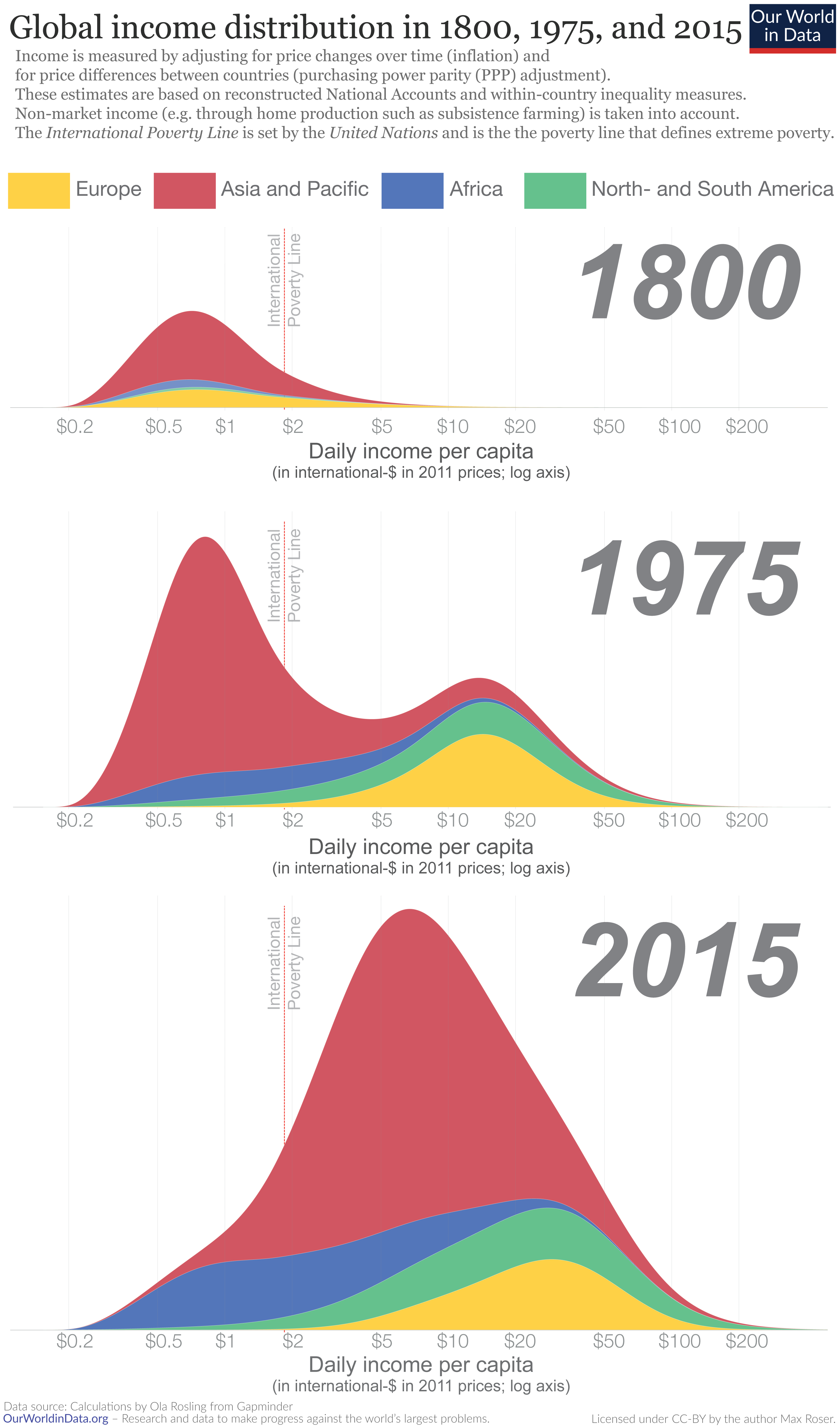
OER PROJECT: WH/ LESSON 9.8ACTIVITYDBQ SOURCES: GLOBALIZATION4Document 4In this excerpt, Simon Dalby, a geographer and expert in environmental studies and sustainability, considers the ways in which some trends in global capitalism have led to increased insecurity among the poorest people.Economic security for some can mean worse economic conditions for others. The United Nations Human Development Report of 1994 suggested that the wealth ratio between the poorest 20% and the richest 20% of the world population grew from 30:1 to 60:1 between 1960 and 1991. This trend of increasing inequality has continued since. Some are getting richer and the number in absolute poverty goes down, but this is often at the expense of people who are displaced or marginalized. The poor end up with fewer protections. These are clearly matters of concern to anyone worried about international security and the possibility of poverty leading to violent conflict.Source: Adapted from Simon Dalby, “Geographies of Global Environmental Security,” in Eleonore Kofman and Gillian Youngs, eds., Globalization: Theory and Practice, Third Edition (New York: Continuum, 2008), 31. This excerpt has been edited for clarity.
OER PROJECT: WH/ LESSON 9.8ACTIVITYDBQ SOURCES: GLOBALIZATION5Document 5Source: Artist unknown, reproduced in New Zealand’s “The Daily Blog” in a February 2019 posting by Dr. Geoff Bertram, Senior Associate at the Institute for Governance and Policy Studies, Victoria University of Wellington, New Zealand. https://thedailyblog.co.nz/2019/02/24/guest-blog-geoff-bertram-climate-change-free-trade/.
OER PROJECT: WH/ LESSON 9.8ACTIVITYDBQ SOURCES: GLOBALIZATION6Document 6Source: Our World in Data, University of Oxford, United Nations, Population Division, https://ourworldindata.org/life-expectancy.
OER PROJECT: WH/ LESSON 9.8ACTIVITYDBQ SOURCES: GLOBALIZATION7Document 7In this excerpt, Mexican journalist Andalusia Knoll Soloff writes about the impacts of globalization. Soloff’s work has been published by Teen Vogue, VICE News, BBC, NBC, and Latino USAamong other outlets.Your clothes are evidence that globalization created jobs in the global south. Read the tags on your shoes, shirt, and pants. Were they made in China, Honduras, Bangladesh or some other distant part of the globe? But then think: If your shoes cost $100, how much do you think the person who glued their soles on got paid for each pair of shoes? How many hours do you think they would need to work to be able to purchase a pair? What kind of conditions do you think they work in?...In recent years Nike has hailed itself as a “social justice” company ....But wait for the other sneaker to drop. Nike’s factories around the world also have a long history of abuses. In 1997, an accounting firm documented how workers at a factory making Nike products in Vietnam were exposed to toxic chemicals, forced to work 65hours a week, and earned only $10 dollars. ... The company was eventually pressured by international watchdogs to set labor standards, but investigations have shown that they still do not comply with these standards. ...Nike is just one example of a transnational corporation that benefits from increased global trade ....While it has created hundreds of thousands of jobs across the world, that has not necessarily created prosperity. In fact, global inequality has risen exponentially over the past 30 years. In the United States alone, the top .001 percent earned 636% more in 2014 than what they earned in 1980 while there was no increase in income for the bottom half of earners.Source:Andalusia Knoll Soloff, “The Trouble with Globalization,” OER Project: World History, Unit 9, https://www.oerproject.com/OER-Media/PDFs/1750/Unit9/The-Trouble-with-Globalization?PageId={F0BC6415-2213-40E7-B43D-4A1ED9A0DB8D}.