Our website uses cookies to understand content and feature usage to drive site improvements over time. To learn more, review our Terms of Use and Privacy Policy.
The Great Fire of London: Fire, Fear, and a False Confession
This video explores the tensions simmering in London before the great fire of 1666. Plague, poverty, and suspicion of Catholics and foreigners all fanned the flames of prejudice. Check out how the disaster changed London.
Think about the following questions as you watch the video
What social and political tensions existed in London before the fire broke out?
Why did the fire spread so quickly, and why was it so destructive?
Who was Robert Hubert, and why was he blamed for starting the fire?
Why is the “official” death toll of six people considered unreliable by historians today?
What positive changes resulted from the fire?
: London, 1666: a massive fire ripped through and destroyed around 80 percent of the city core in mere
: days. Its population reeled from tragedy. The devastation was almost too much to fathom.
: So, when 26-year-old Frenchman Robert Hubert claimed to have started the blaze, they believed him. He was
: convicted and executed. The problem? He definitely didn't start the fire. So, if Hubert didn't,
: who did? And why was everyone else so ready to believe him? To answer those questions, we need
: to take a closer look at exactly what was going on before the city set a flame. London in the 1660s
: was not a great place to be. In 1665, the city endured its last major bubonic plague outbreak,
: which killed 15 to 20 percent of the city's population– somewhere between 70 and 100 thousand people.
: Despite that, the city was still densely-populated, with narrow streets and poor infrastructure.
: And it was burdened by poverty and unrest, which, as is often the case, fed into prejudices against
: the city's most marginalized groups. In this case, Catholics and foreigners. See,
: the Catholic Church had been the sworn enemy of the Protestant Church of England ever since the
: two had their messy divorce, over a divorce in the 1530s. In the first half of the 1600s, England's
: Parliament clashed with then King Charles I over his ties to Catholicism—among many other things—
: which led to two civil wars and the king's eventual execution. By the 1660s, his son, Charles
: II, was in charge, but Protestants were skeptical of his reign. Many were still wary of Catholic
: potential power grabs by Rome and the papacy. Plus, even though Charles II promised religious freedom,
: if you didn't conform to the Church of England, things were still pretty gnarly. Presbyterians,
: Baptists, and Quakers were kind of out of luck, as far as the government was concerned. Things
: weren't great for immigrants living in London, either. As England fought a series of clashes
: at sea over control of global trade as part of the Second Anglo-Dutch War, French and
: Dutch refugees were seen as the enemy, too. These tensions were playing out in a densely-populated
: city of narrow streets plagued by poverty and poor infrastructure, and I guess plague. The
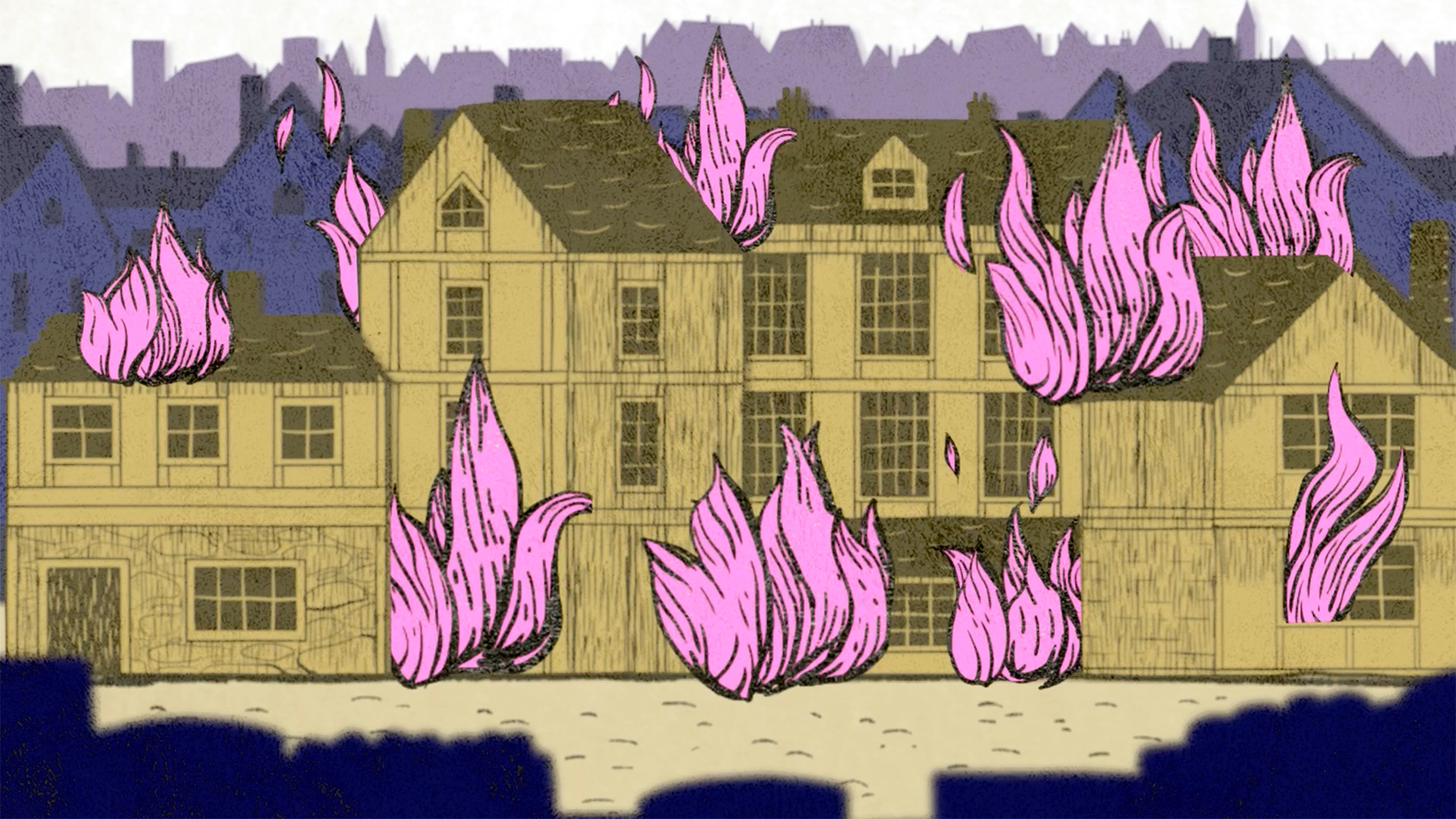
: whole thing was a tinderbox, metaphorically and literally. See, London's medieval houses
: were largely made of oak timber, and many of those homes were covered in tar– which kept people dry,
: but was a major fire hazard. That is to say London was a city ready to explode. And explode it did.
: The Great Fire of London started in the middle of the night, late September first or early September
: second, 1666. Now, fires were pretty common in 1600s London. See, wood houses covered with tar. So,
: local officials didn't take things too seriously at first. When London's mayor, Sir Thomas Bloodworth,
: was informed of the blaze, he initially dismissed it. But this fire was different. Thanks to windy,
: dry conditions, things started to heat up fast, and the firefighting go-to of the time-
: dumping buckets of water on the flames- wasn't doing a whole lot to help. By September 3rd, 300
: houses had collapsed as panicking Londoners fled the city. On September 4th, St. Paul's Cathedral
: burned down, and the fire was still raging, with no end in sight. It was time for King Charles II
: to intervene. He ordered the city to create fire breaks by using gunpowder to quickly tear down the
: houses in the fire's path. But the gunpowder explosions led to rumors that the French were
: invading, leading to even more panic and hysteria among the people of London. Despite the chaos,
: the fire breaks did help tame the fire, with some help from Mother Nature. The winds that
: had literally fanned the flames slowly died down, and by September 6th, the fire was out at last.
: But after five straight days of burning, flames had destroyed about 80 percent of the city core, and
: a quarter of the Greater London area. 13,000 homes and nearly all government and religious
: buildings were burned to the ground. London's survivors were largely houseless, traumatized,
: and hungry for someone to blame. And that someone, as we know, was Robert Hubert. His identity as a
: foreigner and a suspected Catholic made him a convenient scapegoat. But even though Hubert
: confessed to the crime, his story was absolutely implausible from the beginning—for one thing,
: he wasn't even in London when the blaze started. And an investigation in the following weeks
: found that the fire was probably just a terrible accident. Early in the morning of September 2nd,
: a baker by the name of Thomas Farriner awoke to find both his bakery and his home on fire.
: It's hard to know exactly what happened that night, but lots of people think somebody just
: failed to put out the oven. Farriner fled with his family, but left behind a maidservant—
: the fire's first official victim. Even though the fire was ruled accidental,
: it was hard to get the word out with newspapers and post offices burned down. Plus, Londoners were
: pretty committed to the idea of the fire being a foreign Catholic conspiracy, Whether or not they
: believed in Hubert’s guilt specifically. It wasn't until the modern era that the real story became
: common knowledge– long after Hubert’s execution for a crime he didn't commit. To this day, nobody's
: exactly sure why Hubert confessed to starting the blaze. And other questions remain, too. Like, the
: Fire of London had a confirmed death toll of just six people, which seems suspicious. On one hand,
: people did evacuate the city pretty quickly. But on the other, a densely populated urban maze of
: twisting alleyways and hay-stuffed structures set aflame? It's kind of a recipe for some major
: casualties. Plus, fire destroys victims' bodies into char and ash, and with a population made
: up largely of impoverished laborers, there was no reason for officials to actively look for or count
: their casualties. Spending the time and money to do so was a privilege reserved for the wealthy.
: That means it's possible that many more perished in the Great Fire of London, their final moments
: ignored by history for centuries. Today's experts say hundreds to thousands of people may have died
: in the blaze. And for those who survived, life was pretty bleak. The city was rife with mass
: houselessness and disease. Most residents were refugees in their own country, camped out in
: tents surrounded by rubble, while looters roamed the city. And with its finances devastated, England
: soon ended its war with the Dutch. London's xenophobia, or suspicion of strangers, only
: strengthened. Hate crimes against Dutch and French Catholics spiked. Many people were assaulted,
: severely beaten, or even lynched solely because of their religion or nation of origin. As the city
: rebuilt (out of less flammable materials this time around), there were some changes for the better–
: like the establishment of London's first official fire brigade, which could respond much more
: effectively than a bunch of people with buckets of water. And the advent of fire insurance as a means
: of recovering lost funds and items. Eventually, London was reborn from the ashes a more modern
: city– but at a staggering cost. The Great Fire of London was a horrible urban catastrophe. And
: while the entire city shouldered the cost, the highest toll was paid by already marginalized
: groups– those living in poverty whose deaths went uncounted, and foreigners and religious
: minorities who faced suspicion, hostility, and brutality at the hands of their fellow Londoners.
: However, out of the destruction, London was able to build back better, creating a thriving