Our website uses cookies to understand content and feature usage to drive site improvements over time. To learn more, review our Terms of Use and Privacy Policy.
The Scientific Revolution: Where Did Science Come From?
The roots of Europe’s Scientific Revolution extend further back than you might think. This video explores the history of science in a global context.
Think about the following questions as you watch the video
What discoveries did Copernicus and Galileo make, and how were their ideas received?
What is the scientific method, and who is credited with formally writing it down in Europe?
How does Ibn al-Haytham’s work challenge the idea that the scientific method began in Europe?
What are some examples of important scientific progress before the Scientific Revolution?
Even if the Scientific Revolution wasn’t the first moment of science, what makes this period significant?
: Today we generally split time into two segments. Before the common era or BCE and the common era
: or CE. But there's another way many of us think about time and it's BS. Before Science, that is.
: And when we think about the moment we went from BS to AS, we normally point to a period during
: the 16th and 17th centuries when science exploded, known as the Scientific Revolution. But it turns
: out that perception might not be 100% accurate after all. The 16th and 17th centuries were a wild
: time for Europe. The so-called Age of Exploration and all the conquests and colonialism that went
: along with it meant that all kinds of new ideas and plants and animals were pouring into Europe
: from all over the globe. With lots of time and money on their hands, budding European scientists
: started asking some really big questions about how the world worked. And they conducted all
: kinds of experiments, often with the help of Indigenous people who got none of the credit.
: These experiments included things like suffocating birds and mice inside glass chambers in an attempt
: to understand how the body works. One guy, Hennig Brand, even tried using the "golden stream" of human
: urine to make the philosopher stone, leading to the discovery of phosphorus. In 1543, another guy,
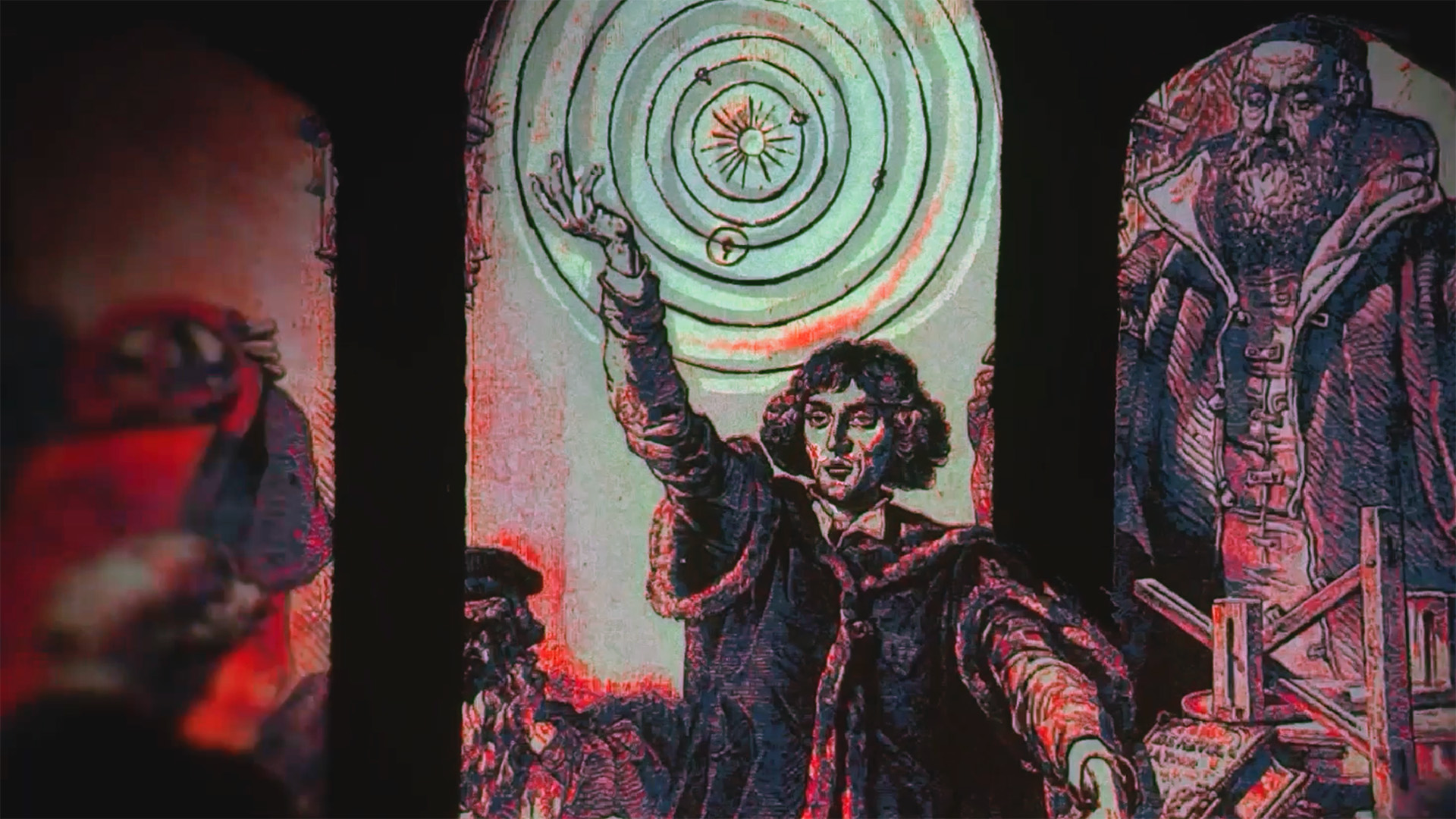
: the Polish astronomer Nicolas Copernicus, had his eyes fixed up, hoping to answer a specific
: question. Why was it that the planets appeared to move erratically through the sky, sometimes even
: seeming to swap directions? He took detailed notes about how individual planets moved over time,
: eventually revealing that contrary to prevailing opinion at the time, the Earth actually revolved
: around the sun and not the other way around. So, it wasn't that the planets were reversing
: direction. It's that their erratic loops were an optical illusion based on how the Earth was
: moving through space. Many contemporary scholars and church officials dismissed Copernicus' theory
: as a neat mathematical trick. But some other scholars thought Copernicus might have a point.
: Like in 6009, Italian scientist Galileo Galilei tested Copernicus' theory. He carefully recorded
: the position of the stars and planets night after night, then analyzed his notes to draw the exact
: same conclusion that the planets, including Earth, were revolving around the sun, just like
: Copernicus said. Unlike Copernicus, though, who was generally dismissed as a weird quasi-magician,
: Galileo's work really caught the eye of the church, and they were not amused. They summoned
: him to appear before the Inquisition and found him guilty of suspected heresy, sentencing him to
: house arrest for the rest of his life. Copernicus, Galileo, and all these other budding scientists of
: the era had something in common. They all formed ideas by asking a question, making observations
: or conducting experiments to test those questions, then drawing conclusions based on that evidence,
: otherwise known as the Scientific Method, which is generally how we think about science today.
: These ideas were cemented in the 1620s by a lawyer and philosopher named Sir Francis
: Bacon in his book Novum Organum. Bacon detailed the groundwork of what would later be cemented as the
: Scientific Method, advocating for systematic observation and experimentation as the means
: to scientific discovery. Through this process, Bacon explained, we could build our knowledge
: from critical observations, not deduce it from general principles. But Bacon himself fell
: victim to his own scientific explorations. He died after catching bronchitis, stuffing
: snow into a dead chicken to see if cold could preserve meat like salt could. Luckily, Bacon's
: ideas would live on long after him. But that's definitely not the whole story. As it turns out,
: those European science bros weren't the first ones to figure out the scientific method after all.
: Centuries earlier and thousands of miles away, an Arab Muslim scholar named Ibn al-Haytham was
: also tinkering with the scientific method. Ibn al-Haytham was an accomplished mathematician of
: Arab origin from Basra, Iraq. In the early 11th century, he conducted a series of experiments on
: the behavior of light, building on Aristotle's earlier findings that light passing through a
: pinhole can project an image. In one of his experiments, Ibn al-Haytham observed that candles
: shining through pinhole openings in a tapestry created a distinct spot of light in a straight
: line onto the wall opposite from the tapestry, proving that light travels in a straight line.
: He then built on that work, proving that the light we see doesn't come from within our eyes,
: which was the prevailing theory at the time, but from objects reflecting light projected on
: them from another source, like a candle or the sun. To make these groundbreaking discoveries,
: Ibn al-Haytham wasn't fully using what would later be called the scientific method,
: but he was implementing elements of it whenever he could. Controlled observation, an emphasis on
: demonstrable proof, and analyzing and drawing conclusions from what he saw. Ibn al-Haytham
: recorded his findings and the method he used to produce them in a seven volume treatise called the
: Book of Optics, centuries before Francis Bacon ever stuffed a chicken. A few centuries later,
: Ibn al-Haytham's work was translated into Latin. The Book of Optics was then picked up by a 13th
: century English scholar named Roger Bacon, whose work was then several more centuries down the
: line picked up by Francis Bacon. No relation, just a weird Bacon coincidence. Ibn al-Haytham's
: work shows that early modern Europeans weren't the first people to use the scientific method
: to make new discoveries. They weren't even the first ones to have a scientific revolution. See,
: Ibn al-Haytham wasn't doing all this in a vacuum. He was a student of the golden age of Islam,
: a period starting from the 8th century that led to huge collaborative advancements in science
: across the Islamic world, centuries before the period we think of as the scientific revolution.
: And early scientific advancement wasn't limited to the Islamic world either. From the 7th to the
: 13th century, China experienced its own scientific golden age, making key discoveries in agriculture,
: navigation, and astronomy. We can also thank Chinese scientists of this era for
: technological advancements like the development of gunpowder and the compass. And that's not
: even taking into account all the other kinds of science practiced by people all around the world
: throughout history like indigenous Americans or traditional midwives who also use variations of
: the scientific method, which makes calling what went down in 17th century Europe the scientific
: revolution start to feel a little tenuous. And to complicate things further pre-scientific
: revolution Europe wasn't quite as scientifically backwards as a lot of us think it was. Sure,
: there were the folks who blamed a winter storm on God's will, a plague outbreak on witchcraft,
: and laughed Copernicus and Galileo out of the room, and in Galileo's case, into house arrest.
: But there were also plenty of people who undertook the noble pursuit of scientific observation long
: before Francis Bacon came along to write about it. Like 13th century English astronomer Johannes
: de Sacrobosco described the Greek and Islamic knowledge of how ships disappear over the horizon
: and that stars and constellations were visible at different latitudes showing that the earth
: is round rather than flat--a conclusion that is apparently still too scientifically advanced for
: some modern-day humans to comprehend. He published his explanations in 1230 in a textbook called The
: Sphere which became required reading in the new universities that were popping up all over Europe.
: So by the time what we called the Scientific Revolution rolled around, science had already
: arguably been going on all over the world for thousands of years. But while looking at Europe's
: scientific revolution as the moment science became well, science is pretty narrow-sighted
: and Euroentric. It was a time of big changes for science and scientists. Not just because of all
: these new discoveries, but because of how fast it happened. Before the 16th century, science spread
: like a slow trickle. But after the 16th century, it was like a tsunami. And focus wasn't limited to
: all those new discoveries either. They were also printing older philosophical and scientific texts
: like Ibn al-Haytham's book and through colonialism encountering established ideas and knowledge from
: around the world. So when we get right down to it, there's really no such thing as BS.