Cookie Policy
Our website uses cookies to understand content and feature usage to drive site improvements over time. To learn more, review our Terms of Use and Privacy Policy.

Unit 6 Overview
In the mid-nineteenth century, industrial powers extended their empires across new regions of the world, creating new and unequal social hierarchies.
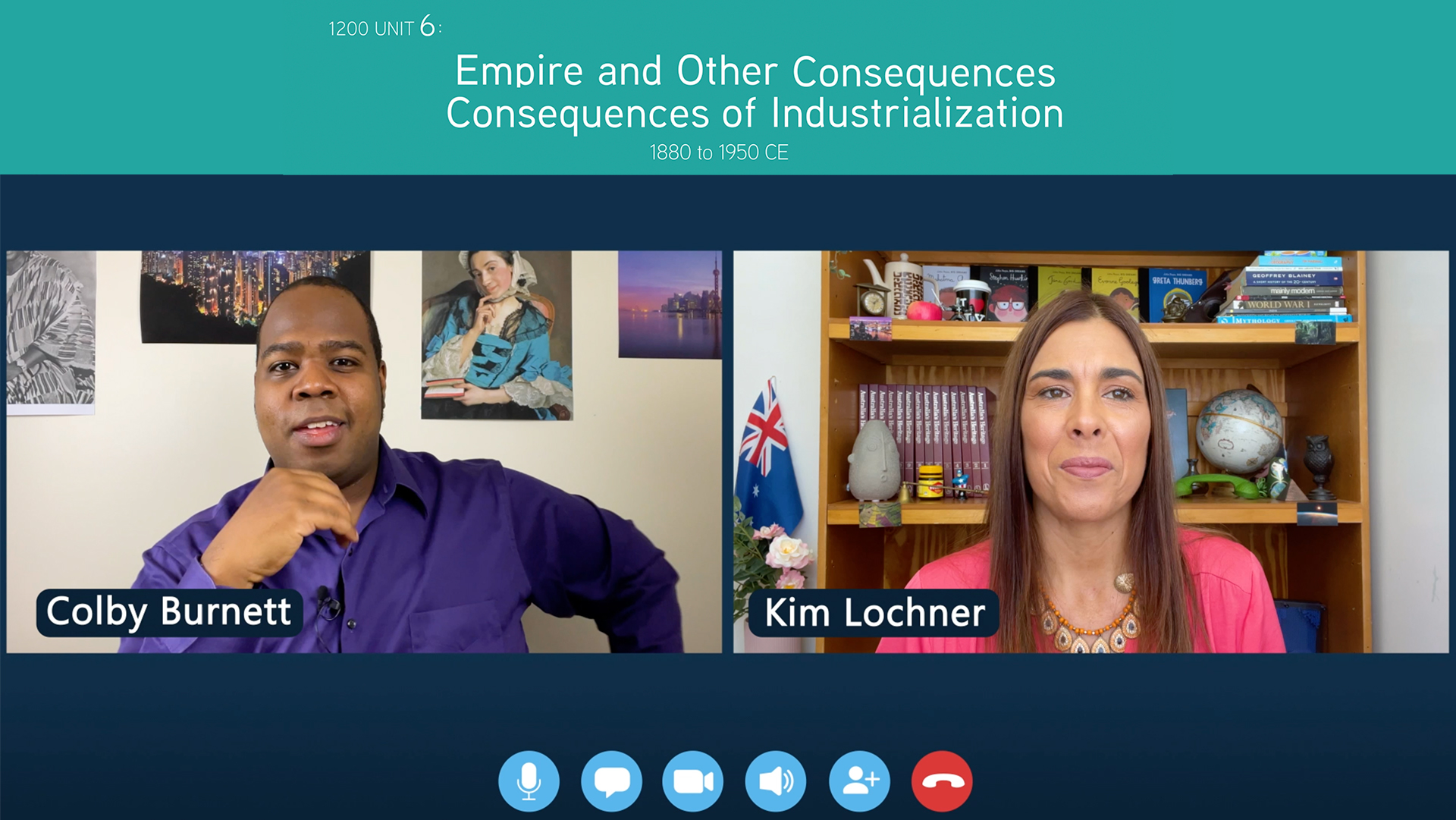
Think about the following questions as you watch the video
- How were the empires of this period different from earlier empires?
- What is surprising about the fact that Britain, France, Germany, Japan, and the United States held empires in this period?
- What is the difference between imperialism and colonialism?
- How did global economic equality change between 1800 and 1975?
- How did the French change Hanoi, and how did the people there respond?
: Hi Kim!
: Hey Colby! I just wanted to show you how well my orange tree is doing!
: That's great! Hey! I'd like to pay you five dollars to pick
: all those oranges and send them to me, and then I'll sell you orange juice for ten dollars.
: Oh but that makes no...
: Oh well you just explained all of imperialism and colonialism. Do we even have to do the unit now?
: Blast! My imperial ambitions have been met with local resistance.
: I mean Unit 6: Imperialism. Yes that was my intention all along.
: Hi I'm Kim Lochner.
: And I'm Colby Burnett. We're hear to introduce Unit 6:
: Empire and Other Consequences of Industrialization 1850 to 1950 CE.
: The transformations we've seen so far in the long 19th century were positive in a whole lot of ways.
: Political revolutions helped developed ideas on individual rights, the sovereignty of the people,
: and citizenship. The Industrial Revolution allowed humans to produce many more consumer goods.
: Capitalism established an efficient free market. Reform movements and socialism introduced
: strategies to fight for the rights of workers and their families. But, we have also seen that all of
: these great ideas have their limits. Rights, priveleges, and wealth came to some people,
: but not others. Large portions of the world's population lived on the margins of these
: transformations. Whether it was because of gender, social class, occupation, ethnicity,
: or even just where they happened to live, some people did not benefit from these new ideas and
: changes. Now, what are the major factors that kept people from the benefits of reformism,
: industrialization, or democracy is something we talked a lot about already.
: Empire!
: Kim, we talked about this.
: Well it is the reason we both speak English even though we
: were born thousands of miles from England in different directions.
: Kim, your cue is new social hierarchies.
: New social hierarchies, got it.
: Employing the communities frame can help us understand how empires
: produced inequalities between and within society from 1850 to 1950. By definition,
: empire describes an unequal relationship between the people who rule and the people who are
: ruled. Empires weren't new in 1850, they've been around for millennia. In this course,
: you've already encountered the examples of the great land-based empires of Eurasia, West Africa,
: and Mesoamerica. And you've heard plenty about the beginnings of European overseas empires.
: But in this period, the nature of empire changed as industrialization and new ideas about race
: and nationalism took hold. These transformations allowed industrial empires to extend their control
: over new communities and reorganize those colonized communities into new social hierarchies.
: Into new social hierarchies.
: I'm here, sorry! I was playing Animal Crossing.
: So, industrialization provided new technologies that allowed empires to reach farther than ever
: before. Meanwhile, racism and nationalism provided colonizers with justifications and motivations to
: spread their conquests. Britain's gradual conquest of India, with its immense wealth and large
: population began this trend. Then, by the 1880s, Britain was competing with many other imperial
: states that were all vying to acquire vast empires in South and Southeast Asia, Africa, and Oceana.
: These new industrial empires were more invasive, more extensive, and more exploitative than the
: ones that had come before. By the beginning of the 20th century, a third of the world's landmass and
: population were part of the industrialized empires ruled by Britain and France,
: as well as by newcomers like Germany, Japan, and the United States. And even though many of these states
: were at the forefront of democracy for their time, the empires they ruled were very unequal.
: We can understand inequality by looking at two important concepts of this era. The first
: is imperialism. Imperialism is the set of ideas and beliefs that a society holds that justifies
: taking over people and ruling them. The second concept is colonialism. Colonialism describes the
: actual practices that empires carry out in their colonies which stop people in those colonies from
: getting the rights of citizens and rules them from an often violent and oppressive system.
: Each empire connected the imperial country to its colonies and the colonies to each other.
: They used industrial transportation and communication networks to rule over much
: larger areas than was previously imaginable. These networks tied together an exploitative system of
: production and distribution. The colonies produced raw materials which was sent to the imperial state
: and manufactured into consumer goods. The colonies then brought back those consumer goods at a higher
: price. This meant that the money flowed from the colonies to the imperial state, making some people
: poor in order to make other people rich. All of this was made possible by the inequality of the
: empire as a community, divided between imperial citizens and colonial subjects. We can see the
: results of this inequality and exploitation in these two simple charts of global income--the
: amount of money made by people in different
: 1800, before the rise of the new imperialism. It shows that most people everywhere were quite poor,
: making what would amount to less than a dollar a day now. The majority of people lived in Asia,
: so we see a large number of Asians in that big hump of people living in quite poor circumstances.
: But, most Africans, Europeans, and people in the Americas were similarly not wealthy. Only a small
: number of individuals were comparatively wealthy and they came from different parts of the world.
: There's a second chart which Colby was supposed to email to me.
: I got it. Okay, this is the same chart but for 1975 after the large empires of the world
: had finally collapsed. Here we see two humps rather than one. There's still a hump of people
: living in poverty. Most of them lived in Asia or Africa, two regions that were heavily colonized
: in the intermediate years. By contrast, people in Europe and North America mainly fit in the second,
: wealthier hump to the right. Was it empire and colonialism that created this
: double hump of poor in one region and wealthy in another? If so, how?
: "How were industrial empires created
: and contested, and how did those processes shape our world today?"
: If we want answers, we have to look to the histories of the colonies themselves. For
: people living in the colonies, empires destroyed old, local systems and replaced them with new,
: foreign ones. These new systems disregarded the needs of local people in favor of the
: desires of colonizers. The result was dramatic change. Take the city of Hanoi, the capital of
: the independent state of Vietnam at the beginning of this era. In 1883, the French annexed Vietnam
: so Hanoi became a French-ruled city. In an effort to modernize the city and make it easier to rule,
: the French destroyed many old neighborhoods and replaced them with straight roads and
: orderly districts. Because imperialism was hierarchical, the French segregated the city
: with the white districts in the center and indigenous-Vietnamese neighborhoods in the less
: desirable areas. From there, the Vietnamese commuted into the white districts for low
: paying jobs. They had almost no say in the process. Not everything was destroyed,
: some large buildings were preserved, but only as tourist sites reflecting history of local
: culture. The city had fundamentally transformed. Outside of town, the French seized small farms
: and turned them into vast rubber plantations to feed French industry instead of the Vietnamese
: people. But of course the Vietnamese fought back. Sometimes, the resistance was almost invisible.
: It took the form of work slow downs or hiding from French labor gangs or just not following
: the law. Sometimes it was loud and dramatic. In 1908 for example, Vietnamese farmers surrounded
: the office of the governor and protested against French rule. They marched, made speeches, and
: even threatened the colonial state. Their protest was eventually put down, violently. Nevertheless,
: it's part of a long history of resistance that would ultimately bring down French rule.
: Elsewhere as well, colonial subjects responded to empire by finding ways to resist. Market women
: boycotted British goods in Nigeria, Cuban peasants armed themselves and conducted a
: guerilla war against Spanish rule. In India, resistance ran the gamut from work slowdowns
: all the way up to a widespread armed rebellion against British rule in India in 1857. So, the
: history of empire in this era is the history of imperial ideas, the experiences of colonial rule,
: and the methods of resistance. All of these in the end contributed to the making of our modern world.
: Wow! And here I thought industrialization was just about factories and making stuff
: faster. It did change countries and people and, well, everything.
: Hey Kim, I downloaded Animal Crossing too, so we can trade now.
: Oh, cool, well come check out my virtual garden. I've got a great citrus grove going on.
: Be right there. And, by the way, could I interest you in some digital orange juice?
: Hey! No, no stay away!
: Hey Colby! I just wanted to show you how well my orange tree is doing!
: That's great! Hey! I'd like to pay you five dollars to pick
: all those oranges and send them to me, and then I'll sell you orange juice for ten dollars.
: Oh but that makes no...
: Oh well you just explained all of imperialism and colonialism. Do we even have to do the unit now?
: Blast! My imperial ambitions have been met with local resistance.
: I mean Unit 6: Imperialism. Yes that was my intention all along.
: Hi I'm Kim Lochner.
: And I'm Colby Burnett. We're hear to introduce Unit 6:
: Empire and Other Consequences of Industrialization 1850 to 1950 CE.
: The transformations we've seen so far in the long 19th century were positive in a whole lot of ways.
: Political revolutions helped developed ideas on individual rights, the sovereignty of the people,
: and citizenship. The Industrial Revolution allowed humans to produce many more consumer goods.
: Capitalism established an efficient free market. Reform movements and socialism introduced
: strategies to fight for the rights of workers and their families. But, we have also seen that all of
: these great ideas have their limits. Rights, priveleges, and wealth came to some people,
: but not others. Large portions of the world's population lived on the margins of these
: transformations. Whether it was because of gender, social class, occupation, ethnicity,
: or even just where they happened to live, some people did not benefit from these new ideas and
: changes. Now, what are the major factors that kept people from the benefits of reformism,
: industrialization, or democracy is something we talked a lot about already.
: Empire!
: Kim, we talked about this.
: Well it is the reason we both speak English even though we
: were born thousands of miles from England in different directions.
: Kim, your cue is new social hierarchies.
: New social hierarchies, got it.
: Employing the communities frame can help us understand how empires
: produced inequalities between and within society from 1850 to 1950. By definition,
: empire describes an unequal relationship between the people who rule and the people who are
: ruled. Empires weren't new in 1850, they've been around for millennia. In this course,
: you've already encountered the examples of the great land-based empires of Eurasia, West Africa,
: and Mesoamerica. And you've heard plenty about the beginnings of European overseas empires.
: But in this period, the nature of empire changed as industrialization and new ideas about race
: and nationalism took hold. These transformations allowed industrial empires to extend their control
: over new communities and reorganize those colonized communities into new social hierarchies.
: Into new social hierarchies.
: I'm here, sorry! I was playing Animal Crossing.
: So, industrialization provided new technologies that allowed empires to reach farther than ever
: before. Meanwhile, racism and nationalism provided colonizers with justifications and motivations to
: spread their conquests. Britain's gradual conquest of India, with its immense wealth and large
: population began this trend. Then, by the 1880s, Britain was competing with many other imperial
: states that were all vying to acquire vast empires in South and Southeast Asia, Africa, and Oceana.
: These new industrial empires were more invasive, more extensive, and more exploitative than the
: ones that had come before. By the beginning of the 20th century, a third of the world's landmass and
: population were part of the industrialized empires ruled by Britain and France,
: as well as by newcomers like Germany, Japan, and the United States. And even though many of these states
: were at the forefront of democracy for their time, the empires they ruled were very unequal.
: We can understand inequality by looking at two important concepts of this era. The first
: is imperialism. Imperialism is the set of ideas and beliefs that a society holds that justifies
: taking over people and ruling them. The second concept is colonialism. Colonialism describes the
: actual practices that empires carry out in their colonies which stop people in those colonies from
: getting the rights of citizens and rules them from an often violent and oppressive system.
: Each empire connected the imperial country to its colonies and the colonies to each other.
: They used industrial transportation and communication networks to rule over much
: larger areas than was previously imaginable. These networks tied together an exploitative system of
: production and distribution. The colonies produced raw materials which was sent to the imperial state
: and manufactured into consumer goods. The colonies then brought back those consumer goods at a higher
: price. This meant that the money flowed from the colonies to the imperial state, making some people
: poor in order to make other people rich. All of this was made possible by the inequality of the
: empire as a community, divided between imperial citizens and colonial subjects. We can see the
: results of this inequality and exploitation in these two simple charts of global income--the
: amount of money made by people in different
: 1800, before the rise of the new imperialism. It shows that most people everywhere were quite poor,
: making what would amount to less than a dollar a day now. The majority of people lived in Asia,
: so we see a large number of Asians in that big hump of people living in quite poor circumstances.
: But, most Africans, Europeans, and people in the Americas were similarly not wealthy. Only a small
: number of individuals were comparatively wealthy and they came from different parts of the world.
: There's a second chart which Colby was supposed to email to me.
: I got it. Okay, this is the same chart but for 1975 after the large empires of the world
: had finally collapsed. Here we see two humps rather than one. There's still a hump of people
: living in poverty. Most of them lived in Asia or Africa, two regions that were heavily colonized
: in the intermediate years. By contrast, people in Europe and North America mainly fit in the second,
: wealthier hump to the right. Was it empire and colonialism that created this
: double hump of poor in one region and wealthy in another? If so, how?
: "How were industrial empires created
: and contested, and how did those processes shape our world today?"
: If we want answers, we have to look to the histories of the colonies themselves. For
: people living in the colonies, empires destroyed old, local systems and replaced them with new,
: foreign ones. These new systems disregarded the needs of local people in favor of the
: desires of colonizers. The result was dramatic change. Take the city of Hanoi, the capital of
: the independent state of Vietnam at the beginning of this era. In 1883, the French annexed Vietnam
: so Hanoi became a French-ruled city. In an effort to modernize the city and make it easier to rule,
: the French destroyed many old neighborhoods and replaced them with straight roads and
: orderly districts. Because imperialism was hierarchical, the French segregated the city
: with the white districts in the center and indigenous-Vietnamese neighborhoods in the less
: desirable areas. From there, the Vietnamese commuted into the white districts for low
: paying jobs. They had almost no say in the process. Not everything was destroyed,
: some large buildings were preserved, but only as tourist sites reflecting history of local
: culture. The city had fundamentally transformed. Outside of town, the French seized small farms
: and turned them into vast rubber plantations to feed French industry instead of the Vietnamese
: people. But of course the Vietnamese fought back. Sometimes, the resistance was almost invisible.
: It took the form of work slow downs or hiding from French labor gangs or just not following
: the law. Sometimes it was loud and dramatic. In 1908 for example, Vietnamese farmers surrounded
: the office of the governor and protested against French rule. They marched, made speeches, and
: even threatened the colonial state. Their protest was eventually put down, violently. Nevertheless,
: it's part of a long history of resistance that would ultimately bring down French rule.
: Elsewhere as well, colonial subjects responded to empire by finding ways to resist. Market women
: boycotted British goods in Nigeria, Cuban peasants armed themselves and conducted a
: guerilla war against Spanish rule. In India, resistance ran the gamut from work slowdowns
: all the way up to a widespread armed rebellion against British rule in India in 1857. So, the
: history of empire in this era is the history of imperial ideas, the experiences of colonial rule,
: and the methods of resistance. All of these in the end contributed to the making of our modern world.
: Wow! And here I thought industrialization was just about factories and making stuff
: faster. It did change countries and people and, well, everything.
: Hey Kim, I downloaded Animal Crossing too, so we can trade now.
: Oh, cool, well come check out my virtual garden. I've got a great citrus grove going on.
: Be right there. And, by the way, could I interest you in some digital orange juice?
: Hey! No, no stay away!