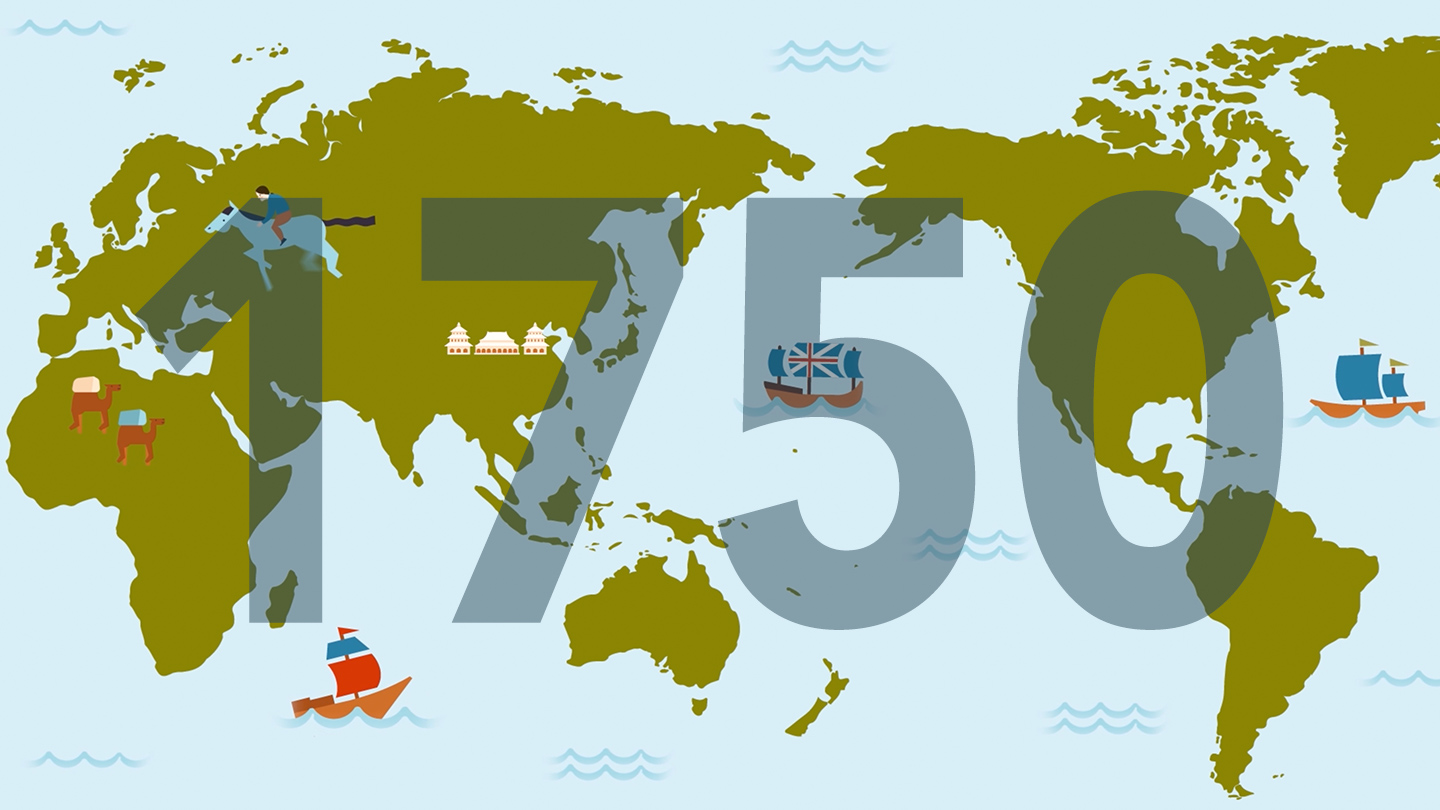
Our website uses cookies to understand content and feature usage to drive site improvements over time. To learn more, review our Terms of Use and Privacy Policy.
Unit 1 frames modern world history through broad themes that help contextualize and evaluate historical narratives.
Unit 1 examines major changes in communities, production, and distribution from 1750 to the present.
Acceleration is a core theme, emphasizing faster, larger, and more rapid historical change over time.
Scale is another core theme, comparing communities and systems across local, regional, and global levels.
The unit uses acceleration and scale to understand changes from production and communities to empires and climate change.
Before industrialization, most production came from plants, animals, and people. From 1200 to 1750 CE, growing networks of trade and empire spread exchange and new ideas. Historians use records, fossils, buildings, and DNA to track these changes. Growth also brought inequality, oppression, and environmental harm. The world before 1750 was unlike today in many ways, yet city life, exchange, and daily needs still show clear links to the present.
Nobody living in 1750 could have predicted the changes that the next century or two would bring. But evidence was growing of dramatic change on the horizon.
Think about the following questions as you watch the video
Why start a course like this in 1750?
The video argues that the world of 1750 was changing. What examples does it give?
How did the Qianlong Emperor and Lord Macartney have different views of the world when they met?
How was Britain’s growing wealth based partly on its control of Bengal in this period?
What does the map of British ship journeys around the world tell us about global trading patterns?
: So, you have the chicken fried rice
: and I have a pepperoni calzone.
: How global.
: - Okay, what do I owe you?
: - About $17.50?
: - Oh, okay.
: Oh, that reminds me!
: Hi, I'm Kim Lochner,
: and along with Colby Burnett,
: we're introducing Unit 1: The World in 1750.
: Nothing is particularly important about the year 1750.
: It's not a more significant year in world history than 1749,
: or 1751, or even 1650 or 1550.
: So why do we use this year as a marker
: to start this world history course?
: One answer is we can honestly consider 1750
: and the years around it as an era of transformation
: that laid the foundation for the world in which we live today.
: The world we live in is the product of a long, long history.
: Our universe was probably formed around 13.8 billion years ago.
: Our solar system, with the sun and the earth,
: coalesced about 4.5 billion years ago.
: Life emerged on our planet about 3.7 billion years ago.
: Physically modern humans evolved much later,
: about 250,000 years ago.
: We have only learned to farm, to live in cities, to write,
: and to construct states in the last 10,000 years.
: All of this happened long before 1750.
: If we could have looked at the earth in the year 1750
: from a satellite in orbit,
: we would have found a patchwork of human societies
: on every inhabitable continent.
: If we zoomed in a bit further,
: to the cruising altitude of a jetliner,
: we would have seen a lot of stuff
: that looked very different from today.
: But many societies in 1750
: would look pretty much the same as in 1650,
: or 1550, or even 1450.
: In some ways, people still did things
: like their ancestors had
: for centuries or even millennia.
: For example, in 1750,
: production and distribution of goods
: was generally carried out through well-worn systems.
: People still mostly obtained energy
: from the same sources as ancient societies--
: human power, animal power,
: water power,
: and, ultimately, the sun.
: Most people were still farmers who produced their own food.
: Only a few were specialists.
: Much of what these specialists made--
: leatherwork, iron, or paper--
: had been around for quite a while.
: Most networks were also quite limited and unsophisticated.
: Most goods traveled only short distances to market.
: Most people only knew other people from a few miles away
: and rarely traveled more than maybe a few miles
: from the place they were born.
: A few religious and philosophical ideas
: were spread quite widely,
: but most culture that people possessed
: was only shared with people in nearby areas.
: The communities of 1750 were politically varied,
: but mostly would have been recognizable to visitors
: from a thousand years before.
: People lived in kingdoms, chiefdoms, and religious states.
: Religion played a central role in most peoples' lives,
: like it had for many centuries.
: Most large religions were hundreds
: or even thousands of years old.
: The world of 1750 was changing.
: Steam power engines emerged for the first time
: as inefficient little experiments in China.
: Then more effective experiments appeared in Europe.
: These engines promised new types and amounts of energy.
: New products were produced at greater rates,
: including complicated tools like microscopes,
: innovative weapons like the flintlock musket,
: and new medicines like quinine for malaria.
: These innovations and the people who carried them
: moved further and faster around the world.
: Colonization decisively linked the Americas
: to Europe, Asia, and Africa only a few centuries previously.
: Trade networks and colonization
: were even starting to integrate
: Polynesia and Oceania into this system.
: Scholars who had travelled along these routes
: were using their new knowledge
: to imagine new kinds of communities.
: These were more representative, more democratic,
: or were more imperial and exploitative.
: - So, in what ways was this world of 1750
: a story of shared human experience,
: and in what ways were there
: distinct and unique
: This question can only be answered by zooming in further
: to a bird's-eye view
: to look at what humans were experiencing
: in the vast variety of states and societies of this time.
: At this scale,
: we see encounters between representatives from societies
: on opposite sides of the world.
: Not too long after 1750, for example,
: a British diplomat named Lord Macartney
: visited the Chinese court of the Qianlong Emperor.
: The meeting didn't go well.
: The emperor refused Macartney's request
: to open trading relations between the two countries.
: They each understood this failure very differently.
: The British diplomat, representative of a small state
: but one growing in power and eager for trade,
: could not understand why the Chinese
: weren't eager to sell British consumers
: their porcelain, tea, and fine cloth.
: The emperor, ruler of a vast domain
: whose economy was based on land, not trade,
: saw little to gain in trading
: with this small, upstart country
: with nothing to offer.
: Ironically, the place that would ultimately connect
: British and Chinese economies was not in either country.
: It was Bengal, in India.
: Until the mid-18th century,
: Bengal had been just one province
: of the Mughal Empire that dominated India.
: Mughal emperors were not as averse to British trade
: as the Chinese Qianlong emperor.
: Beginning in 1696,
: they granted a group of British merchants
: rights to trade in Bengal.
: These British merchants--
: called the British East India Company--
: found wealthy Bengali merchant families
: eager to deal with them.
: By 1750, the Bengali port city of Calcutta
: had swelled to over 120,000 people.
: Together, British and Indian merchants
: were building a modern city
: at the heart of an ancient trade route.
: Cloth from the region,
: made by Indian weavers and carried on British ships,
: traveled around the world,
: along with opium grown in the surrounding countryside.
: Yet despite the cooperation
: between Bengali and British merchants,
: this was not an equal partnership.
: In 1757, war between the Mughal emperors
: and the British East India Company
: resulted in Bengal becoming the first colonial possession
: of the British Indian empire.
: Britain would eventually use the wealth of Bengal,
: and in particular its opium, to break open trade with China.
: We'll encounter that story later in this course,
: when we look at the Opium Wars of the mid-19th century.
: Britain, Bengal, China--
: three different regions of the world,
: with vastly differing cuisines,
: lifestyles, music, and politics.
: But, by 1750, these three societies
: were becoming closely linked,
: even when some resisted those links.
: We get some sense of their connection
: by looking at voyages of ships between these regions.
: BURNETT: This map shows just British ship journeys
: around the world in the half-century after 1750.
: The huge fleets of ships
: leaving Britain went many places.
: A great number went around southern Africa to India,
: including Bengal.
: But the data is incomplete.
: Most of the shipping between Bengal and other parts of Asia,
: including China, was in fact carried on Asian-owned ships,
: and we don't have a complete set of records for these journeys.
: A more complete version of this map
: would show even denser networks of trade
: linking Britain to India and China.
: Societies all over the world were connecting
: in similar ways in 1750.
: Africa, the Americas, Europe,
: Asia, Polynesia, Oceania, were all connecting.
: But these connections happened in an uneven way.
: Some regions integrated rapidly,
: others came together slowly and fitfully.
: Within each region, some people quickly adopted
: new cultures and ideas, and others resisted.
: All of these reactions,
: from embracing change to resisting it,
: contributed to shifts in the way
: people understood and lived in communities;
: to the building of networks of exchange across the world;
: and to the production of new goods
: and their distribution
: over larger and larger trade networks.
: Not too long ago,
: historians described world history
: from 1750 to the present as the "Rise of the West"
: and its main story was one in which
: European and North American countries like Britain,
: innovated their way to global power.
: But the relationship between Britain, Bengal, and China
: shows this history was more complicated,
: more entangled, and more global.
: And this story is just one of the many entangled
: global stories in this era.
: Together, these stories give us a picture
: of how many ideas and institutions
: of the world in which we live emerged in this time:
: the nation-state, industrialized economics,
: modern imperialism, capitalism, and, later, socialism.
: The mid-18th century was the nursery
: of these modern institutions,
: and that is why we begin this course in 1750.
: Wow, this is a lot to digest.
: - Oh, need an antacid?
: - No, I meant all the massive changes to human existence
: in the last couple of centuries.
: - Oh, I knew that.
: - Is that one orange?