Our website uses cookies to understand content and feature usage to drive site improvements over time. To learn more, review our Terms of Use and Privacy Policy.
Nationalism brings people together through shared identity and a sense of connection. The nation-state model shapes much of the modern world, but it can leave stateless nations and minority groups out. From 1750 to 1914, literacy, mass media, migration, and print helped nationalism spread quickly. Nationalism helped some people resist colonial rule, but it also supported violence and exclusion. People still debate nation-states and imagine local, larger, and online political communities.
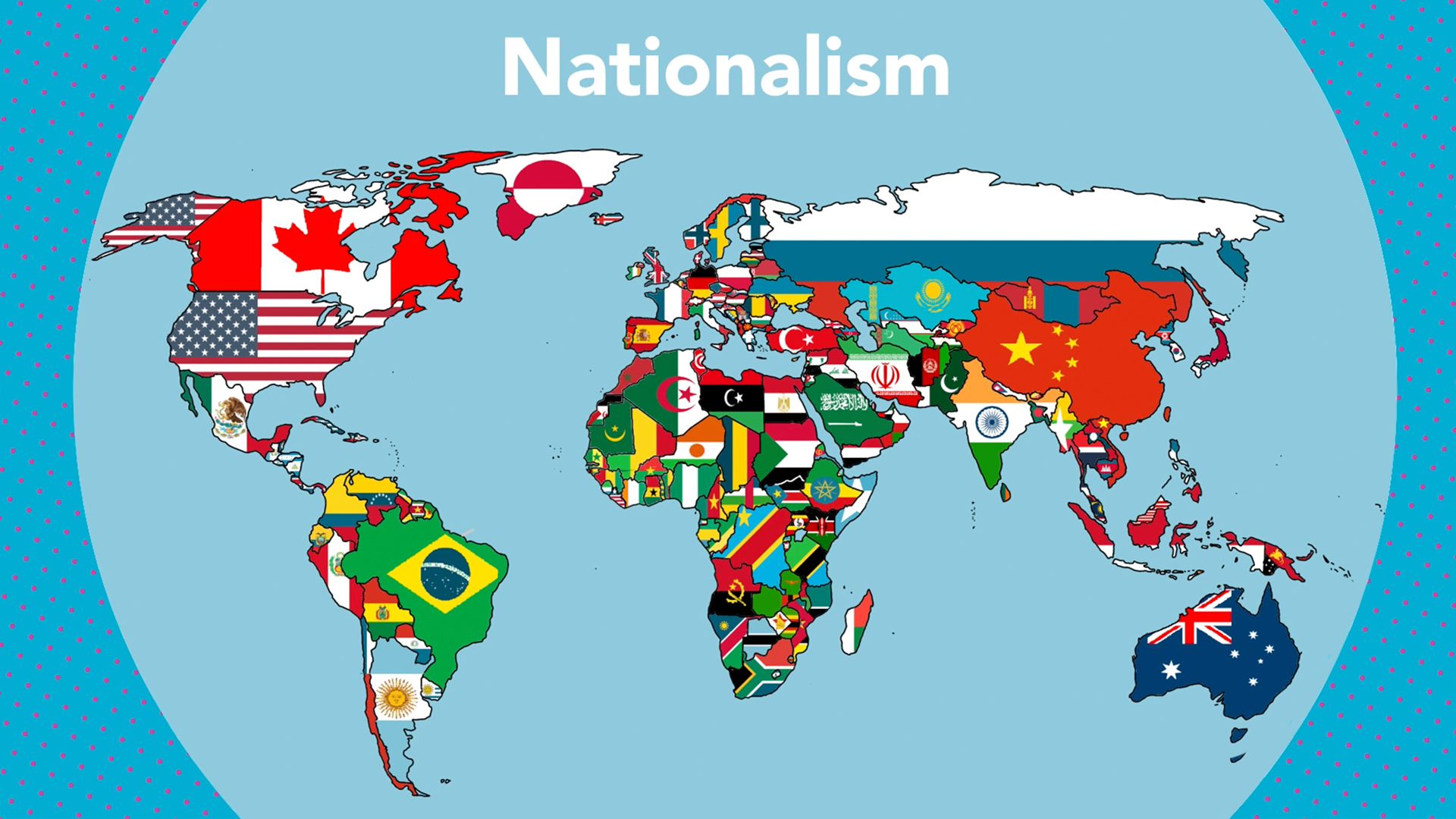
Nationalism defines nations as political communities built from shared identities, goals, and imagined connections among people.
The nation-state model organizes much of the modern world but excludes stateless nations and minority communities.
Literacy, mass media, migration, and print culture helped nationalism spread rapidly between 1750 and 1914.
Nationalism can unite people in anti-colonial struggles but can also justify violence and minority oppression.
People today still debate nation-states and explore local, transnational, and online political communities.
Nationalists make historical claims that help them achieve their political goals. It’s time for you to test those claims. Is nationalism good or bad?
Think about the following questions as you watch the video
How does this video define nationalism?
What did Benedict Anderson mean when he called the nation an “imagined political community”?
According to the video, where did nationalism begin and how did it spread?
How did nationalism contribute to the extreme violence of the twentieth century?
How do nationalists construct ideas about their nation?
What is some evidence referenced in this video as to whether nationalism is good or bad?
: Let's say you're watching the opening parade of the Olympic Games, hundreds of individuals
: marching together each under their own banners, all wearing matching outfits.
: Which team will you be rooting for? Why? Did you say, because they're from my country?
: Or, that's where my ancestors came from. Maybe you just like the flag.
: Let's think about that for a second. Why does any of that matter to you?
: You've probably never met any of these people. They're most likely not from your hometown,
: and I'm guessing you're not a world-class swimmer or shot putter. Why do you care whether these
: individuals win a game being played thousands of miles away? Your answer to that question probably
: reveals your participation in the most impactful ideology of the last 200 years: nationalism.
: Nationalism is an ideology that makes it possible for millions of people, including
: you, who have never and will never meet each other to care about one another, to share a common goal,
: to kill and to die for each other. Nationalism is the belief that the borders of a state
: should match the homeland of a people, a nation. That might seem obvious to you.
: Today, most everyone in the world is a citizen of a nation-state, but in the late 18th century,
: nation was a pretty radical idea. In the year 1750, most people identified locally
: with their family or village or possibly with a larger religious community.
: People were used to being governed by someone foreign, usually a monarch or an emperor, but
: that all started to change at the end of the 18th century when an age of revolutions reshaped power
: in the Atlantic world. Now before we get ahead of ourselves, let's define what nationalism is.
: Nationalism is both a cultural and political project, and it makes two big arguments:
: first, that nations exist and second, that nations have a right to govern themselves.
: The political scientist Benedict Anderson defined the nation as an imagined political community.
: That's the cultural part of nationalism. It's the "that's my team" part. Nationalism asserts
: that nations exist, like the Italian nation or the Nigerian nation, but you can't touch
: or hold a nation. It's something that a group of people collectively believe in, but just because
: it exists only in people's imaginations doesn't make the idea any less powerful.
: Unlike empires, nations are imagined as having a right to govern themselves within the border of some ancient homeland.
: This idea is called a nation-state, a sovereign state whose citizens are members
: of the same nation, but believing something doesn't make it real. Why has nationalism
: been so powerful in the past two centuries? Why do we live in a world of nation-states?
: Nationalism has made a lot of people believe very deeply in the idea that they are part of
: the same community and that their nationality is the most important part of their identity.
: Millions of people might believe in the same nation. Like you and those Olympic athletes,
: most of them will never meet each other. Their societies might be terribly unequal,
: and yet in their minds they all believe they're citizens of the same great nation.
: This belief makes it possible for millions of strangers to share common goals and common identities.
: It has made millions of strangers willing to fight, to kill, and to die for each other.
: So that's a powerful idea, and it has thoroughly reshaped our world, so let's explore how that happened.
: Benedict Anderson traced the beginnings of modern nationalism
: to the Atlantic revolutions of the late 18th and early 19th century. There might have been some
: isolated examples of nationalism earlier, but when European colonies in the Americas stopped thinking
: of themselves as subjects of European monarchs and started to think of themselves as a nation,
: that really got the nationalism ball rolling. The French Revolution took these ideas flowing around
: the Atlantic and put them together into a comprehensive ideology of nationalism.
: As the French rose up and fired their king by decapitating him, the revolutionary government
: desperately needed to unify their citizens in the face of threats from other European monarchs.
: They promoted French culture and French language. Thanks to universal conscription,
: military service became a national duty for every male citizen. Nationalist passions helped Napoleon
: build his armies and launch his conquests. However, as Napoleon swept across Europe,
: the presence of French conquerors inspired conquered peoples to adopt their own nationalisms
: as a strategy of resistance. It went something like this. Hey, why do our oppressors keep
: telling us they’re team France? Can't we just form a team Italy and kick them out?
: The forces of nationalism, once they were unleashed, were hard to contain.
: Now, nationalism was straightforward in a country like France, which had a centralized government and relatively
: well-defined borders, and they'd already cut off their king's head, so they had a head start,
: but other nations weren't so lucky. In places like Italy and Germany, nationalists struggled to unify
: many different principalities, city-states, and kingdoms into a single nation.
: In other places, nationalists rose up within large multi-ethnic empires, demanding their own nation-state
: made up of Hungarians, Serbians, Greeks, Turks, Czechs, Romanians, Ukrainians, and many others.
: But no one seemed to quite agree on what territory belonged to which nation or
: even who should lead that nation, and so the 19th century saw many wars as nations unified
: and empires crumbled. From the Atlantic revolutions, nationalism spread around the globe. Nationalists
: in Egypt, Japan, India, China, and elsewhere imagined and demanded their own nations.
: Nationalism spread like wildfire in the 19th century, but it was the extreme violence of
: the 20th century that made nationalism the most important ideology in modern history.
: World War One was caused in part by a Serbian nationalist who assassinated the Austrian Archduke,
: but it was also caused by increasing nationalist competition among Europe's great powers.
: Extreme forms of nationalism made possible some of the greatest atrocities in human history including
: the Armenian Genocide and the many horrors of the Second World War, particularly the Holocaust.
: After the Second World War, a new wave of nationalism swept the world as colonized peoples
: liberated themselves from empire and formed their own nations. Today in the 21st century,
: nationalism continues to evolve. New technologies make communication and travel easier,
: and many argue that this makes new transnational identities even more significant, but others still
: point to the troubling resurgence of militant nationalism, which embraces racism and xenophobia.
: Nationalism is less than three centuries old, and for a species that only started building
: cities about 50 centuries ago, that makes it pretty new, but it's also constructed on some
: ideas that are very old. Nationalists search for common historical experiences that link different
: groups of people together. Shared language, cultural traditions, and religion have all helped
: nationalists create the idea that modern nations have deep connections to the past,
: And, well, if a deep connection didn't really exist, nationalists just created it.
: Nationalist thinkers and politicians created myths and histories that supported the
: idea of their nation. They promoted public education and rituals like national anthems
: and pledges of allegiance that promoted national unity and national identities. These ideas spread
: around the world quickly thanks to the rise of mass printing and more literate populations.
: So here's the question. Is nationalism good or bad? Nationalism makes it possible for millions of
: strangers to unify on a massive scale. It allows people who have never met to cooperate with and
: even die for one another. Nationalism offered a revolutionary ideology that has liberated millions
: of people from the rule of kings and empires, but nationalism has also caused a lot of conflicts
: and atrocities since the long 19th century. That's because once people started defining who belonged
: in a nation, they also started defining who was not a part of that nation.
: Foreigners, political enemies, and minorities became frequent targets of nationalists. In some places,
: nationalists defined membership to the nation along racial or ethnic lines. Other places excluded women.
: Often those considered foreign, like Jews in Nazi Germany, were persecuted, murdered, and expelled
: from their homes. Nationalism demands that the nation come above all other identities.
: Frequently, this has driven nations to war as they compete for the same territory or for national prestige.
: Even today, millions of people in Kurdistan, Basque, Spain, Quebec,
: Angola, Tibet, and many other places believe that they should have their own nation-state.
: Many continue to fight and to die for this belief. For better and for worse, we live
: in a world of nation-states. Nationalism has provoked some of humanity's greatest atrocities
: as well as our greatest triumphs. It's an ideology that both empowers and subjugates. Nationalism is
: probably here to stay, so in the future, can we imagine forms of nationalism that unite,
: rather than divide? Is it possible for a world of many different nations to cooperate toward
: shared goals in an era where challenges like climate change transcend our national borders?
: So is nationalism good, bad, or both?