Cookie Policy
Our website uses cookies to understand content and feature usage to drive site improvements over time. To learn more, review our Terms of Use and Privacy Policy.

Unit 4 Overview
This video explores how industrialization in the 1800s sparked reform movements that still shape our world today.
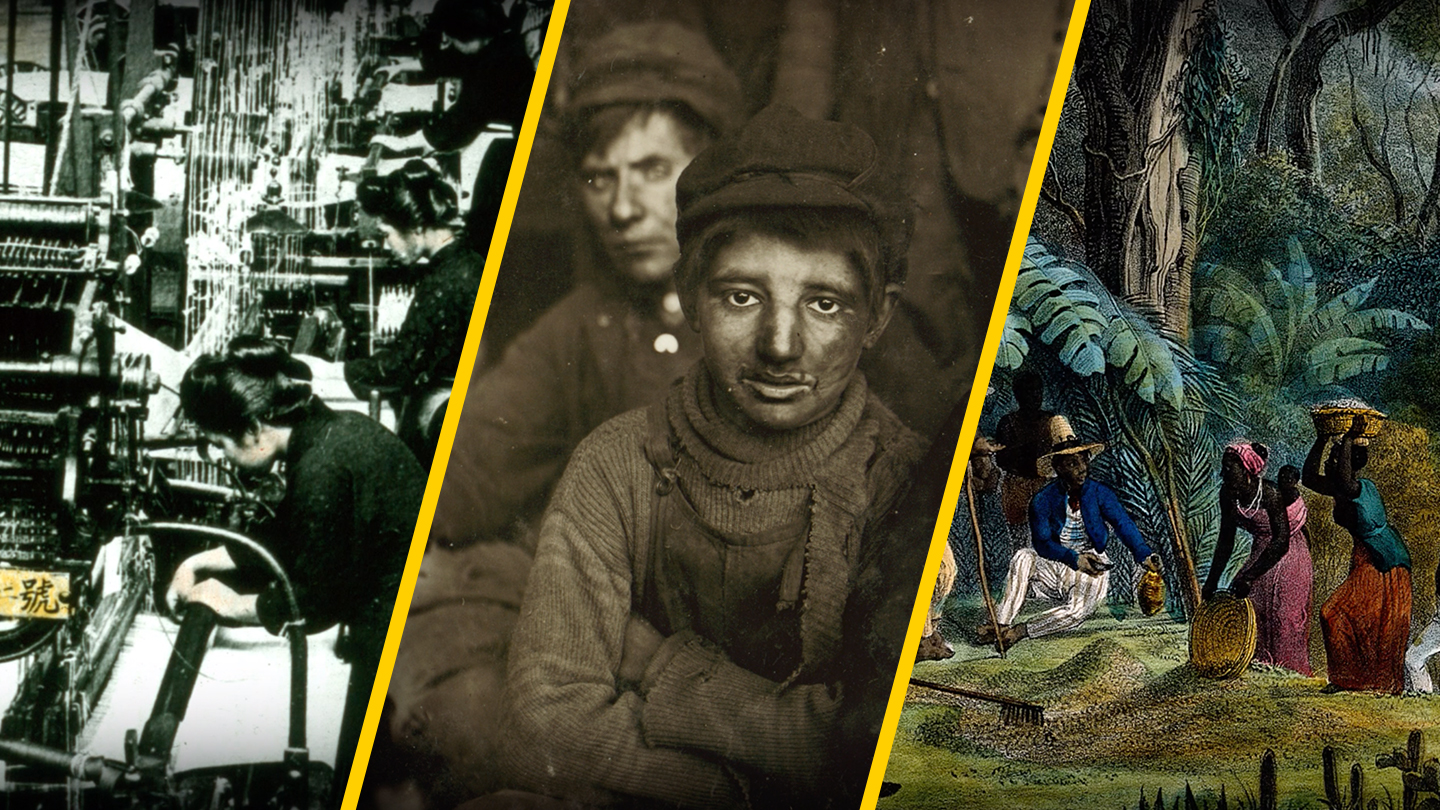
Think about the following questions as you watch the video
- What roles did women play in the abolition of slavery in the Atlantic world?
- What were some questions social reformers raised about the status and activities of children?
- What is meant by working class, or proletariat?
- Did the abolition of slavery create a fair system of labor in the British Caribbean?
: Okay, so-- ready to do the video?
: I protest.
: What?
: Just practicing.
: Oh-- okay, you mean with all the strikes and revolts
: and demonstrations we're going to discuss?
: Yeah, that too. - Uh-huh.
: (music playing)
: Hi, I'm Colby Burnett, and along with Kim Lochner,
: we're introducing Unit 4--
: Transformation of Labor and Social Relations.
: So far, we have seen how changing political identities
: after 1750 set in motion a modern world
: of sovereign nation-states
: and citizens with political rights.
: And we've observed how the Industrial Revolution
: transformed humanity by creating new ways of living and working.
: But we also know
: that both of these transformations had limits.
: Not everybody enjoyed the same political rights.
: And industrialization meant different things
: for different people in different places.
: These two revolutions in politics and production
: sometimes interacted in unexpected ways.
: In some cases, they worked together
: to create change.
: In others, they rubbed up against each other
: and created results that nobody planned for.
: In this unit, we focus on some of those
: unexpected consequences.
: We investigate--
: how did the Industrial Revolution
: and political revolutions transform the way people worked,
: lived, and learned in the long 19th century?
: How did all of these changes contribute
: to creating the world we live in today?
: Any answer to these questions
: must include two linked elements of all human societies--
: how we work, and what our relations are with each other.
: We must also take into account
: how the modern world began to create
: the categories of identity that we all take for granted today
: such as race, class, and gender.
: These social revolutions were evident
: in both the home and public space.
: Women often took the lead.
: In many countries, women were unwilling
: to let liberal and national revolutions pass them by.
: They demanded political rights through movements for suffrage--
: or the right to vote.
: Like many struggles for social transformation,
: this fight was long and hard.
: In the 19th century, some women won the right to vote.
: But this only included women who owned land.
: They could vote in local elections
: in places as far flung as Argentina, Colombia,
: some U.S. states, Sweden, and South Australia.
: But it was only in the early 20th century
: that full women's suffrage really started
: to come into effect.
: It began in New Zealand and Finland and slowly spread.
: In every case,
: women's suffrage was only achieved because women--
: and some male allies-- fought for it.
: Women also led many movements
: to challenge one of the most destructive institutions
: of the long 19th century--
: the ordering of the world along racial lines.
: Prior to 1750, there was racism,
: which presented in many ways, including in hierarchies
: and slavery based on race.
: But in this era, these ideas solidified
: into the modern systems of eugenics and white supremacy.
: These ideas had devastating impacts
: in the decades that followed,
: and continue to oppress people today.
: Social revolutions in this era
: led to a broad-based fight against these ideas
: and against the institutions of slavery.
: COLBY: We mostly know the names
: of the men who led the fight against slavery--
: men like Frederick Douglass in the United States
: and Olaudah Equiano in the United Kingdom.
: But many of the movement's unsung heroes were women,
: such as the African-American activist/writer
: Phyllis Wheatley.
: In early 19th century Britain,
: housewives refused to buy sugar grown on plantations
: worked by enslaved people.
: Their boycott was crucial to ending the legal enslavement
: of human beings in the British Empire.
: Women's leadership in these reform movements
: ultimately challenged assumptions about gender roles.
: Women defied being forced out of public life
: and having limited social, as well as political, rights.
: Social reformers also became concerned with children.
: Were they to be factory workers,
: subject to terrible conditions and low pay?
: Should they be sent to school to be shaped to society's needs,
: or be allowed to play?
: Changing norms in our understanding
: of gender and childhood permanently shifted
: how communities defined themselves in this era.
: These social reforms were linked to economic issues.
: Labor, women's rights, and the roles of children
: were all challenged by the Industrial Revolution's
: transformation of the way we work
: and our systems of production and distribution.
: KIM: Industrialization turned more and more people--
: women, men, and children-- into wage laborers.
: They worked in factories, farms, or offices
: for a weekly or hourly wage.
: Much of the world's population now formed a working class,
: people who sold their labor
: because they had nothing else to sell.
: They were paid for their work
: and used that pay to buy consumer goods made by others.
: In other words, wage laborers helped stimulate
: the free market economic system-- the capitalist system.
: This transformation to paid work
: helped eliminate the legal status of slavery
: in much of the world.
: But the capitalist free market economy also often featured
: low pay and terrible working conditions.
: Many formerly enslaved people now found themselves
: working for meager wages.
: COLBY: Only by organizing did laborers find ways
: to demand reforms.
: These demands increased
: as the long 19th century progressed
: and they introduced the world to socialism,
: a system that sought to give workers control.
: Socialist ideas helped spark revolutions
: in Mexico and Russia.
: The struggle over which system was better--
: capitalism or socialism-- continues to the present day.
: This debate about production and labor was very evident
: in the British Caribbean colonies.
: In 1750 this was a society based
: on the labor of enslaved Africans.
: A middle class of overseers ran things
: for a ruling class of plantation owners.
: The enslaved workers experienced racism, danger, and violence.
: All the while they harvested and processed sugar
: that was in high demand in Europe and around the world.
: The promises of political rights were strong in Britain itself,
: yet they were almost completely absent
: from this colonial society.
: But pressure for reform grew,
: both from the enslaved people
: and from political liberals in Britain.
: Less than a century later, in 1834,
: Britain abolished slavery in its colonies.
: Of course, the plantation owners still needed laborers.
: But the formerly enslaved didn't want to work on plantations.
: They mostly wanted to grow food on their own land
: or start businesses.
: KIM: In response, plantation owners imported
: workers from other regions, especially India.
: These Indian workers were not legally enslaved,
: but rather indentured-- contractually obligated
: to work for their employer for a period of years.
: Enslavement and indentured servitude
: often looked pretty similar, though.
: The workers were treated terribly.
: They were confined to estates,
: brutally punished for any infraction,
: and paid pitiful amounts.
: In response, by the late 1840s,
: Indian workers started to demand reforms.
: They wanted to be treated better and paid more.
: Conditions improved only gradually.
: Plantation owners often tried
: to pit the formerly enslaved African workers
: against newly conscripted workers from India
: by offering one group advantages over the other.
: Eventually, workers united across the color line.
: Slowly, they achieved reforms.
: But labor in the sugar plantations of the Caribbean
: remained a difficult and underpaid job
: well into the 20th century,
: when machines took over much of the work.
: The situation in the British Caribbean
: mirrors the process of social and labor reforms elsewhere.
: The Industrial Revolution and political revolutions
: together created the potential for great opportunities
: for all kinds of people.
: Capitalism held the promise of allowing people to prosper
: in a free market and free labor economy.
: But reality was often much darker,
: and the fight for reform and change could only come
: through prolonged struggle.
: Those struggles, as much as anything,
: helped to create the world in which we live today.
: So much progress.
: And oppression.
: And struggle.
: And achievements!
: Eh, it's like the usual history stuff,
: but now it's industrial strength.
: Oh, how long have you been saving that one?
: I just thought of it.
: Right.
: I protest.
: What?
: Just practicing.
: Oh-- okay, you mean with all the strikes and revolts
: and demonstrations we're going to discuss?
: Yeah, that too. - Uh-huh.
: (music playing)
: Hi, I'm Colby Burnett, and along with Kim Lochner,
: we're introducing Unit 4--
: Transformation of Labor and Social Relations.
: So far, we have seen how changing political identities
: after 1750 set in motion a modern world
: of sovereign nation-states
: and citizens with political rights.
: And we've observed how the Industrial Revolution
: transformed humanity by creating new ways of living and working.
: But we also know
: that both of these transformations had limits.
: Not everybody enjoyed the same political rights.
: And industrialization meant different things
: for different people in different places.
: These two revolutions in politics and production
: sometimes interacted in unexpected ways.
: In some cases, they worked together
: to create change.
: In others, they rubbed up against each other
: and created results that nobody planned for.
: In this unit, we focus on some of those
: unexpected consequences.
: We investigate--
: how did the Industrial Revolution
: and political revolutions transform the way people worked,
: lived, and learned in the long 19th century?
: How did all of these changes contribute
: to creating the world we live in today?
: Any answer to these questions
: must include two linked elements of all human societies--
: how we work, and what our relations are with each other.
: We must also take into account
: how the modern world began to create
: the categories of identity that we all take for granted today
: such as race, class, and gender.
: These social revolutions were evident
: in both the home and public space.
: Women often took the lead.
: In many countries, women were unwilling
: to let liberal and national revolutions pass them by.
: They demanded political rights through movements for suffrage--
: or the right to vote.
: Like many struggles for social transformation,
: this fight was long and hard.
: In the 19th century, some women won the right to vote.
: But this only included women who owned land.
: They could vote in local elections
: in places as far flung as Argentina, Colombia,
: some U.S. states, Sweden, and South Australia.
: But it was only in the early 20th century
: that full women's suffrage really started
: to come into effect.
: It began in New Zealand and Finland and slowly spread.
: In every case,
: women's suffrage was only achieved because women--
: and some male allies-- fought for it.
: Women also led many movements
: to challenge one of the most destructive institutions
: of the long 19th century--
: the ordering of the world along racial lines.
: Prior to 1750, there was racism,
: which presented in many ways, including in hierarchies
: and slavery based on race.
: But in this era, these ideas solidified
: into the modern systems of eugenics and white supremacy.
: These ideas had devastating impacts
: in the decades that followed,
: and continue to oppress people today.
: Social revolutions in this era
: led to a broad-based fight against these ideas
: and against the institutions of slavery.
: COLBY: We mostly know the names
: of the men who led the fight against slavery--
: men like Frederick Douglass in the United States
: and Olaudah Equiano in the United Kingdom.
: But many of the movement's unsung heroes were women,
: such as the African-American activist/writer
: Phyllis Wheatley.
: In early 19th century Britain,
: housewives refused to buy sugar grown on plantations
: worked by enslaved people.
: Their boycott was crucial to ending the legal enslavement
: of human beings in the British Empire.
: Women's leadership in these reform movements
: ultimately challenged assumptions about gender roles.
: Women defied being forced out of public life
: and having limited social, as well as political, rights.
: Social reformers also became concerned with children.
: Were they to be factory workers,
: subject to terrible conditions and low pay?
: Should they be sent to school to be shaped to society's needs,
: or be allowed to play?
: Changing norms in our understanding
: of gender and childhood permanently shifted
: how communities defined themselves in this era.
: These social reforms were linked to economic issues.
: Labor, women's rights, and the roles of children
: were all challenged by the Industrial Revolution's
: transformation of the way we work
: and our systems of production and distribution.
: KIM: Industrialization turned more and more people--
: women, men, and children-- into wage laborers.
: They worked in factories, farms, or offices
: for a weekly or hourly wage.
: Much of the world's population now formed a working class,
: people who sold their labor
: because they had nothing else to sell.
: They were paid for their work
: and used that pay to buy consumer goods made by others.
: In other words, wage laborers helped stimulate
: the free market economic system-- the capitalist system.
: This transformation to paid work
: helped eliminate the legal status of slavery
: in much of the world.
: But the capitalist free market economy also often featured
: low pay and terrible working conditions.
: Many formerly enslaved people now found themselves
: working for meager wages.
: COLBY: Only by organizing did laborers find ways
: to demand reforms.
: These demands increased
: as the long 19th century progressed
: and they introduced the world to socialism,
: a system that sought to give workers control.
: Socialist ideas helped spark revolutions
: in Mexico and Russia.
: The struggle over which system was better--
: capitalism or socialism-- continues to the present day.
: This debate about production and labor was very evident
: in the British Caribbean colonies.
: In 1750 this was a society based
: on the labor of enslaved Africans.
: A middle class of overseers ran things
: for a ruling class of plantation owners.
: The enslaved workers experienced racism, danger, and violence.
: All the while they harvested and processed sugar
: that was in high demand in Europe and around the world.
: The promises of political rights were strong in Britain itself,
: yet they were almost completely absent
: from this colonial society.
: But pressure for reform grew,
: both from the enslaved people
: and from political liberals in Britain.
: Less than a century later, in 1834,
: Britain abolished slavery in its colonies.
: Of course, the plantation owners still needed laborers.
: But the formerly enslaved didn't want to work on plantations.
: They mostly wanted to grow food on their own land
: or start businesses.
: KIM: In response, plantation owners imported
: workers from other regions, especially India.
: These Indian workers were not legally enslaved,
: but rather indentured-- contractually obligated
: to work for their employer for a period of years.
: Enslavement and indentured servitude
: often looked pretty similar, though.
: The workers were treated terribly.
: They were confined to estates,
: brutally punished for any infraction,
: and paid pitiful amounts.
: In response, by the late 1840s,
: Indian workers started to demand reforms.
: They wanted to be treated better and paid more.
: Conditions improved only gradually.
: Plantation owners often tried
: to pit the formerly enslaved African workers
: against newly conscripted workers from India
: by offering one group advantages over the other.
: Eventually, workers united across the color line.
: Slowly, they achieved reforms.
: But labor in the sugar plantations of the Caribbean
: remained a difficult and underpaid job
: well into the 20th century,
: when machines took over much of the work.
: The situation in the British Caribbean
: mirrors the process of social and labor reforms elsewhere.
: The Industrial Revolution and political revolutions
: together created the potential for great opportunities
: for all kinds of people.
: Capitalism held the promise of allowing people to prosper
: in a free market and free labor economy.
: But reality was often much darker,
: and the fight for reform and change could only come
: through prolonged struggle.
: Those struggles, as much as anything,
: helped to create the world in which we live today.
: So much progress.
: And oppression.
: And struggle.
: And achievements!
: Eh, it's like the usual history stuff,
: but now it's industrial strength.
: Oh, how long have you been saving that one?
: I just thought of it.
: Right.