Our website uses cookies to understand content and feature usage to drive site improvements over time. To learn more, review our Terms of Use and Privacy Policy.
This video explores the colonization of Africa after the 1885 Berlin Conference. Learn the story of Dahomey and its all-female army that resisted the French invaders.
Think about the following questions as you watch the video
What was the “Scramble for Africa,” and why was the Berlin Conference significant?
How did Africans resist European colonization?
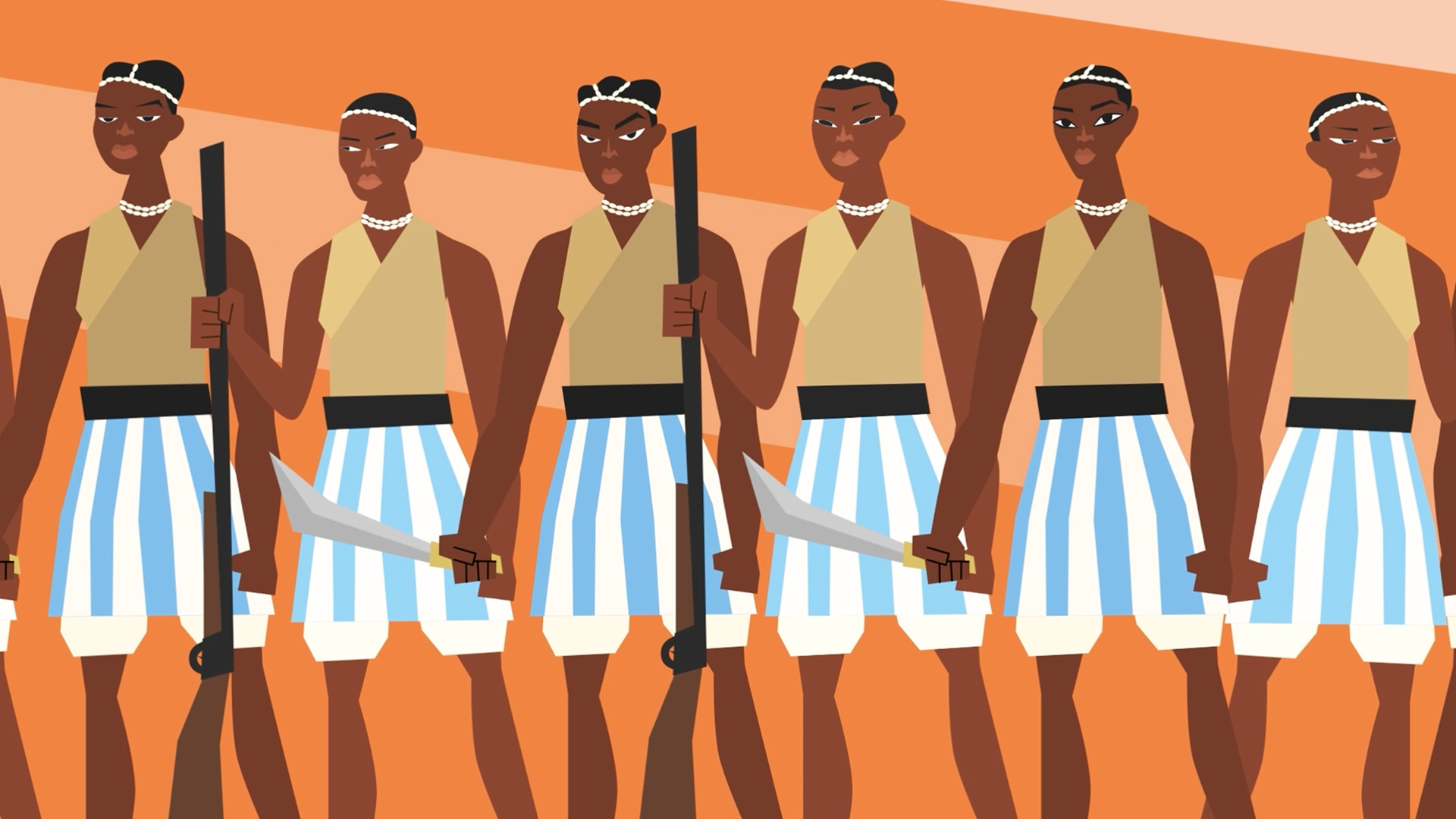
Who were the Agojie, and why were they so feared?
Why did Dahomey lose to the French, and how did the French treat them after their defeat?
What were the long-term effects of colonization on Africa?
: In the 1880s, the most powerful empires in Europe were trying to grab as much land and resources
: as they could, and they had their sights set on Africa. But across Africa, diverse peoples
: resisted foreign rule in a variety of ways. They did small things, like giving fake directions so
: Europeans got lost. But they also fought in military campaigns. And in the West African
: Kingdom of Dahomey, the largest female army in history took on the French in a fierce war. This
: idea of one group of people exerting dominance over another to increase their own wealth and
: power is known as colonialism, and it was a big thing among European powers like Britain,
: Portugal, France, Belgium, and Italy in the 19th century. Eventually, these empires turned their
: attention to the resource-rich interior of the African continent. In the 1870s, only ten percent of the
: African continent was under control of European countries. The other ninety percent of Africa remained under
: indigenous rule. To Africans themselves, this meant the vast majority of the continent belonged
: to the diverse peoples who lived there. But to Europeans, that untouched ninety percent was a massive
: opportunity. In an effort to avoid an all-out European war as empires scrambled to steal as
: much African land as they could, they decided to set some ground rules for claiming new territories
: at the Berlin Conference. In attendance: Germany, France, Great Britain, Belgium, Italy, the US,
: Austria-Hungary, and the Ottoman Empire, among others. Notably missing: anyone from the African
: continent. But Africans weren't going to sit back and let Europeans do whatever they wanted. Their
: land was home…and it was worth fighting for. Some of the fiercest fighting of the era took place in
: the wealthy West African Kingdom of Dahomey, in what is now southern Benin. Dahomey was founded
: in the 17th century and grew to flourish in the mid-18th century under the rule of King Agaja,
: who held total power over the state and ruled with one main goal: expanding his empire within Africa.
: To support this goal, King Agaja commanded an army of thousands—including hundreds of women known
: as the Agojie. Some of the Agojie joined Dahomey's army voluntarily, while others were forced to join
: after committing a crime or were kidnapped from rival African kingdoms. But together,
: they formed the largest all-female fighting force in history. The Agojie were divided
: into highly trained regiments of riflewomen, huntresses, reapers, gunners, and archers. As
: protectors of Dahomey and the king himself, they were revered for their skill and bravery and lived
: in the palace as wives of the king, or *ahosi* in the Dahomean Fon language. They were so fierce that
: the first Europeans who encountered them (and lived to tell the tale) called them Amazons because their
: military skill rivaled that of the famous women warriors from Greek myth. And that skill came in
: handy when Dahomey, under King Behanzin, went head-to-head with the French in 1890.
: By the end of the 19th century, the Dahomean army was weakened after battles with the
: nearby Egba kingdom, although they still posed a formidable threat. But the French had their sights
: set on the Dahomean land, and teamed up with one of Dahomey's enemies, the kingdom of Porto-Novo,
: to help them get it. However, it was King Behanzin who decided to strike first. On March 4th, 1890,
: 3,000 Dahomean troops launched an attack on the French in Cotonou. And while the French had guns
: and cannons, Dahomey had something else: 1,000 Agojie warriors. The Agojie were able to
: break through French lines thanks to their fierce hand-to-hand combat. But as fighting drew on,
: even these fearsome warriors were no match for France's superior weaponry. When the conflict,
: which came to be known as the First Franco-Dahomean War, was over, France
: had lost only eight soldiers, while Dahomey lost hundreds. And although the first conflict was
: over, neither country was secure. The French still had their eye on all that Dahomean land. And for
: the kingdom of Dahomey, the French were still far too close for comfort. So, in a half-hearted
: effort to limit future conflict, the French and Dahomeans signed an agreement in which Dahomey
: acknowledged official French control of Porto-Novo. It also gave France the right to occupy and
: trade in Cotonou, although technical sovereignty would go to Dahomey. Despite the agreement,
: the French still walked around Cotonou like they owned the place. And the Dahomeans kept raiding
: villages in French territory. King Behanzin even bought weapons from German manufacturers
: via northern trade routes so he would be ready for the seemingly inevitable next fight with the
: French. In other words: no one was really trying very hard to keep the peace. And it wasn't long
: until these tensions boiled over. In March of 1892, Dahomean forces raided several villages
: near the Frenchified Porto-Novo, and the French parliament retaliated by declaring war on Dahomey,
: officially kicking off the Second Franco-Dahomean War. And this time, they were prepared for the
: fearless Agojie warriors. The French invaded Dahomey from their hold on the coast, marching
: north toward the capital city of Abomey. The Dahomeans, armed with their German guns, launched
: their counterattack, using the same swift frontal assault that worked last time. This time, though,
: it didn't go so well. The Dahomey army suffered devastating losses, and the French marched on
: to Abomey, fighting the Dahomean resistance from town to town. But when they arrived at
: the capital, they found that King Behanzin and his remaining troops had set the city on fire
: and disappeared into the countryside, where they regrouped in hopes of maintaining control of the
: Abomey Plateau—the last remaining land under Dahomey control. This was the last straw for the French.
: In 1893, the French government greenlit the total destruction of the Dahomean kingdom to stamp out
: any possibility of resistance. And so began the third and final Franco-Dahomean War. The French
: hit the coast with 3,000 soldiers ready for a fight…but this time, they didn't get one.
: After holding out for years, King Behanzin and his officials surrendered their kingdom
: and sovereignty to the French colonizers. The French exiled King Behanzin to the West
: Indies and sent dozens of the captured Agojie warriors back to Europe, where they were shown
: off in an exhibition that toured through major cities. These fierce warriors, who bravely fought
: European colonizers to protect their homeland, were paraded around in the equivalent of a human
: zoo. The French also tried to erase every inch of the Dahomean legacy in Africa itself—including
: the Agojie. The former warriors who weren’t shipped off to Europe were denied any role in public life.
: And to make sure the Agojie's incredible story didn't inspire rebellious behavior,
: the French destroyed artifacts and suppressed oral traditions in the region that celebrated
: the Agojie and their bravery. And while the powerful Agojie were unique, their story was all
: too common. People across the continent resisted European colonizers, fighting to keep their land,
: traditions, and culture. But by 1914, all of the African continent was under European control,
: aside from modern-day Liberia and Ethiopia. And for Africans, the suffering didn't end when the
: wars did. Under the control of European empires, people across Africa were exploited, murdered,
: and mutilated. They were forced to extract natural resources for colonizers to make European empires
: wealthier, while their own nations were decimated. And the effects of that exploitation echoed across
: generations up to the present day. While the era of explicit European colonial rule ended
: decades ago, we're still reckoning with the horrific impacts of the Scramble for Africa
: today. European colonization tried to erase entire African civilizations, cultures, and languages,
: and it derailed economic development across the continent. But colonizers also tried to erase