Our website uses cookies to understand content and feature usage to drive site improvements over time. To learn more, review our Terms of Use and Privacy Policy.
The Spanish Civil War: Hitler’s Testing Ground for WWII
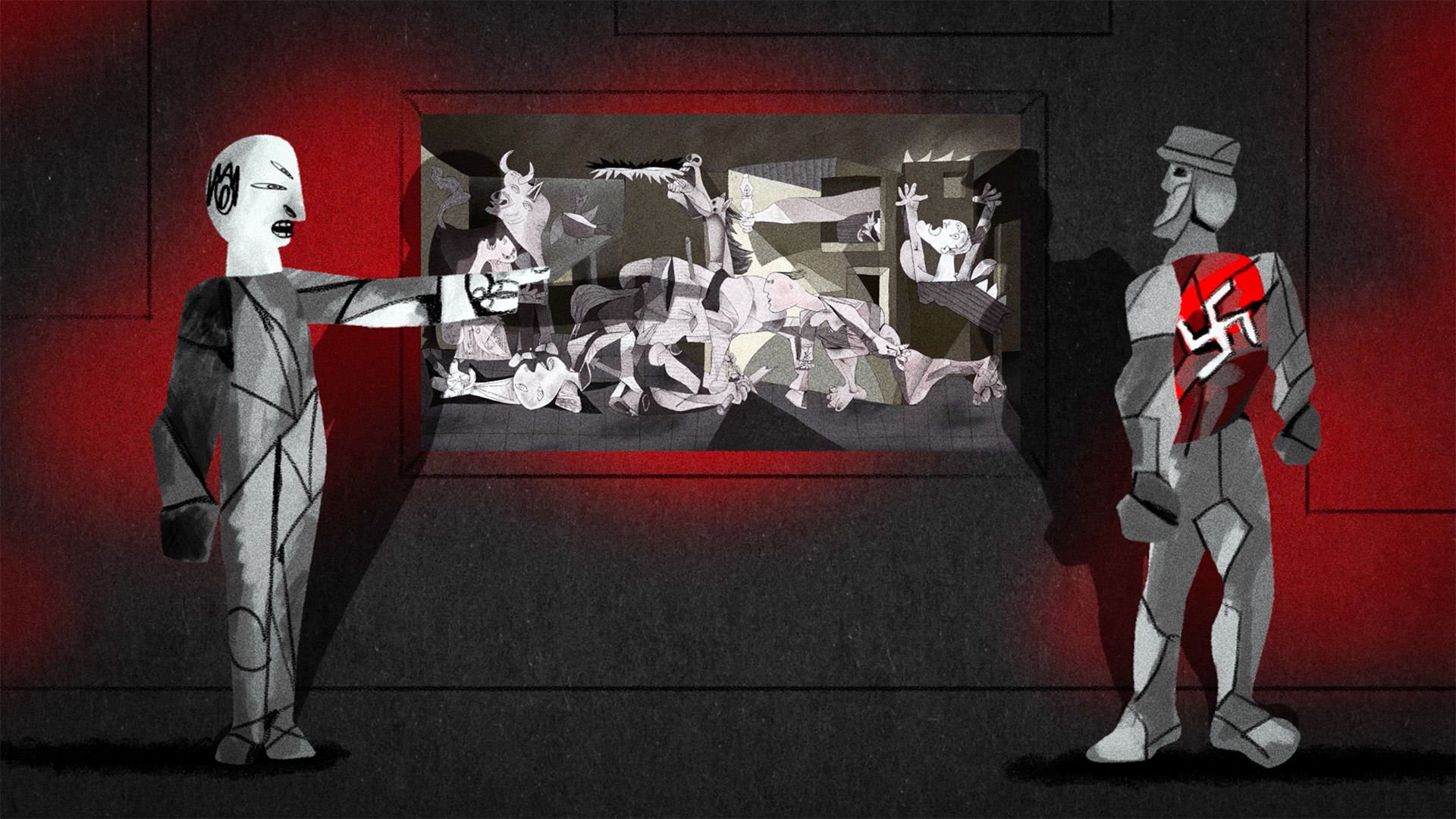
Pablo Picasso’s Guernica captures the horrors of the Spanish Civil War. This video digs into what art reveals about global conflict.
Think about the following questions as you watch the video
What happened in Guernica on April 26, 1937?
Why did Picasso paint Guernica, and what does the painting show?
Why did Picasso blame a German officer in Paris for the bombing?
Why is the Spanish Civil War called a “dress rehearsal” for World War II?
What happened to Guernica after the war, and why?
: April 26th, 1937. In a small town in the Basque region of Spain,
: the sky is falling. The day began like any other. It was a Monday, market day,
: when local farmers would bring their crops to the town square and people from all
: over the region would come to buy them. Up to 12,000 people were in Guernica that day—
: nearly double the town's usual population, most of them civilians. Nine months earlier,
: Spanish Nationalist forces had launched an uprising to overthrow the country's democratically
: elected Republic, igniting the Spanish Civil War. Since then,
: a vague sense of danger constantly hung in the air—but the nearest battlefront was 18 miles away,
: and in Guernica, it was business as usual. At around 4 p.m., the bells of the Church
: of Santa María rang out—a warning that Nationalist planes had arrived. Four hours later, 85%
: of the buildings in Guernica were reduced to rubble, and hundreds of civilians were dead.
: News of the air raid soon reached Pablo Picasso in France. Spanish by birth,
: he had moved to Paris in 1904, attracted to the city's vibrant avant-garde art scene. He was a
: committed anti-fascist and had already been working on a commissioned painting to show
: support for Spain's struggling republic. But, stunned by the news of the attack's brutality,
: he quickly shifted his focus and completed an enormous new artwork in just 35 days.
: Measuring over 11 feet tall and 25 feet wide, Guernica captures the town's devastation after the raid.
: Victims lie crumpled and broken at the bottom of the canvas. A mother holding her deceased infant
: howls, her head thrown back to the heavens. A man engulfed in flames screams with his arms
: outstretched, seeking a savior that will never come. Animals, too, bellow their pain
: and horror at being trapped in this inferno of death and destruction. Guernica became an
: instant symbol of resistance against the Spanish Nationalist movement and its leader,
: Generalissimo Francisco Franco. The painting debuted in the Spanish pavilion of the International Expo
: in Paris. Then it toured Europe to raise money and support for the struggling Republic.
: In one exhibit in London, the price of admission was a pair of boots in good enough shape to be
: sent to the Spanish front. Years later, after the Nazis occupied Paris,
: a German officer visited Picasso in his studio. Upon seeing a photo of Guernica,
: he asked the artist, "Did you do this?" Picasso replied, "No, you did."
: Why would Picasso blame a German for the bombing of a Spanish town during the Spanish Civil War
: ordered by Spanish Nationalist leader Franco? The answer is, Franco wasn't acting alone.
: He was part of a global slide into fascism and authoritarianism that occurred between
: the world wars. By the time Franco and his partners declared a coup against Spain's
: leftist government, many countries already had right-wing regimes in power or on the rise,
: including Germany, Italy, Poland, Hungary, Romania, Finland, Austria, Japan, and Greece.
: The rebelling Nationalists aimed to cleanse Spain of liberalism and democracy, which they believed
: were dismantling traditional society. They wanted clearly defined social hierarchies, gender roles,
: and Catholic morality. A beefed-up military would be used to enforce government policies.
: Franco's uprising quickly generated fears of another world war. In August 1936, more than
: 20 nations, including France, Great Britain, Italy, Nazi Germany, and the Soviet Union,
: signed an agreement that they would not intervene in Spain. But this commitment to neutrality
: didn't last—international support for both sides flooded in. To the Spanish Republic,
: the Soviet Union sent hundreds of tanks, trucks, planes, and armored cars, as well as hundreds of
: thousands of weapons and over 29,000 tons of ammunition. The International Brigades, made
: up of 40,000 volunteer soldiers from more than 50 countries, also supported the Republic. Meanwhile,
: Italy, led by fascist dictator Benito Mussolini, sent 75,000 troops along with planes, warships,
: submarines, and hundreds of thousands of weapons. Nazi Germany sent fewer troops—only about 19,000—
: but its air force was crucial in transporting Franco's Army of Africa from Morocco to Spain
: in the early days of the war. Before long, Spain had become a dress rehearsal for World War II:
: Republicans vs. Nationalists, left vs. right, democracy vs. fascism. Hitler,
: in particular, had powerful motivations for supporting Franco. Two years earlier, he had risen
: to become the absolute dictator of Germany and immediately set his sights on the rest of Europe.
: Hitler and the Nazis were preparing for what they saw as an inevitable war for conquest.
: In defiance of the military restrictions laid out in the Treaty of Versailles, they began developing
: new technologies like the Panzer I tank, and the cutting-edge bomber and fighter planes
: that powered their new air force, the Luftwaffe. Spain provided, not only an opportunity to divert
: Europe's attention from Hitler's actions, but also a laboratory to experiment with these new
: war technologies and tactics. The Spanish Civil War proved to be a valuable testing ground for
: the Nazis. They quickly realized that the Panzer I was outclassed by the Soviet armored vehicles:
: it was prone to overheating and had inadequate armor protection, requiring its squads to carry
: bigger, anti-tank guns. These lessons informed the upgrades and modifications of the Panzer II, III, and
: IV. The Nazis also experimented with a new air tactic: the bombing of cities and civilians with
: the intent to create terror. In fact, the Guernica bombing was planned by the same German officer-
: Wolfram von Richthofen—who would later design the air raid on Poland that began World War II.
: In that war, the Nazi military would deploy their Panzers and Luftwaffe in a combined strategy called
: Blitzkrieg, or "lightning war"—coordinated, unrelenting attacks that overwhelmed Europe.
: By 1939, with help from the Nazi and Italian governments, the Nationalists had captured
: virtually all of Spain. England and France had yielded to Hitler in ways that made it clear
: there would not be a strong anti-fascist European coalition. Franco declared victory on April 1st.
: The Spanish Republic was no more. That meant Guernica, commissioned by the hopeful Republic
: two years earlier, had no home. The painting traveled to New York City's Museum of Modern Art,
: where an estimated 20 to 30 million visitors witnessed Picasso's bold political statement.
: Picasso's ultimate wish was for Guernica to remain on loan to MoMA until democracy was
: restored in his native Spain. In 1981, six years after Franco's death
: and eight years after the artist's death, Picasso's attorney confirmed that the